| Author |
 Replies: 27 / Views: 2,653 Replies: 27 / Views: 2,653 |
|
|
|
Pillar of the Community
United States
3552 Posts |
The other feature to note is that of the slightly larger girth of the posterior portion of the hair denoted by the red arrows on the MS63 coin. 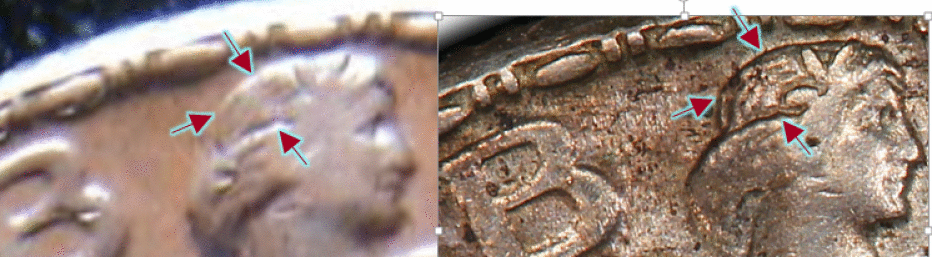 |
|
Pillar of the Community
United States
3552 Posts |
Quote:
It looks at least MS-64 to me. In the unlikely event this coin turns out to be genuine and unaltered it should be stated that my sources taught me that even with the lowest possible mint state coin (MS60 grade) any coin can still possess unappealing features such as: a. numerous and heavy bag marks, b. substantial scuff marks & c. miscellaneous surface aberrations BUT it cannot have any signs of wear whatsoever. The right temple and cheek on the coin in question are evidently worn IMO. I stand to be corrected should anyone opine differently with supported examples on anything that I have brought forth. |
|
Moderator
 United States
23522 Posts |
Quote:
I stand to be corrected should anyone opine differently with supported examples on anything that I have brought forth.
The best way to react to this is to suggest you look at a bunch more SLQ's. The cheek and hair are the very_first_place which show strike weakness, on an issue which is known for strike weakness. That's why the "FH" designation exists, to differentiate well-struck examples from poorly-struck ones. This is fundamental about SLQ's to such an extent that savvy graders don't include the head or shield in a grading opinion at all. They're only there as an arbiter of strike strength because those details cannot be trusted to accurately reflect "wear." I'm seeing a coin with very slight wear. No worse than 55, possibly 58, and likely dipped because of the evidence shown by the rim in a couple pics. If toning that dark is visible on the rim, it was also on the face of the coin at some point. Where it went is obvious, and only offers one conclusion.... Frankly, if I were interested in submitting the coin I'd probably be going over the rim with a Q-tip to lose that toning because it would be a red flag at a TPG. |
|
Pillar of the Community
 United States
709 Posts |
Quote:
The sides of the neck of the coin under discussion are essentially parallel to one another.
The MS63 coin clearly shows that the lines adjacent to each side will quickly intersect if further extended; this is not the case with the AU? coin unless one considers infinity as an attainable endpoint... Quote:
Irrespective of any referenced coin's features neither MD nor toning variations will disguise a fact such as the neck of the figurine of this coin in question lacks a normally tapered/sloping form on both the dorsal and ventral sections of the neck. 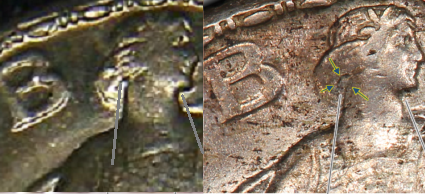 I can also draw lines, showing that the slope of the neck does match. My pictures were taken at an angle, not straight up and down, so it's not going to be exact, but you get my point. I don't really see any concern over the authenticity. No two coins are going to have the exact same wear/strike patterns. Quote:Frankly, if I were interested in submitting the coin I'd probably be going over the rim with a Q-tip to lose that toning because it would be a red flag at a TPG. What would you put on the Q-Tip? I don't have any experience with silver coins. |
|
Pillar of the Community
 United States
5828 Posts |
Quote:
In the unlikely event this coin turns out to be genuine and unaltered Why would this coin not be genuine or be altered? Looks lightly dipped, maybe, IMHO and I'm 99.99% sure its real. Plus, diping it doesn't really count as "altering" Edited by ChildOfTheWheat
05/19/2015 5:49 pm
|
|
Pillar of the Community
United States
3552 Posts |
Quote:
...cheek and hair are the very first place which show strike weakness... After further checking a bunch of SLQs I concur with SD's weak strike observation for the referenced areas. |
|
Pillar of the Community
United States
3552 Posts |
I am still unsure why the almost horizontal trait just below the parallel yellow line on the PCGS 53 is absent on the AU? coin under discussion? To further assist in deciphering my inquiry note the following series of photos that aim to show what I'm asking. In an effort to show some commonality among SLQs in reference to this horizontal line question I used the: 1929 25C FH PCGS #26120397, 5773, MS63 & a 1929 PCGS #5772 AU53 & a 1920-S 25C (Regular Strike) PCGS #511567 G6 to indicate the gradual and expected deterioration of this essentially level line. The AU? gray-colored coin photo is somewhat elevated in this sequential series of photos to emphasize its non-PCGS status but still positioned right next to the PCGS AU53 for easier diagnosis: 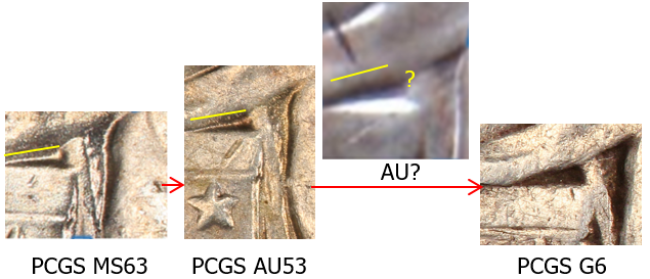 |
|
Pillar of the Community
United States
3552 Posts |
And finally, please do not forget to address the varying shape of Liberty's top/side rear head previously alluded to. Could 'all' of these noticed variations simply have something to do with nothing more than the angle of incident lighting or the position of the camera's angle per: Quote:
...pictures were taken at an angle, not straight up and down, so it's not going to be exact... Help me figure out where I'm steering off course here guys. |
|
Pillar of the Community
United States
709 Posts |
Quote:
I am still unsure why the almost horizontal trait just below the parallel yellow line on the PCGS 53 is absent on the AU? coin under discussion? Not entirely sure which line we're looking at, but I replaced this with a new picture of my coin. Is this better? 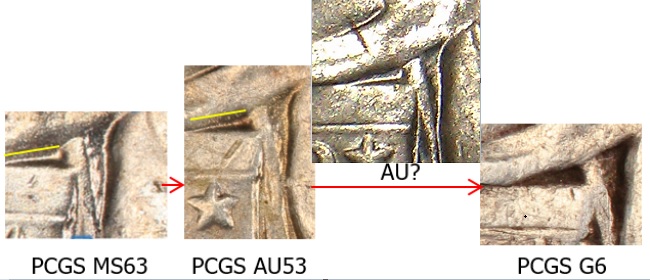 Quote:
And finally, please do not forget to address the varying shape of Liberty's top/side rear head previously alluded to. New picture, I tried to match up the angle better. 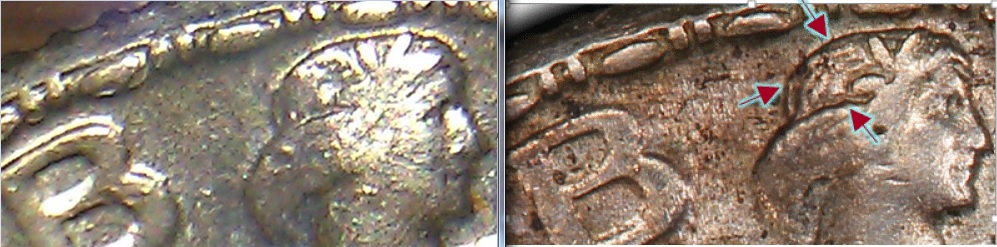 |
|
Pillar of the Community
United States
3552 Posts |
Quote:
Not entirely sure which line we're looking at... But why now does this horizontal line show up in the new photo that was used to replace the original one (of 05/17/2015 at 5:39 pm) that I first worked with? Please forgive me for my shortcomings but I hope my frustrations are reasonable when attempting to effectively explain my numerous observations when the same areas seem to visually change each time after a new photo of the same view is retaken but from a seemingly different camera angle or lighting setting etc. All now appears as it should. Case closed at least from my perspective. |
|
Pillar of the Community
United States
709 Posts |
I see what you are saying. That's what makes coins so hard to photograph. The same coin can appear vastly different based on angles, lighting, background, the use of flash, etc. It also makes grading from pictures a challenge.
Thanks for the input all.
|
|
Pillar of the Community
United States
589 Posts |
Quote:
The best way to react to this is to suggest you look at a bunch more SLQ's. The cheek and hair are the very_first_place which show strike weakness, on an issue which is known for strike weakness. That's why the "FH" designation exists, to differentiate well-struck examples from poorly-struck ones. This is fundamental about SLQ's to such an extent that savvy graders don't include the head or shield in a grading opinion at all. They're only there as an arbiter of strike strength because those details cannot be trusted to accurately reflect "wear."
NGC MS-61  |
| |
Replies: 27 / Views: 2,653 |







 First Page


 Posted 05/19/2015 06:56 am


