| Author |
 Replies: 11 / Views: 5,601 Replies: 11 / Views: 5,601 |
|
|
New Member
United States
49 Posts |
Alright, I'm hoping that someone can help me identify a coin. I have no means to scan the image to the computer, so I'll have to describe it. It is a copper penny that is about the same size as a Kennedy half dollar. On the front is a male bust and writing that appeares to be Spanish or Latin? On the reverse is what appears to be a seated soldier holding a "triton" with a shield leaned against the rock he is seated on. There is a wreath aroung the seated soldier, and outside of the wreath is "One Penny". Under the seated soldier is the date of 1921. The thing that I found curious is the foreign writting on the obverse with the "One Penny" written in English. Anyone have any idea as to what the coin is?  Thanks in advance. |
|
|
|
Moderator
 United States
6563 Posts |
this it?  Not Allowed - Auto-Removed /countries/img9/76-810.jpg) |
|
New Member
 United States
49 Posts |
Yep, thats it! What is it?
|
|
Moderator
United States
6563 Posts |
I guess I failed to mention that.
It's a British One Penny. KM#810 bronze
Value is between $.30 and $45 depending on condition
Please post when you can get a picture or scan of it
Edited by GO
01/02/2008 12:30 am
|
|
New Member
United States
49 Posts |
Thank you very much, graceoutcast! I think the condition is low because it has a dent (looks like someone was going to try and make a necklace out of it) in the top of the obverse. It was in a roll of halves that I was searching, and I thought it was pretty neat looking so I kept it.
|
|
Moderator
 Australia
16989 Posts |
The language is Latin, and translates (and expands out) to: George, fifth of that name, by the grace of God king of all the Britons, Defender of the Faith, Emperor of India. The basic obverse design, of a monarch's portrait with their titles, abbreviated, in Latin, around their head, has been used in Europe since the Dark Ages and is essentially a direct copy of the layout of the coins of the old Roman Empire. Why do you find it strange to see English and Latin mixed on the same coin? All your American coins are the same, with the Latin phrase "E Pluribus Unum".  The reverse shows Britannia. She (yes, it's a female!) is seated on a rock, holding Neptune's trident as a symbol of Britain's naval supremacy. Beside her is a shield with the Union Jack painted on it. Don't say "infinitely" when you mean "very"; otherwise, you'll have no word left when you want to talk about something really infinite. - C. S. Lewis
|
|
Valued Member
Ireland
112 Posts |
quote:
The language is Latin, and translates (and expands out) to: George, fifth of that name, by the grace of God king of all the Britons, Defender of the Faith, Emperor of India.
why was he 'emperor' of india? I presume george the sixth was also called emperor of india? until what year was there an english monarch on the currency in india? |
|
Moderator
Australia
16989 Posts |
Queen Victoria adopted the title of Empress of India in 1876, once the last vestiges of the old Mughal Empire were wiped out after the Indian Mutiny in 1857. " Emperor of India" took pride of place in the royal titles until India's independence. And shortly afterwards, too. It wasn't until 1949 that the titles on British coinage were changed. Yes, a year after India obtained independence in 1947, George VI was still Emperor of India on the coinage. But only on the coinage of Britain and Australia. Every other dominion and colony either went without coinage for a year or two until they sorted it out, or for larger ones that couldn't wait (like Canada) they struck 1947-dated coins in 1948. In Canada's case, this was why the "1947 maple leaf" coins were struck. The maple leaf means, "hello, I was actually struck in 1948, not 1947, but they haven't sent us the Emperor-less dies yet". It's also why Canadian coins actually dated "1948" tend to be scarcer. I don't know why British coinage remained unchanged for so long. Maybe it was in defiance, reminding the world that not all of the old princely states recognised or chose to join the new Republic. Maybe they were hoping the Indians would realise that independence was a bad idea and they would change their minds. Maybe they were just lazy.  Don't say "infinitely" when you mean "very"; otherwise, you'll have no word left when you want to talk about something really infinite. - C. S. Lewis
Edited by Sap
01/02/2008 08:38 am
|
|
Valued Member
Ireland
112 Posts |
quote:
Maybe they were hoping the Indians would realise that independence was a bad idea and they would change their minds
maybe your right, since their independance have india thrived as a country? i mean, not everyone in Hong Kong, were happy about the british lease on the country ending and returning back to the chinese government in 1999. in certain cases, the countries/states occupied by the british, actually benefited economically. but with regard to the coins, I doubt it was laziness or cost was too much, I believe it was pride that was a major factor. even today, the refusal of the british to adopt the euro currency. the sterling pound means so much to the british government and its people and the strength of the pound is incredible when compared to other currencies. |
|
Valued Member
Ireland
498 Posts |
Good british,right of abode.
|
|
Pillar of the Community
Australia
2830 Posts |
G'day, "Britannia" has graced English, British, and United Kingdom coins for over 200 years: mostly copper and, from 1860, bronze coins. She also appeared on silver groats. In some versions, there is a lighthouse in the background, and in some, there is a ship (variety collectors count the port-holes). Britannia was unhelmeted, and she held a plant of some description in her 1797 (twopence & penny) & 1799 (halfpenny & farthing) versions: back then, she faced left.
Peter in Oz
|
|
Pillar of the Community
United Kingdom
2930 Posts |
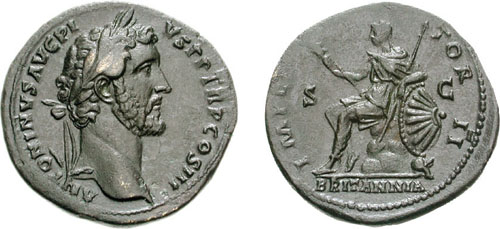
Britannia has been on the reverse of coins for longer than 200 years - for example Charles II (1684) had a tin farthing with Britannia as a reverse type. Obviously as the type originated as a personification during roman rule, the reverse image is not uncommon on 1800+ year coins.- see attached Antoninus Pius example -- if this works. Image:  britannia.jpg britannia.jpg41.2 KB Edited by Bacchus2
01/04/2008 07:29 am
|
| |
Replies: 11 / Views: 5,601 |
|







 Posted 01/02/2008 12:21 am





 britannia.jpg


