| Author |
 Replies: 9 / Views: 1,428 Replies: 9 / Views: 1,428 |
|
|
New Member
United States
44 Posts |
Can anyone point out how to date these coins? Thanks. 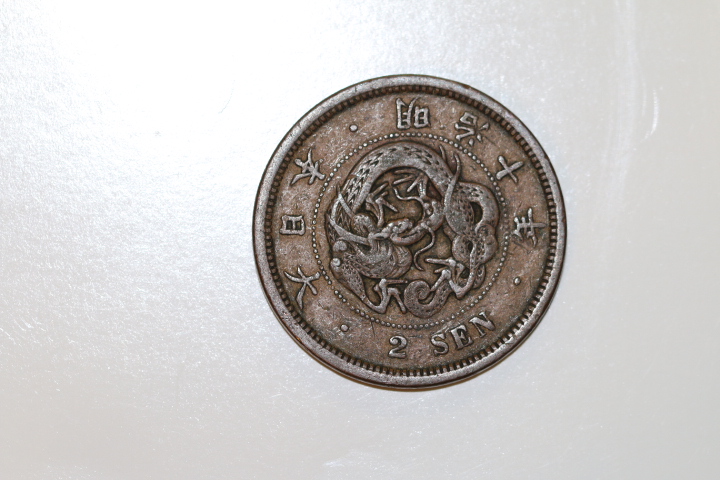 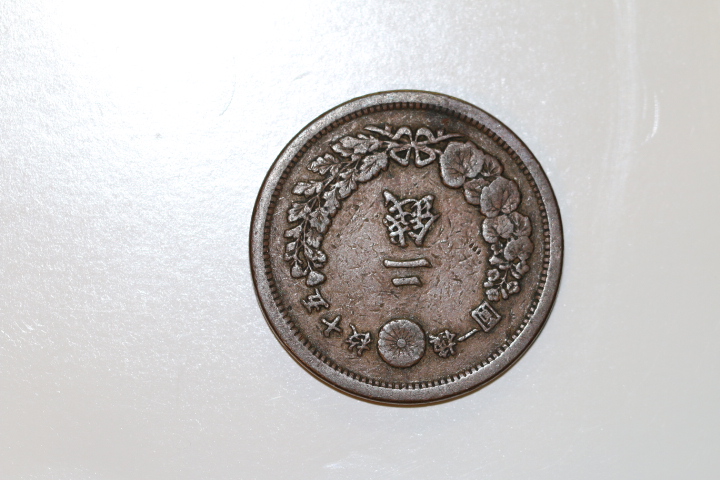 |
|
|
|
Pillar of the Community
United States
1391 Posts |
Close, Japan 2 Sen, Year 15 (1882), Y#18.2.
|
|
New Member
 United States
44 Posts |
Gotta study more to read the dates on these things.
|
|
Pillar of the Community
Australia
3841 Posts |
I disagree. It's dated Meiji 10 which is 1877. This is the "V" scale variety.
|
|
Bedrock of the Community
Canada
11922 Posts |
 the year appears to be 1877. |
|
Pillar of the Community
United Kingdom
2624 Posts |
That is all very well, but I think the question was not just the date but the method of dating ( Which characters refer to the date?)
|
|
Pillar of the Community
Belgium
2895 Posts |
|
|
Moderator
 Australia
17005 Posts |
The characters that make up the date are the ones that run from 12 o'clock to 3 o'clock on the first picture.
The character at 3 o'clock, the one that "looks like a telegraph pole", is the character that means "year". It's pronounced "nen" in Japanese, "nien" in Chinese, and "nyeon" in Korean; the same dating system can be found on coins from all these countries, though only Japan and Taiwan continue to use it today.
This "year" character always appears at the end of the date, which is important; sometimes, Chinese script is read left to right, sometimes right to left - it depends on the country and the date the coin was issued.
The two characters at the opposite end of the date-phrase from the character for "year" are the reign-name or era-name of the emperor or king that issued the coin. It's always two characters, except for coins of the Republic of China (both pre-1949 mainland China and post-1949 Taiwan) which uses four characters there which translate to "Republic of China". This reign-name can functionally be treated as the "name" of the emperor/king. On your coins, the characters are "Mei Ji" (to give them their Japanese pronunciations; they would be "Ming Zhi" in Chinese). This indicates the coin belongs to the Japanese Meiji Emperor.
All of the characters in between the reign-name and the character "year" are the actual date-numerals. In the case of this coin, there's only one numeral, the character for "10". So this coin was struck in the 10th year of the Meiji era. You then need to look up (on a website, coin catalogue or other reference or date-calculator) what that converts to in the AD calendar; in this case, the answer is "1877".
Don't say "infinitely" when you mean "very"; otherwise, you'll have no word left when you want to talk about something really infinite. - C. S. Lewis
|
|
Pillar of the Community
Belgium
2895 Posts |
Thanks Sap, now I know the correct explanation.
|
|
Pillar of the Community
United Kingdom
2624 Posts |
Nice explanation...the enlightenment won't last long unfortunately since I will never keep all that in my head.
|
| |
Replies: 9 / Views: 1,428 |
|





 Posted 10/21/2015 01:24 am





