| Author |
 Replies: 82 / Views: 16,421 Replies: 82 / Views: 16,421 |
|
|
|
Pillar of the Community
United States
711 Posts |
The more I think about preventing fraud here, the more I am convinced they must all have images hosted online for the end users to verify.
|
|
Pillar of the Community
United States
562 Posts |
Regarding the image of the fake 2005 quarter Krugerrand in a fake NGC holder, I see the previous pictures posted were in error. It wasn't the actual fake discovered. Here's an updated image of the fake coin and holder: 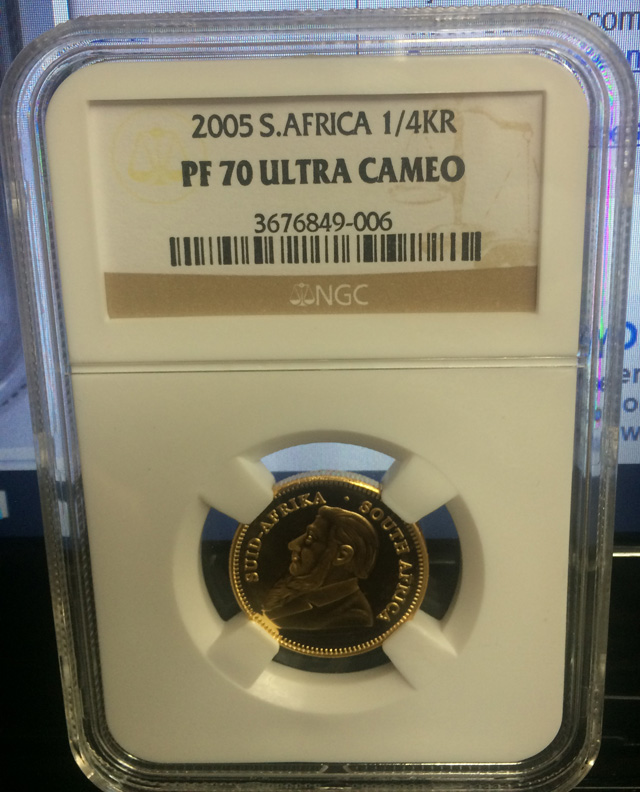 Source: http://www.numismaticnews.net/artic...r-identified |
|
Rest in Peace
United States
7075 Posts |
 I have really tried to study coins -- and I look at the fakes when somebody here posts about them -- but I really feel like I will never know enough to stay ahead of the crooks. |
|
Valued Member
 United States
392 Posts |
I think your right, Buckeye. I think imaging should be a part of the package (not an up charge option) when you submit for cert. The problem is how do you image all of the slabbed coins from the past? That's the weakness, and where the counterfeiters will target.
It might be that some creative person will start such a site, charging a reasonable fee for image and storage, and cut the major TPGs out of the picture. But, you'd still have a problem with counterfeit coins in counterfeit slabs.
Remember the article that started this thread. It was stated that only under magnification were the experts able to detect the smallest of errors on the logo of the slab. Would most of us be able to make those kinds of distinctions on computer photo images? I don't know the answer. Jack
|
|
Valued Member
United States
392 Posts |
Buddy - you have done an amazing job with hunting down and shining the light of truth on lots, and lots of fakes here on CCF. We all owe you a debt of gratitude. You've saved countless collectors from being cheated. On behalf of those you have helped, thank you. Jack
|
|
Pillar of the Community
United States
4963 Posts |
I agree that TPGs should offer free photography. I think it's worth it for their reputation.
|
|
Pillar of the Community
United States
711 Posts |
Maybe you need to supply your own images along with the coins to reduce cost? Just brainstorming here. Maybe instead of selling a $300 device to test slabs, the TPG's could sell a $50 - $100 photo rig consisting of an 18% gray background, a few jansjo like lights, but maybe fixed position lighting for consistency, and a platform to place a smartphone on to snap pics from. Then you have the right to sumbit photos for life, if they are approved by the graders as being representative of the coin in hand. Once approved and the grading process complete, the photos are uploaded to the site for verification by end users that the coin in hand is in fact the one in the slab that the TPG certified. Maybe even have a discussion thread for the coin on the site to keep track of provenance. |
|
Valued Member
United States
392 Posts |
Buckeye - I think your plan is brilliant, BUT, I don't see the TPGs going into the photographic equipment category. I really like the idea of keeping track of the provenance. That in itself is a neglected area of real importance to future collectors. Jack
|
|
Bedrock of the Community
United States
17884 Posts |
Much more likely would be a program similar to the reholdering. For a small fee you could send in your older NGC slabs and NgC would photograph and add them to the verification database. (I mention NGC because at this time PCGS still doesn't seem to be all that interested in adding photos to their site.)
Edited by Conder101
11/18/2015 10:48 am
|
|
Pillar of the Community
United States
3552 Posts |
Unfortunately or fortunately, depending upon one's point of view, this dynamic scenario provides job security for all TPGs: an issue somewhat similar in concept to keeping up with terrorists' latest tactics for devising undetectable electronic communications..
|
|
Pillar of the Community
United States
3552 Posts |
Quote:
They are selling empty slabs out the back door to a group of Chinese counterfeiters. What entity exactly should one assume the word 'they' refers to in the above statement? Is this some 3rd party illegal operation in China, or some TPG taken-for-granted as reputable but cutting side deals in the states, or some other yet-to-be-disclosed faction? This statement is somewhat nebulous and could cause litigious actions depending upon its unintended implication and who/what it affects etc. I'm not trying to stir things up with my above statements but instead only trying to become more educated in this complex issue. Depending upon which veritably accurate answer(s) to my questions surface, any credibility I once had in certain institutions could be severely undermined. |
|
Pillar of the Community
United States
3552 Posts |
Quote:
".confirmed that these two coins are in rather old NGC slabs..these slabs are both "NGC7" style. 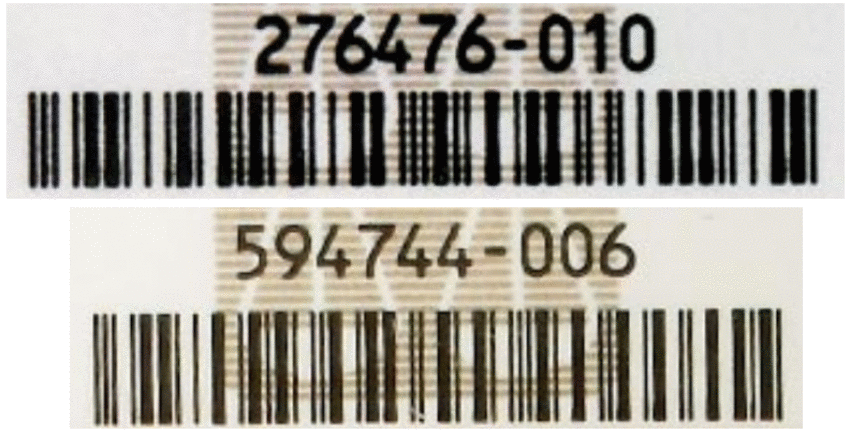 These are the two bar-codes shown in this post. I lined them up so that the width of each brown-colored label was the same. Are we to 'assume' that both of these labels are 'genuine' NGC productions? If they both are to be portrayed as authentic, I fail to understand how NGC would allow the 276476-010 to pass their QC when the 6 is clearly touching the 4 and the ink appears to be bleeding out (causing extra thickness) on virtually every numeric and bar-code digit. How can anyone assert that this 276476-010, for example, is a genuinely labeled slab in which the printing process was just a bit flawed.? Some winning bidder could have really made out big time on this coin at an auction where the majority of the bidders just incorrectly wrote it off as fake because of this printing... Are the top two TPGs known for periodically displaying these type of inconsistencies? If this action falls within the bounds of accepted protocol, maybe Bowers should begin a subset collection for varietal bar-codes with elevated premiums for touching digits etc.  |
|
Bedrock of the Community
United States
12057 Posts |
Quote:
Are the top two TPGs known for periodically displaying these type of inconsistencies? Yup. Misprints, incorrect year/denomination/MM, incorrect attributions, off-center or miscut labels, blurry printing, faded printing..just a few things that I've seen through the years. PCGS had a run for awhile with missing bar codes. Most egregious "duh" moment was a PCGS rattler with an upside down label; also have seen an old white small ANACS which had a 1910-S Wheat 1c labelled as a 1879-S Morgan $1. Member ANA - EAC - TNA - SSDC - CCT #890 "Most of the things worth doing in the world had been declared impossible before they were done." -- Louis D. Brandeis |
|
Valued Member
United States
392 Posts |
mdpmedia - Regarding the comparison labels, just want to say that is one heck of a good detective job. But, I must say, I have no idea what you said in your previous post (about your prior credibility). Jack  |
|
Pillar of the Community
United States
3552 Posts |
Quote:
...no idea what you said in your previous post (about your prior credibility). I'll assume my sentence below is the one causing the confusion: Quote:
Depending upon which veritably accurate answer(s) to my questions surface, any credibility I once had in certain institutions could be severely undermined.
I only meant to say that since the word 'they' did not actually name specifically what organization or business was pushing out empty slabs to the Chinese counterfeiters, I was just hoping that no one had concrete evidence that companies like NGC or PCGS in the USA were doing things like this. If this were the case, it would surely cause some severe issues in the numismatic world. I was attempting to gently suggest this situation as a highly unlikely but possible event in my previous post. Sometimes when the words become twisted only the author truly knows what the heck he/she was intending to convey. In retrospect my sentence was poorly worded and I hope this clarifies it somewhat better. |
| |
Replies: 82 / Views: 16,421 |








 First Page
 Previous Page


 Posted 11/16/2015 5:47 pm


