











 Posted 12/10/2015 2:30 pm


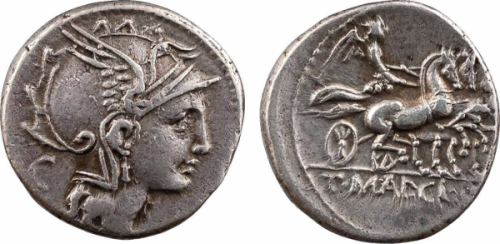
Appius Claudius Pulcher, T. Manlius Mancius, and Q. Urbinius. 111-110 BC. AR Denarius. Rome mint. Helmeted head of Roma right; square object behind / Victory driving triga right. Crawford 299/1b; Sydenham 570a; Mallia 2.
And a Writeup stolen from the internet
https://coins.www.collectors-societ...px?sc=317289
This denarius was produced in the Roman Republic in 111-110 BC. The coin can be dated since it was minted under the moneyers Appius Claudius Pulcher, T. Manlius Mancinus, and Q. Urbinius, discerned from their initials (AP. CL. T.M. QVR) in exergue on the coin's reverse.
The ancient Romans defined their moneyers as tresviri auro argento aere flan do feriundo or "the three men for casting and striking of gold, silver and bronze." The position was held for one year, usually early in a Roman noble's career, although there typically was an age requirement. The moneyers were responsible not only for producing Roman Republican coins, but also for their design.
For this particular denarius, the moneyers chose an obverse design featuring Roma, the female deity who personified the city and state of Rome. On the reverse is winged Victory, the goddess personifying the same (in other words, the Roman equivalent of the Greek goddess Nike) riding a triga, or three-horse chariot.
The triga was a curious choice for the coin's design. At the time, the biga and qudriga (i.e., two- and four-horse) were the most common chariot types, particularly at the very popular chariot races. As such, the triga was probably more appropriate for war: a notable example dating from Greek mythology was Achilles' chariot, drawn by three horses (two of them immortal). Even so, on this coin the triga appears very small and lightweight like a racing chariot, and unlike a war version, which would be much larger and armored. Indeed, Victory appears to be balancing on the axle with very little support or protection, similar to the precarious situation of an actual chariot racer (except without the wings).
Why the moneyers decided on a triga for Victory's conveyance is unknown. Not only was it uncommon as a racing chariot, it was also rarely depicted on Roman Republican coinage. In fact, this coin is one of only two Roman Republic denari that incorporated the triga as a design element.
And a Writeup stolen from the internet
https://coins.www.collectors-societ...px?sc=317289
This denarius was produced in the Roman Republic in 111-110 BC. The coin can be dated since it was minted under the moneyers Appius Claudius Pulcher, T. Manlius Mancinus, and Q. Urbinius, discerned from their initials (AP. CL. T.M. QVR) in exergue on the coin's reverse.
The ancient Romans defined their moneyers as tresviri auro argento aere flan do feriundo or "the three men for casting and striking of gold, silver and bronze." The position was held for one year, usually early in a Roman noble's career, although there typically was an age requirement. The moneyers were responsible not only for producing Roman Republican coins, but also for their design.
For this particular denarius, the moneyers chose an obverse design featuring Roma, the female deity who personified the city and state of Rome. On the reverse is winged Victory, the goddess personifying the same (in other words, the Roman equivalent of the Greek goddess Nike) riding a triga, or three-horse chariot.
The triga was a curious choice for the coin's design. At the time, the biga and qudriga (i.e., two- and four-horse) were the most common chariot types, particularly at the very popular chariot races. As such, the triga was probably more appropriate for war: a notable example dating from Greek mythology was Achilles' chariot, drawn by three horses (two of them immortal). Even so, on this coin the triga appears very small and lightweight like a racing chariot, and unlike a war version, which would be much larger and armored. Indeed, Victory appears to be balancing on the axle with very little support or protection, similar to the precarious situation of an actual chariot racer (except without the wings).
Why the moneyers decided on a triga for Victory's conveyance is unknown. Not only was it uncommon as a racing chariot, it was also rarely depicted on Roman Republican coinage. In fact, this coin is one of only two Roman Republic denari that incorporated the triga as a design element.
Edited by arnoldoe
12/10/2015 4:08 pm
12/10/2015 4:08 pm


