Quote:
Does anyone have more info on this one?
Presumably you want to know specifically about this type with the LXXII element in the reverse left field.
Kent in RIC VIII reports a series of coins of this type in a slightly reduced AE2 module minted from 351-355 at Siscia, and another from 352-355 at Aquilea for both Constantius II (Cs2) and Constantius Gallus (Csg). In both cases the obverse bust has a letter "A" behind it. Though a bit obscured, yours has that feature:
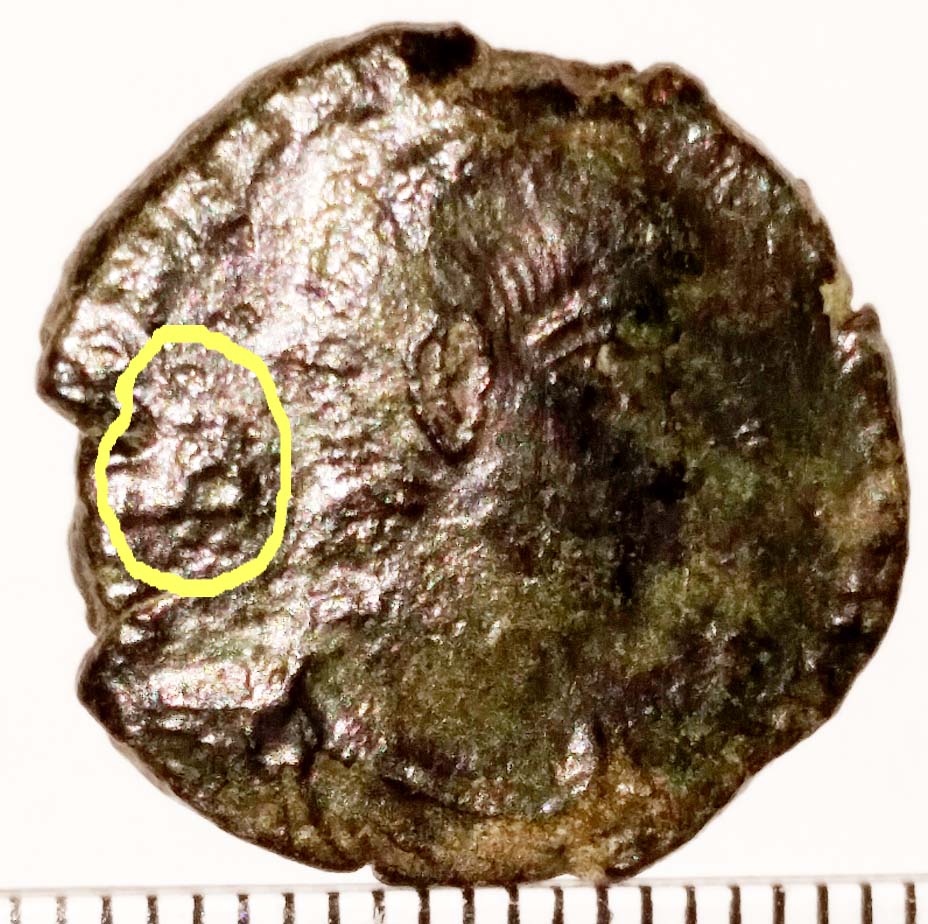
However, in the area I have circled, just below the letter "A" I think I see two balls which normally appear at the ends of the diadem for Cs2. Since the coins of Csg are bareheaded, your coin may in fact be attributed to Cs2. I am not sure of that, since the bust does not seem to show clear evidence of a diadem. On the other hand it doesn't show the obverse letter "A" very well either, so I leave the matter open.
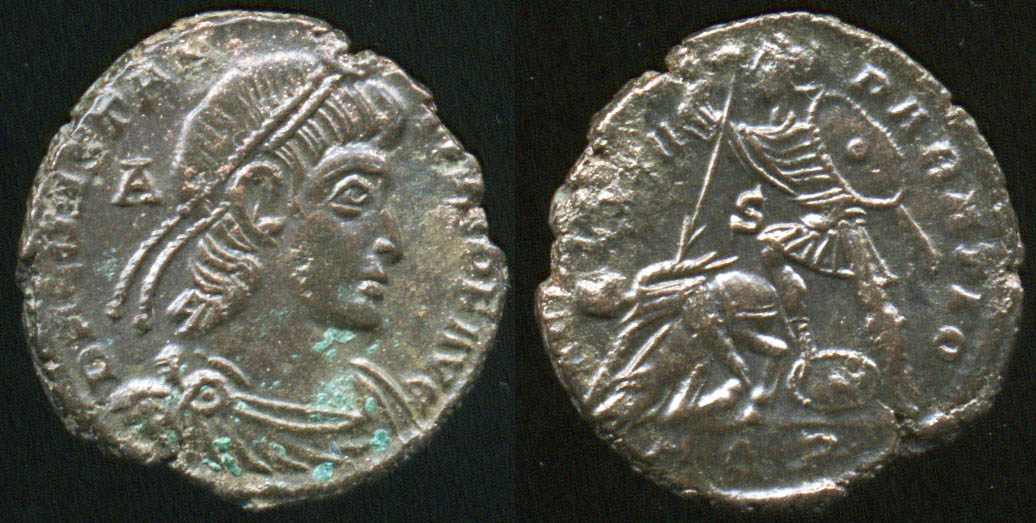
Bob linked us to a CNG pic of a clear example of this coin type from Aquilea for Gallus. Here is one from my collection for Cs2, also from Aquilea:
Kent makes no comment about any special meaning for the use of the Roman numeral LXXII (72), but his associate in the
LRBC project, Robert A.G. Carson, wrote in his survey
Coins of the Roman Empire, "...the number LXXII in the reverse field indicates the standard of 72 to the pound." This is as you reported earlier, Finn. This represents a reduced module from the size of the Falling Horseman type introduced earlier as the AE2, so-called "Centenionalis," but it is still larger than the AE3 module which had been replaced by the new bronze, and to which the AE2 eventually gave way later.
There are several combinations of field marks for these coins, all of which bear the FTR falling horseman reverse. The OP coin has the same combination of marks as my example for Cs2, with an "S" near the reverse center in addition to the numeral along the left edge. The RIC numbers for this combination are Cs2= #193; Csg = 194. Both of these are rated as C (common) in RIC VIII. As a matter of scale I acquired my example in 2001 for slightly less than US$4, so these are not rare coins by any standard.
I hope that's enough background, but if not, let me know.








 First Page


 Posted 02/05/2016 11:03 am


