| Author |
 Replies: 90 / Views: 20,776 Replies: 90 / Views: 20,776 |
|
|
|
Valued Member
108 Posts |
So back to the comments. I appreciate all the good and bad. I never said that the Canadian dollar was specimen. I merely said it was P/L. I see what others are saying about P/L coins from Canada and have to disagree. Just because I can see this 1948 Dollar is original. As far as the.50 cent piece goes I think it's specimen. As I said before I guess we'll find out when it's back from grading.
|
|
Pillar of the Community
Canada
1633 Posts |
Quote:
Don, that looks like a well-struck PL to me. I agree. ICCS has only ever certified one 1964 specimen cent, and I have a feeling it's a mis-attributed PL cent. |
|
Valued Member
108 Posts |
So..in the United States we have a business strike and a Proof strike and you can tell the difference by the rim.You can also tell usually by looking at the coin but not always. So for all of you Canadian posters
. tell me the difference between your regular strike and specimen strike.
|
|
Valued Member
108 Posts |
|
|
Valued Member
108 Posts |
Only difference is my dealer friends are small dealers not kissing NGC and PCGS and heritage auctions or the big ones asses.
You all might want to ask yourself why all Coins with the same grades aren't the same when you compare them. Just like in some auctions you can pay 62 money for 64 graded Coins because they are the ones The Big dealers got the butt kissing favors on.. you all enjoy yourselves here!
|
|
Valued Member
108 Posts |
This Coin is NOT a proof minted in 1878 so you are all telling me in Canada you didn't have the technology until 1949? 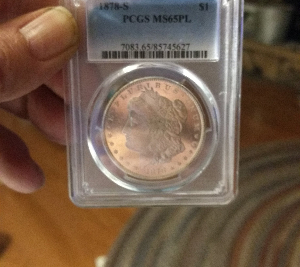 |
|
Valued Member
108 Posts |
|
|
Valued Member
108 Posts |
|
|
Moderator
 Canada
10476 Posts |
Quote:
Had any of you looked at my photos you would have seen I already had a 1937(Which you all swear weren't specimens that year yet) GRADED specimen 62 Actually, nobody said that. In fact, there are two types of specimen strikes for 1937 (mirror and matte). What was said, is that for Canadian coins, there are no PL strikes earlier than 1949 (in Canada, the term PL means something different than US coins). Quote:
This Coin is NOT a proof minted in 1878 so you are all telling me in Canada you didn't have the technology until 1949? We did, from 1858 to 1975 (VIP sets for the latter), but we have always called those strikes "specimen strikes" in which the early strikes with each dies did have a proof cameo. Exceptional specimen strikes, with deep cameos, were often graded by PCGS and NGC as "proof" (they graded the net result, not the process). For example, the coin below is from the 1967 gold $20 specimen set. It is a specimen strike... but PCGS graded it PR-67 DCAM. In the last year, PCGS has stopped this, and now will assign 'cameo' and 'deep cameo' designations to PL and SP strikes. Confused yet? Welcome to Canadian coins...  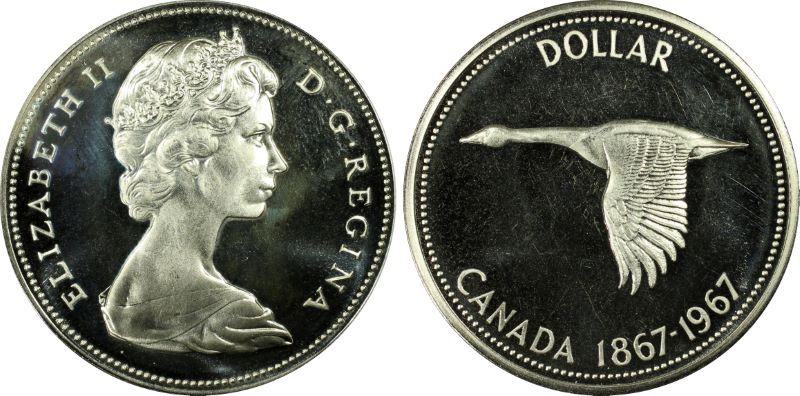 "Discovery follows discovery, each both raising and answering questions, each ending a long search, and each providing the new instruments for a new search." -- J. Robert OppenheimerContent of this post is licensed under a Creative Commons Attribution-NonCommercial 3.0 Unported License. See: http://creativecommons.org/licenses...0/deed.en_USMy eBay store
|
|
Valued Member
108 Posts |
|
|
Valued Member
108 Posts |
I also have many of those sets ( from Canada) They originally came in Cardboard in the later dates. As far as the guy who posted the nickel pic ( was funny) I'm using an Android. Try taking close ups of a whole set, close enough for people to see the difference between specimen or not. My pics before shrinking down are at 1200. They have to be cropped to 300.
|
|
Valued Member
108 Posts |
I would say welcome to grading companies.. not to Canadian Coins! You would be amazed at the grades you get as the small Guy compared to the big dealers but I understand what you mean about Canadian Coins. I've had some pretty rare ones but sold most of them. I kept a 1946 Half with the hoof in 6 graded AU 53 but couldn't get Them to attribute The Coin. The minute I was to sell it to a big dealer I guarantee it would be. I've seen some stuff that most collectors don't want to see. It's all business for the big dealers including doctoring Coins to get them to grade higher. I like my Coins original. It has gotten so bad you can send in original toned coins and they'll call Them questionable color.
|
|
Valued Member
 United States
190 Posts |
Getting back to my original question dealing with telling the difference between mirror finish PL and SP strike Canada pennies, I want to talk about a bit of information coming from the Charlton. I do not have the Charlton in hand, but my friend at the coin shop was showing me what it said in his 15 year old copy about PL and SP strikes in the 1960's. Charlton basically says in his book that there is no difference between PL and SP strikes for coins minted in the 1960's (1964, 1965, and 1967 to 1969) other than the packaging. On another thread it was suggested that a 1967 penny might be a SP strike from the SP set because it has more details than another penny also showing. There is also a clear color difference between the two coins shown in the thread's photos that I noticed. The supposedly PL coin having less details has a more golden color, whereas the SP strike with more details has more of a brick red-orange color. However, 1967 is one of the years that was included in the Charlton as being a year were all PL's and all SP's were struck the same, and only the packaging was different and this is for all dimensions. In addition, you cannot use more details as the only diagnostic, because it is possible that a coin could be struck weaker or have been struck using dies that were more worn, thus creating different amounts of details. Now Charlton does say the earlier dates with the SP label were struck special. I think all pennies prior to 1953 that are SP are actually special strikes. Charlton says nothing about the coins minted in the 1970's and onward in this particular copy of the book. I have noticed on 1970's SP strikes that they have more of a brilliant surfaces finish, but my friend says that the coins put in cellophane wrap tend to lose that brilliant look, so that cannot be used as a diagnostic. My friend also suggested to me that I might be just double collecting PL strikes, and not actually collecting anything different. He said just because the penny was placed in a double penny or double dollar set instead of a basic cello wrap set does not mean it was struck any differently or that the strike is different. He said, I should not worry about collecting SP strikes until the mint changed over to the striated field in the 1990's on SP set coins. He does not believe there is any difference between SP and PL until that change. He has been collecting Canada coins for a number of years now for his personal collection, and he also has been working at a coin dealership in the USA for several years. His words brought me back to the original question I posted.
Are PL and SP pennies actually struck differently or is the only difference the packaging for pennies struck in the 1960's, 1970's, 1980's, and early 1990's?
If they are struck differently, how do you know if you did not pluck them out of the SP sets and cut them from cello yourself? What diagnostics are you using to tell the difference? Are you only going by color and amount of details or is there other diagnostics you are using? What are those diagnostics?
For PL strikes it has been suggested that they are not any different than circulation strikes; however, special care is given to those coins at the time of minting more so than those made for circulation thus resulting in a better strike with PL surfaces. It does not matter rather the dies used were different or the same as those used for circulation purposes, they are clearly made differently thus deserve the PL label as opposed the basic MS label given to standard BU business strikes. In 1965, 1966, and 1967, special care was used to mint US Special Mint sets, thus they are different than MS coins. US mint sets are different from Canada mint sets because no special care was given during the striking process. Mint sets are put together from the best examples available taken from piles of coins headed for circulation. The dies are not polished and coins are not specially handled before going into the mint sets, thus US mint set coins are MS strikes just like coins coming from rolls. If Canada pennies with mirror finishes that are put into PL sets and SP sets are made the same way and handled the same way, then they are the same. If they are different, then why and how? Was a different die used to make SP pennies? Are they double extra struck like some suggest although the Charlton says, NO! How can you tell one from the other? Is the A pointed here and not there? Is there an extra jewel in the crown of SP struck pennies? Is it the color? What are all the differences that I can use for diagnostics?
Thanks.
|
|
Pillar of the Community
 Canada
9903 Posts |
pasasap, pretend the year is 1964 instead of 2018. You wish to obtain a SP cent. How would you do it?
"Dipping" is not considered cleaning...
-from PCGS website
|
|
Pillar of the Community
Canada
2784 Posts |
DBM I am very glad that you posted your earlier statement. I finally have enough information from the mint. I know exactly how they produce coins. you are absolutely correct. there is no comparison. between the way canadian coins are produced and the american coins. the presses are completely different. I also have my answer for Machine Doubling. thank you so much. |
| |
Replies: 90 / Views: 20,776 |






 First Page
 Previous Page


 Posted 08/14/2018 11:13 pm