| Author |
 Replies: 11 / Views: 4,699 Replies: 11 / Views: 4,699 |
|
|
Valued Member
Canada
127 Posts |
This evening I bought a shiny 1974 nickel dollar for $4. The lady at the store pulled it out of bag of about 30 coins, but this was the only 1974 (maybe from a set). I am collecting silver and nickel dollars this month! I did not magnify it at the store but when I went home I saw that it is definitely a VCR#1 (extra yoke and the line of a doubled roof above it). Sorry about the photo quality. I can't seem to find any comparable ones for sale on the net. Also the Charlton guide has me confused. My question is - how can I tell if a coin is from a proof-like set or a circulation strike? This coin is shiny and cameo, so I am hoping that means proof-like. Happy with this purchase, regardless. 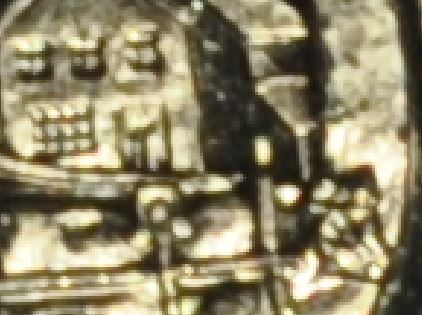 |
|
|
|
Moderator
 Canada
10473 Posts |
VCR#1 is only found in Proof-like sets and specimen nickel cased singles (blue case).
"Discovery follows discovery, each both raising and answering questions, each ending a long search, and each providing the new instruments for a new search." -- J. Robert OppenheimerContent of this post is licensed under a Creative Commons Attribution-NonCommercial 3.0 Unported License. See: http://creativecommons.org/licenses...0/deed.en_USMy eBay store
|
|
Pillar of the Community
United States
4212 Posts |
I'm not familiar w/this variety, but I'm always happy when a member makes a buy they're excited about. Good for you!
|
|
Valued Member
 Canada
127 Posts |
VCR#1 is only found in Proof-like sets and specimen nickel
That is indeed good news. Thanks.
|
|
Pillar of the Community
Canada
3167 Posts |
|
|
Valued Member
Canada
127 Posts |
Here is a better picture of the Double Yoke. I have circled the doubled yoke and the doubled roof. "exhibits an "extra yoke" directly above the normal yoke on the ox's back, just behind the shoulders. You can also see an extra portion of the lowest tier of the roof on the building directly above, floating within the middle tier." from Ken Potter's site on the topic. 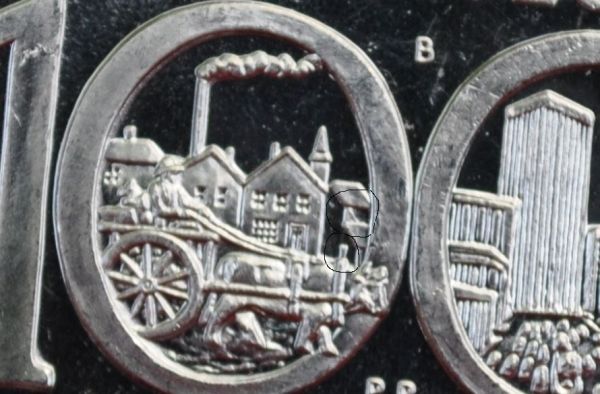 |
|
Pillar of the Community
Canada
1163 Posts |
Yours looks SP Cameo to me from a specimen clam shell case.These are over priced on ebay at the best of times.ICCS SP66 Certified I'v seen them sell for $1000.00. National coin and stamp in Edmonton has one in an original clam case with cameo.You will have to twist his arm off to buy it from him. |
|
Valued Member
Canada
286 Posts |
Thank you for reminding me about this variety, I have sold countless 1974 RCM sets having never checked the dollars. God knows what I may have missed out on. |
|
Valued Member
Canada
127 Posts |
Thanks. You are very likely right that it was a Specimen rather than PL, since it was not in RCM plastic wrap. I checked the ICCS Population report for Variety #1, and there are only a handful graded. The 1974's Winnipeg has so many varieties that it will be fun to complete a collection. The following explains how the doubling likely came about in this coin (and may apply to many other coins). Very interesting (sourced from Ken Potter's site) : "According to Ott, because a die blank starts out with a cone shaped face, (rather than flat as often presumed by collectors), it is possible to create doubling that is restricted to the center of the die if the hub is eased down and only kisses the tip of the cone. Ott suspected that the die blank was set into a hubbing press at a tilt. According to Ott, as the hubbing press operator eased down the hub (known as a "punch" in Canada) with the hydraulic press, the tilt was noticed just as the hub started to impress its image into the cone shaped tip. The hub was then backed off and the die blank reset into proper position. Impression(s) to follow were off register with the first impression and thus the resultant doubled die. In a later phone interview Ott noted that the same or similar effect could have occurred if the die/hub was tilted and forced into proper position by the pressure of the hubbing. This meant that the doubling could have occurred within one pass of the hub unnoticed to the hubbing press operator other than perhaps a tell-tale clunk of the die and hub as they seated themselves into proper position. It should be pointed out that it could have been the hub that was tilted and not the die. The effect would have been identical. Ott's explanation was revealing and helped to understand future finds of hub doubling of a similar nature on other coins." |
|
Moderator
Canada
10473 Posts |
If you want the full list of 1974 varieties, the variety section in the 2013 Charlton catalogue has them all listed. I think there is a VCR #20 to be added to the list... stay tuned...
"Discovery follows discovery, each both raising and answering questions, each ending a long search, and each providing the new instruments for a new search." -- J. Robert OppenheimerContent of this post is licensed under a Creative Commons Attribution-NonCommercial 3.0 Unported License. See: http://creativecommons.org/licenses...0/deed.en_USMy eBay store
|
|
Pillar of the Community
Canada
2366 Posts |
Yes, the 2013 catalogue adds varieties up to 19 from what Ken Potter originally published as well as giving the breakdown as to which varieties have been found in which finishes.
|
|
Pillar of the Community
United States
1781 Posts |
|
| |
Replies: 11 / Views: 4,699 |
|







 Posted 06/20/2013 08:45 am





