| Author |
 Replies: 90 / Views: 20,657 Replies: 90 / Views: 20,657 |
|
Valued Member
United States
190 Posts |
I am collecting Canada Small Cents, and I am collecting Business Strikes (BU) from bank rolls, Proof-Like (PL) Strikes from PL Mint Sets, Specimen Strikes (SP) from Specimen Deluxe Sets, and Proof Strikes from Proof Sets.
Just so it is clear for those who do not know PL and SP are two different Mint Strikes even though the results are very similar with the Mirror-Like finish for both. It is this similarity that causes the issue with identifying them. Now there is another type of Specimen Strike that is found on modern coins. This strike has a striated pattern. Most people refer to this as a satin finish. The SP coins that I am referring to here are the ones with the mirror-like finish. So, here is my question...
As a new collector of Canada Small Cents, I am having a problem determining if I have a PL or an SP. What is an easy way to determine if the penny came from a PL Set or a SP set, if you do not know for sure?
Since I collect both Mint Strike Types, it is very important that I identify them correctly. Any easy hints or ideas would help. If there is one major difference that is easy to see, it would be very helpful to know that difference. The pennies in question are dated 1964, 1965, and 1967 to 1972. They were sold to me as Specimen Strikes, but I want to make sure because SP are very rare for those dates, and PL are very common. I did not pay SP Strike prices for them, so if they are PL that is okay, I just want to know. Thanks.
|
|
|
|
Pillar of the Community
Canada
2845 Posts |
You're still working at that penny collection? Good for you! This thread might be helpful. https://goccf.com/t/195486I'm interested in an answer as well but I'm not sure that anyone will be able to give you it for the reason that lack of consistency prevailed. Otherwise we tend to refer to the finish by knowing which type of set/case it is, but when buying cents, they've obviously already been removed at some point in the past. Specimen finish should have greater detail then PL but not all PL is equal. I'd assume not all SP was either, dependant on how well it was stored over the decades. I don't know if it's true but it's also been said TPGs tend to label high quality coin as SP for the reason it represents the highest criteria finish of that era. This makes sense because as time passes, coins no longer are submitted in their original packaging. Just something to think about....some penny collectors collect on the basis of appearance - brilliant, no cameo, heavy cameo, ultra heavy cameo, etc where the visual difference is far more apparent. |
|
Moderator
 Canada
10473 Posts |
A couple of things first, because it is possible to distinguish the strikes. Specimen strikes for 1967, 1971 and 1972 are as common as proof-like strikes. The 1967 specimen set was issued in two sets: one with a sterling silver medal (red box) and one with the $20 gold coin (black box). 1971 onwards, specimen 1c coins were available in the Prestige "Double Dollar" sets. Although VIP Specimen sets were made from 1968 to 1973, and the entire sets with the original case is quite rare - it is impossible to distinguish which set 1971-1972 specimen coins came from. Expect to pay a heavy premium for 1965, 1968, 1969 and a moderate premium for 1970. I am not aware of any specimen 1c coins from 1964 and 1966. Silver dollars might be a different animal, but I don't think entire sets were issued from that year. Quote:
...but not all PL is equal.  So very true. PL coins struck from brand new dies have been graded as SP or even PR. The coins themselves are superior, so that falls into a grey area. Does one strictly define the coin by the strike run and intended packaging or does one make that decision based upon the coin itself? I collect superior strikes, and prefer the latter... "Discovery follows discovery, each both raising and answering questions, each ending a long search, and each providing the new instruments for a new search." -- J. Robert OppenheimerContent of this post is licensed under a Creative Commons Attribution-NonCommercial 3.0 Unported License. See: http://creativecommons.org/licenses...0/deed.en_USMy eBay store
|
|
Valued Member
 United States
190 Posts |
|
|
Pillar of the Community
Canada
4911 Posts |
Feel free to call me Will.
|
|
Moderator
Canada
10473 Posts |
I would have to ask Sandy Campbell about the 1964 specimen sets... The danger of these rare, raw sets is that unscrupulous sellers will put the specimen strikes in TPG holders, and slip nice PL strikes into the case and try to sell it as a specimen set - I have seen that no less than five times with 1965 and 1970 specimen sets... "Discovery follows discovery, each both raising and answering questions, each ending a long search, and each providing the new instruments for a new search." -- J. Robert OppenheimerContent of this post is licensed under a Creative Commons Attribution-NonCommercial 3.0 Unported License. See: http://creativecommons.org/licenses...0/deed.en_USMy eBay store
|
|
Valued Member
United States
190 Posts |
I am sorry but I just did not have the time to read everything carefully until now. Thank you for the extra information because it does help. However, I still not read what I was looking for here. What I needed to know was there some difference that could be easily seen to determine the difference between Specimen Strike and Proof-Like Strike for those coins minted with mirror-like surfaces. What I really need is some kind of diagnostic to follow that would help me confirm SPs and PLs. For now, I have the coins labeled the way I purchased them from the dealers. Unfortunately, the dealers may not actually know if they are SP or PL or they lied. The good news is that I payed $1 or less for all of them. I purchased a large lot of about 100 coins in one case. In this lot I got all the proof pennies minted from 1981 to 2005 for less than $1 each. The lot also contained coins dated between 1974 and 1980. The dealer had these labeled as Specimen. The 1967 I have was taken from a leather silver set according to the dealer I purchased it from. He showed me the set, but I have no proof it is a Specimen Strike either. Most of my PL Strikes came in cellophane, so I am pretty confident that they are all PL Strikes. It is the SP strikes that I question. My understanding is that two different processes where used to create them. I was told that they were double struck resulting in doubled rims, but many of the PL Strikes have doubled rims too.
Is there an easy way to determine if you have a Specimen Strike and not a Proof-Like Strike, or am I out of luck?
|
|
Pillar of the Community
Canada
2845 Posts |
Passap if you can't tell any one main difference between SP or PL pennies that should be your answer. If any are frosted/cameo by today's grading standards, that's referred to as "superior finish", not the packaging they were originally sold in.
The highlight of the Prestige set came in 1973 with the reintroduction of the silver dollar coin that had been taken out of circulation in 1967. For the most part, the other coins could be considered as fillers that completed the set, although it was originally sold for the first time in 1971 to the general public as a nice "prestigious" collector case as opposed to the traditional flimsy paper envelope. I'm not aware of any records that indicate ALL coins within Prestige sets were double struck, other than the dollar coin that was also sold individually. That might be the cause of conflicting information that you've been given. If the entire set was indeed double struck including pennies, looking at my own examples comparing PL/BU to SP/BU, the distinction is certainly not obvious.
|
|
Moderator
Canada
10473 Posts |
Quote:
Is there an easy way to determine if you have a Specimen Strike and not a Proof-Like Strike, or am I out of luck? There is way, but it is certainly not easy. It takes a LOT of experience and a discerning eye to tell the difference. I can probably tell the difference when the coins are in hand, but certainly not with photographs... "Discovery follows discovery, each both raising and answering questions, each ending a long search, and each providing the new instruments for a new search." -- J. Robert OppenheimerContent of this post is licensed under a Creative Commons Attribution-NonCommercial 3.0 Unported License. See: http://creativecommons.org/licenses...0/deed.en_USMy eBay store
|
|
Valued Member
United States
190 Posts |
I also collect U.S. Large Cents. For the past couple of years, I have been studying the different Sheldon and Newcomb varieties. I found Newcomb's attribution guide hard to read without proper photos of real coins. So, I started looking at coins posted on ebay to get a sense of the actual differences. In some cases, the varieties are so similar that it is almost impossible to tell the difference unless you know exactly what you are looking for. I am not sure if this is the case when comparing PL and SP or if there really is no actual difference at all. Unfortunately, my local expert is confused too. I purchased a coin from him today that was labeled Proof. It is a 1964 Canada Small Cent. He also had several coins in the box labeled PL and BU. I asked him why this one coin was was labeled Proof, and he said it came from a leather bound deluxe proof set. Well, he thinks it did anyway. I purchased it and it is now occupying the spot in my collection for the 1964 Specimen Strike. Maybe it is an SP and maybe it is not. Until I figure out the difference, if any differences actually exist, I will not know. Thanks for your inpute, it actually does help. |
|
Valued Member
United States
190 Posts |
Well, what I decided to do is believe the dealers were telling the truth and let it go at that. Some of the coins look almost poof that are called SP, so I guess that is one difference. Also, SP coins were not in cello, so almost all seem to have some spots.
Thanks.
|
|
Valued Member
108 Posts |
So,Is this a Specimen set or not? 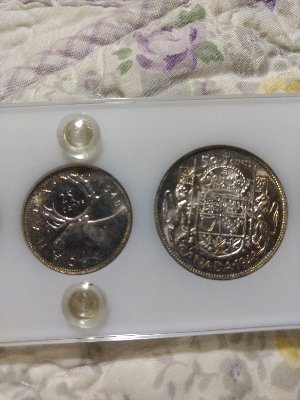 |
|
Valued Member
108 Posts |
I am trying to send a picture of the dollar The A is in between the denticles. I'm pretty sure it's a Specimen set. 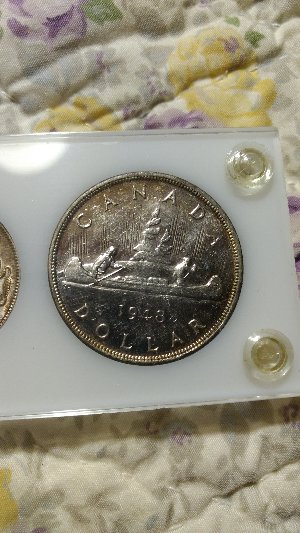 |
|
Pillar of the Community
Canada
1632 Posts |
Your coins are in an after-market plastic holder, in which anyone can place any strike of coin.
Please post close ups of both sides of the coins in question and perhaps we can give you a better answer.
|
|
Pillar of the Community
Canada
1505 Posts |
Even if it is in the leather case, no guarantee. I just purchased a 1970 VIP set, ungraded, in the case. Sent to ICCS, came back PL. It was a reputable auction house, so they took it back, but learned a good lesson and thankfully not too expensive.
|
|
Pillar of the Community
Canada
4911 Posts |
those 1948s are 100% business strikes..sorry to say.
Feel free to call me Will.
|
| |
Replies: 90 / Views: 20,657 |









 Posted 03/14/2016 7:46 pm


