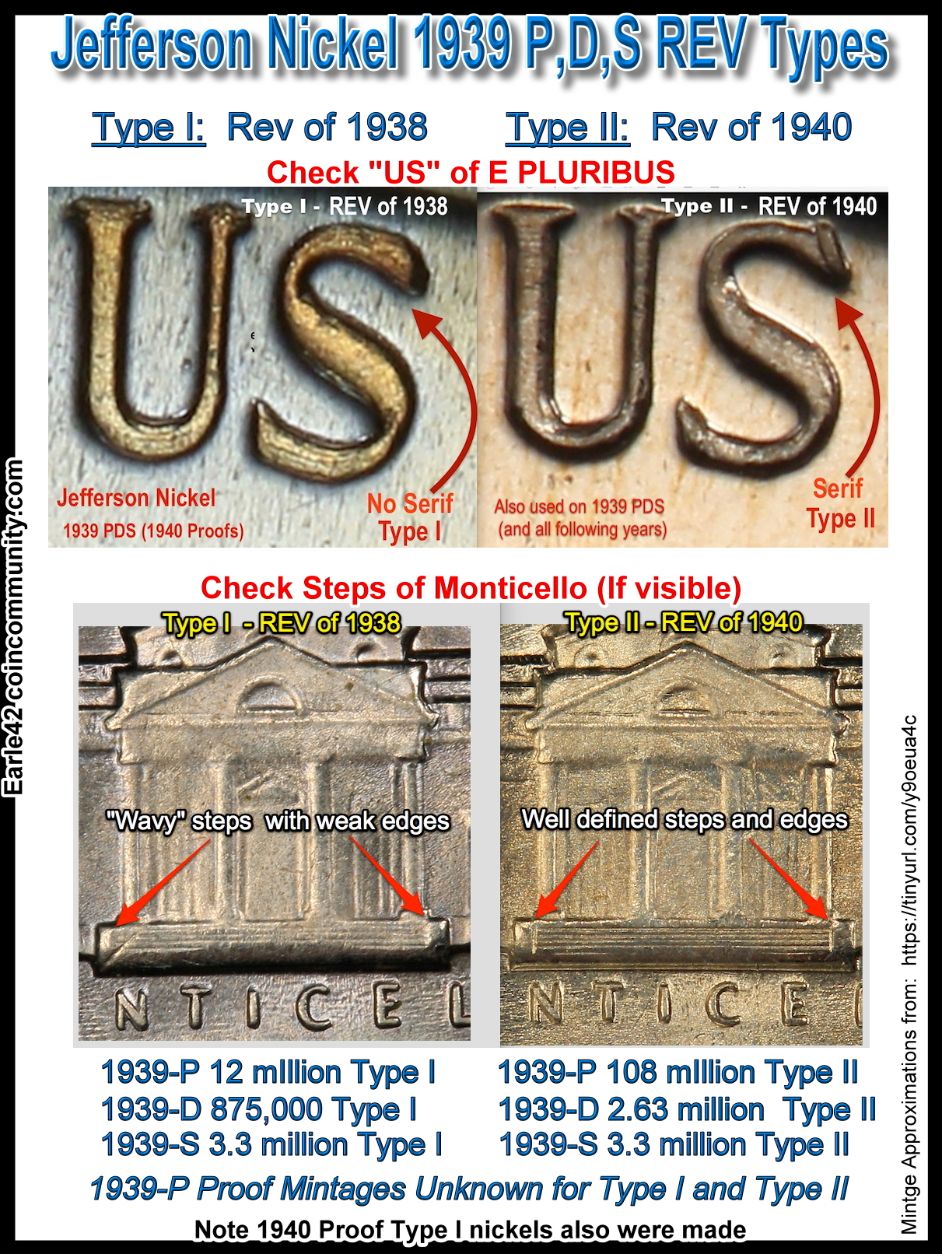
Here are my updated numbers for the 1939
Jefferson nickels with either RDV:
1939(P): 40 RDV 1938 / 278 RDV 1940
- 12.5% of my 1939 CRH finds were with RDV 1938
- (1) 1939 was a Henning nickel
1939D: 4 RDV 1938 / 10 RDV 1940
- 28.5% of my 1939 CRH/Auction finds were with RDV 1938
1939S: 9 RDV 1938 / 3 RDV 1940
- 75% of my 1939 CRH/Auction finds were with RDV 1938
I'm in Connecticut, so the larger ratio for the Philly mint when compared to Coloradobryan may be location, location, location. My Denver finds/bids, the ratio is similar to Bryan's. I'm lucky enough to have an LCS where coins appear on the bid board (origins of the coins unknown) and 3 had the RDV 1938. With that in mind 3 of 12 with RDV 1938. And finally, for 1939S, most of what I've found/acquired have the RDV 1938.
What this seems to suggest to me at this point is this:
- For 1939, the rarer RDV 1938 are more valuable
- For 1939D, the rarer RDV 1938 are more valuable
- For 1939S, the rarer RDV 1940 are more valuable
Keep in mind that I'm on the East Coast and the origins of the coins I won off the board are unknown (e.g., were these east/central/west finds originally and purchased by the poster before migrating east?). I see a poster has a 1939D on the board with RDV 1938. At the price being asked, it's not a great bargin. But being the rarer variety, it approaches an interesting price point.
I like my Philly numbers since these were all roll finds. My Denver and San Fran data may be skewed by not knowing the history behind the origin of the coins I took off the bid board. But perhaps roughly right. If members here, especially our bigger CRH enthusiasts, have the data for their hoards, I'd love to know what ratios they are finding. And I think that having this knowledge will have our members in position to cherrypick finds.
Thanks everyone for the input to Bryan's thread; it makes us all smarter!







 First Page
 Previous Page


 Posted 02/22/2018 7:12 pm