| Author |
 Replies: 41 / Views: 6,348 Replies: 41 / Views: 6,348 |
|
|
|
Pillar of the Community
 United States
6130 Posts |
There were a handful of pattern coins; apparently they never got very far with the design because he did not want to honor the tradition of facing the opposite way of his predecessor on his coins--said the right side of his face was his "bad side". Portrait coins of Edward VIII are exceedingly rare--I think fewer than 10-20 pattern sets were made before he abdicated.
You can get his name on a few colonial coins without portraits. West and East Africa are the most accessible and cheapest; the Indian states of Kutch and Jodhpur also issued coins in his name; albeit in Arabic.
|
|
Pillar of the Community
Canada
514 Posts |
hmm... thanks for the reply!
|
|
Pillar of the Community
United States
4932 Posts |
Numisrob...I own a semi-slick one of those and had no clue...
|
|
Pillar of the Community
United States
1156 Posts |
This 8 reales was struck during the first half of the year when revolutionary forces of the Provincias Unidas del Río de la Plata captured Potosí. Royalists reasserted control later that same year and issued 8 reales with the bust of the Spanish monarch, Fernando VII.  |
|
Pillar of the Community
United States
6130 Posts |
Huh, I had never seen a revolutionary coinage with such refined artwork... normally they are extremely crude and hastily made. I suppose that the Mint employees were involved in the revolution as well?
Fantastic piece of history though!
|
|
Pillar of the Community
United States
1316 Posts |
1382 Billon tornesello of Michele Morosini (1308 - 16 October 1382). He became the Doge of Venice on June 10th of 1382 and died of the plague a few months later in October. The coin was minted in Venice for use in the colonies of Coron and Modon, Negroponte and Crete. Depiction on the one side is of a winged lion of San Marco, seated facing, holding Gospels in forepaws. 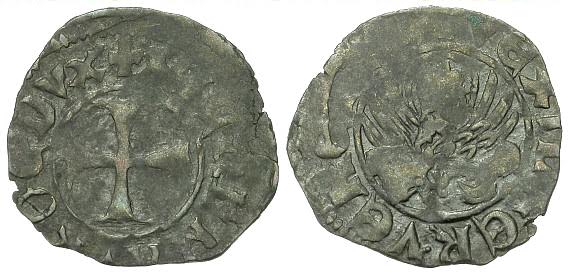 |
|
Pillar of the Community
United States
6130 Posts |
Nice one, Collects82! Another one from my collection of Japanese coins: Hoei Tsuho 10 mon Minted November 1708 - Early 1709   This massive (38mm!) cash coin was introduced by the emperor Higashiyama, in the vain hopes of postponing the crisis that Japan was totally isolated from foreign trade, and her copper mines were becoming exhausted from fueling an economy with millions of copper coins. The solution was to make a coin three times as massive, and value it at ten times greater. These coins were made and distributed to a populace who rightly suspected that they were being stiffed. The Emperor issued a royal proclamation that the coins must circulate (the countermark is the character for "precious", meaning that they were to be treated as silver). This had very little effect and the coins were withdrawn "early" in 1709. Total minting time frame was almost certainly less than six months. |
|
Pillar of the Community
United States
6130 Posts |
I don't have pictures of mine, but here are a few examples from US coins: 1982 P&D zinc cents- The legislature to authorize the composition switch did not go into effect until November of 1982, so all zinc cents are (theoretically) made in just two months, November and December 1982. They are comparatively less common, being only 5-10% of the total (12-16 billion IIRC?) mintage. "Cheerios" cents and dollars - For those who don't remember or are too young, every box of Cheerios for about the first six months of 2000 had a BU cent in a special holder, advertised as "One of the first 10,000,000" 5,500 boxes also had a dollar, now known as the "Cheerios dollar" for using an early pattern die on the reverse. The existence of the dollar seems to confirm that these coins were all made in late 1999 to have the boxes packaged and ready to go in January. 1942 nickels - if memory serves, the War Nickel did not first go into production until April 1942, after several months of regular production and Philadelphia and Denver while the weird billon alloy was being developed. Therefore, all 1942 nickels can be dated to a frame between 4 months (cupronickel) and 8 months (silver). There were also 1909 Indian cents, 1916 Mercury dimes and Standing quarters, and 1938 Buffalo nickels, but I will let Conder or another Moderns guru weigh in on those. |
|
Pillar of the Community
Canada
514 Posts |
I haven't read anything about 1909 USA-pennies being minted in a narrow window... granted both 'Indian Head' & Lincolns were minted that year...
|
|
Bedrock of the Community
United States
17884 Posts |
Chain cents were struck Feb 27th to March 12 1793, Wreath cents were struck April 4 to April 28 1793, 1793 Liberty Cap cents were struck between Sept 12 and Sept 18, 1793. There are many other short run periods in US coinage. The 1793 Half Cents has a similar short run, the 1853 and 1873 no arrows issues of Seated coinage were struck before about Feb 12 of those years. All of the 1795 plain edge cents and the 1796 Liberty caps were struck between Dec 12 1795 and July 1st 1796. Exactly when the 1795's stopped and the 1796 started I don't know. The 1921 Peace dollar was struck Dec 28th trough Dec 31st 1921. There are others. |
|
Pillar of the Community
United States
6130 Posts |
Very good info Conder! I am very surprised about the 1921 Peace dollar... they made a million in 4 days! Also I guess if one counts the 1913 V nickels, those were supposedly all made on a single night to sell illegally to the coin shop down the street. |
|
Pillar of the Community
Poland
3201 Posts |
The thalers and quarter thalers of Nordhausen: "Although no formal mint right seems to have been granted to the town, they started a mint in 1556." "In 1556, the town commissioned mintmaster Valentin Sickel (mm. clover) to mint thalers and quarter thalers. However, the mintage had hardly begun when it had to be stopped again. The dies had not yet been paid so that the die cutter of Brunswick had to sue for his pay. The town's mintage was not continued until 1616." Source of the data and image of the thaler: here. |
|
Valued Member
United States
440 Posts |
Not a coin, but medals.
April 29, 1960 - Presidential gold medal concept provided to the Bureau of the Mint (for President Eisenhower presentation at the Paris Summit)
May 12, 1960 - Bureau of the Mint delivers Presidential gold medals to the White House (for President Eisenhower's trip to the Paris Summit).
May 15 -19, 1960 - Paris Summit collapses. Medals returned to US.
December 30, 1960 - White House delivers Presidential gold medals to Director of the Mint and destroyed (witnessed by White House Office and Bureau of the Mint representatives).
Concept to Delivery: 14 days
Delivery to Destruction: 233 days
This medal is identified as DDE-C3-01, 1960 Eisenhower Paris Summit - Heads of State Award.
|
|
Valued Member
United States
440 Posts |
Edited by DrDarryl
12/25/2016 10:47 am
|
|
Bedrock of the Community
United States
17884 Posts |
Quote:I am very surprised about the 1921 Peace dollar... they made a million in 4 days! Not too surprising, they had been striking a million or so Morgan dollars a week. |
| |
Replies: 41 / Views: 6,348 |







 First Page


 Posted 12/15/2016 4:21 pm





