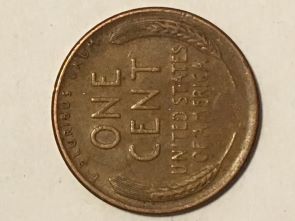
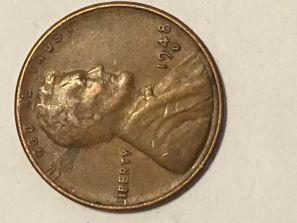
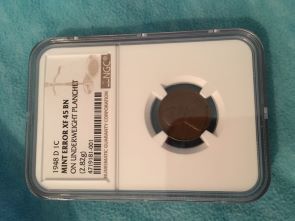
"Shell casing" Bronze (1944-1945)
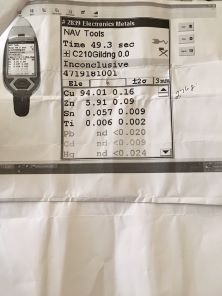
Composition: 95% Copper and 5% Zinc
Diameter: 19mm
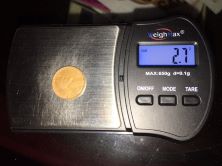
Weight: 2.70g
Edge: Plain
Production of the war-time cent was provided for in an Act of Congress approved on December 18, 1942, which also set as the expiration date of the authority December 31, 1946. Low-grade carbon steel formed the base of these coins, to which a zinc coating 0.0005-inch (0.013 mm) thick was deposited on each side electrolytically as a rust preventive. This coating was applied to the steel before the blanks were made, leaving the rims of these coins extremely susceptible to rust. The same size was maintained, but the weight was reduced from the standard 48 grains (3.1 g) to 42 grains (2.7 g), by using a lighter alloy. Production commenced on February 27, 1943, and by December 31 of that year, the three Mint facilities had produced 1,093,838,670 of the one-cent coins. The copper released for the war effort was enough to meet the combined needs of two cruisers, two destroyers, 1,243 Flying Fortresses, 120 field guns and 120 howitzers, or enough for 1,250,000 shells for large field guns.[32][33]
Wartime brass, 1944-1946. Numerous complaints about the gray color of the 1943 cents, especially that they could be mistaken for dimes, led to a change in composition of the wartime cent. On January 1, 1944, the Mint was able to adopt a modified alloy, the supply being derived from expended shell casings which, when melted, furnished a composition similar to the original, but with a much smaller trace of tin.[citation needed] The original weight of 48 grains (3.1 g) was also restored.
Even before the United States entered the war, there were inklings that the cent, as well as the nickel were in trouble. The nickel was made out of 75% copper. Copper was in huge demand due to its use by defense contractors in the manufacturing process of various supplies and equipment needed in case of the US going to war.
After the attack on Pearl Harbor, the rumors only grew and in January 1942, The Numismatic Scrapbook Magazine reported that Treasury officials were giving serious consideration to using different metal contents for some coins. The first step occurred on January 23rd, 1942, when the Treasury ordered the removal of all but a trace of tin from the cent from the already small amount that had been in use. The existing supply of strips and planchets were used and it is speculated that cents produced in 1942 were produced of both metal compositions. This small change was expected to save 100,000 pounds of tin.
Throughout 1942, there were repeated attempts and pleas to the public to turn in their cents and nickels. Even with these pleas, the shortages continued and for the last six months of the year the mint scaled back production of cents and nickels. During this time, experiments were conducted with various metal compositions, fibers, plastics and even glass. On December 18, 1942, Public Law 77-815 was enacted. This law called for the melting of more silver dollars and for the authorization of metal substitutes for the one cent and five cent coins not to go beyond December 31st, 1946. The nickel had already seen its change utilizing more silver in its content. The Treasury wasted no time and on December 23, 1942, Treasury Secretary Henry Morgenthau, Jr. ordered that all cents produced after January 1st 1943 be comprised of low-carbon steel coated with zinc. The zinc plating was to provide a thin coating to prevent rust and was to be no more than .001 inches thick. The same diameter of coin was maintained, but the weight was reduced from the standard 48 grains to 42 grains, due to the use of a lighter alloy. It took some time to produce sufficient supplies of planchets and production commenced on February 23, 1943 at the Philadelphia Mint with the Denver and San Francisco Mints beginning production the next month.
On February 27th, the first delivery of cents was made to the Treasury and within a few weeks, the steel cents were in circulation. Although the Treasury Department assured the public that the coin, after being in circulation for a while, would gain a distinct appearance, many people noticed the color resemblance of a dime. Complaints continued to pour into the Treasury. For example, due to there magnetic property, many mechanical devices treated the new cent as a slug. Back then, there were quite a few uses for the cent and this was a big deal.
The new cent was so much hated by the public that the Treasury was moved to issue them only when bronze-copper cents were not available. Still, demand for cents for business was so great, that the public was forced to use them as that was what was available. In the fall of 1943, the Treasury announced that no steel cents would be produced after December 31, 1943 and that the mint would produce cents from the pre-war alloy, but without tin. These cents, from 1944 through 1946 were to be known as shell-case cents, as the metal generally came from spent shell-casings. It was also announced that there would be no recall of the steel cent.
Production commenced on February 27, 1943, and by December 31, 1943, the three Mint facilities had produced 1,093,838,670 of the one-cent coins. The copper released for the war effort was enough to meet the combined needs of 2 cruisers, 2 destroyers, 1,243 flying fortresses, 120 field guns and 120 howitzers, or enough for 1.25 million shells four our big field guns. These pennies are sometimes referred to as silver pennies due to their color when in new/AU/BU condition.
After the war, the Treasury did begin recalling steel cents for the next 20 years. Although not publicized, coins were to be returned to the treasury in the normal course of business. By 1950, steel cents were becoming scarce and by 1960, nearly non-existent. By this time, steel cents had deteriorated quite a bit. Even though a recall was in effect, the Mints own records indicate over 930 million remained in circulation.
Unique to this variety
Due to wartime needs of copper for use in ammunition and other military equipment during World War II, the US Mint researched various ways to limit dependence and meet conservation goals on copper usage. After trying out several substitutes (ranging from other metals to plastics) to replace the then-standard bronze alloy, the one cent coin was minted in zinc-coated steel. It was struck at all three mints; Philadelphia, Denver, and San Francisco. Coins from the latter two sites have respectively "D" and "S" mintmarks below the date.
However, problems began to arise from the mintage. Freshly minted, they were often mistaken for dimes. Magnets in vending machines (which took "copper" cents) placed to pick up steel slugs also picked up the legitimate steel cents. Because the galvanization process didn't cover the edges of the coins, sweat would quickly rust the metal, turning the coins into a rusty mess. After public outcry, the Mint developed a process whereby salvaged brass shell casings were augmented with pure copper to produce an alloy close to the 1941-42 composition. This was used for 1944-46 dated cents, after which the prewar composition was resumed. Although they continued to circulate in the 1960s, the mint collected large numbers of the 1943 cents and destroyed them.








 First Page
 Previous Page




 Posted 01/19/2017 05:53 am





 ! If you knew anything, they don't do onset grading!


