| Author |
 Replies: 480 / Views: 54,248 Replies: 480 / Views: 54,248 |
|
|
|
Moderator
 Canada
10477 Posts |
As a geologist, I can appreciate that Dam Quarter!!
"Discovery follows discovery, each both raising and answering questions, each ending a long search, and each providing the new instruments for a new search." -- J. Robert OppenheimerContent of this post is licensed under a Creative Commons Attribution-NonCommercial 3.0 Unported License. See: http://creativecommons.org/licenses...0/deed.en_USMy eBay store
|
|
Moderator
United States
196278 Posts |
Quote:
I found the token catalog reference for the granite token. Link listed below: Excellent!  Quote:
As a geologist, I can appreciate that Dam Quarter!!  |
|
Valued Member
United States
333 Posts |
Where did you get yours? I got one on ebay in December, I believe it was one of two that were listed last year and haven't seen one since then. I've seen them in large lots of tokens (like through Heritage) however, which makes me think they're relatively common yet still difficult to get a hold of. |
|
Valued Member
United States
333 Posts |
You know... this made me check and I found and bought another one. Sorry.  (And yes, I actually was looking for an extra one of these due to their uniqueness. Of the small number of stone items listed in the Token Catalog, this is the only one with a face value.) The next time one comes up I'll leave it for you though. |
|
Pillar of the Community
 United States
574 Posts |
@nautilator, No worries, I only needed the one and I picked up the one that I posted here off of ebay back in May. It would get pretty expensive and time consuming for me to duplicate the entire circulating set. Some of the pieces are just incredibly hard to get ahold of. So, I currently have no plans to even attempt to make a duplicate set. It took several years off and on to put this one together. At this point, I'm pretty sure that I have completed the full circulating coin/tokens set at 34 different materials represented. I left out any materials that I considered to be an impurity meaning that it wasn't added on purpose or wasn't meant to be part of the coin/token. So, I left out mercury from the Silvered late Roman Empire coins, Cadmium impurities from Feuchtwanger cents, and the silicon, sulfur and phosphorus impurities from the Mexican New Peso small change. I also left out any material that had no circulation value attributed to it. That's why I left out the mica from the US Civil War encased postage stamps since their value was attributed to the stamp and not the mica. The materials represented in the circulating set are aluminum, antimony, arsenic (copper bell arsenic), bamboo, bone, carbon(compressed coal dust), cardboard (struck lacquered pressed thick paper Notgeld), celluloid(ivory plastic), chrome, clay(porcelain), copper, CP3(a laminated paper composite similar to Formica), fiber (compressed, Manchoukuo, vulcanized), glass, gold, granite, iron, lead, leather, magnesium, manganese, nickel, palladium/ruthenium, paper (compressed pages of books), plastic, platinum, silver, tin, zinc, vulcanite (vulcanized black rubber), and wood. If you know of any other materials used for coins or tokens that actually circulated. Please let me know. It would seem that all that is left to do in regards to the circulating set is the write up. I still have to do a bit more research on the pieces in the set before I can produce a good write up but when I am done with it I will post a rough draft in this thread first. In regards to the granite token the "Black book of US paper money" attributes that token as a token that is made out of concrete and not a token that is made of granite but after inspecting it in hand and looking at other examples on the internet. I'm pretty sure that it is made of granite. What is your take on that? Concrete? Or granite? Edited by casualcoincollector
09/01/2018 06:03 am
|
|
Valued Member
United States
333 Posts |
It has the grain of granite to be sure. They may have listed it as concrete because it was supposedly drilled out of the dam. I just saw that black book entry and was quite surprised that the listed value is $35.
How deep do you feel like going into subtypes? For example, you might consider deerskin a type by itself.
Also, how sure are you that the tessera was a coin? I've found little about glass jetons/coins out there despite supposedly being used in ancient times.
|
|
Moderator
United States
34563 Posts |
Quote:
when I am done with it I will post a rough draft in this thread first. Lookin' forward to reading this when you have it! "If you climb a good tree, you get a push."
-----Ghanaian proverb
"The danger we all now face is distinguishing between what is authentic and what is performed."
-----King Adz
|
|
Pillar of the Community
United States
574 Posts |
@nautilator,
I don't know about adding deerskin, leather is leather in my opinion. I didn't even bother to differentiate between porcelain and baked clay. I think that they are close enough and clay is clay. I know they are slightly different on a molecular level but as long as they look more or less the same and have the same overall texture I don't think that differentiation is needed. At that point it just seem like you're splitting hairs.
But with that being said I would like to see how different it looks, do you have a photo of a deerskin coin/token or know where I can find a photo of one?
In regards to the glass tessera. I haven't been able to find much information on them either. I am assuming that the bulk of the information is in Italian which is making it rather hard to find. I don't think that they qualify as coins but do think that they qualify as circulating tokens and the general consensus seems to be that they were circulated as some form of money. Based on that I think they count.
Edited by casualcoincollector
09/01/2018 4:10 pm
|
|
Pillar of the Community
United States
574 Posts |
|
|
Valued Member
United States
333 Posts |
The different leathers/skins have distinctively different feels -- and smells -- to them. But in truth, it's probably because of whatever way they've been prepared. It seems that even reissues of the same currencies have a noticeably different color to them as compared to the original. When I get around to them, I will be considering them different subtypes of leather. (Speaking of which, I probably should start assembling things together...) 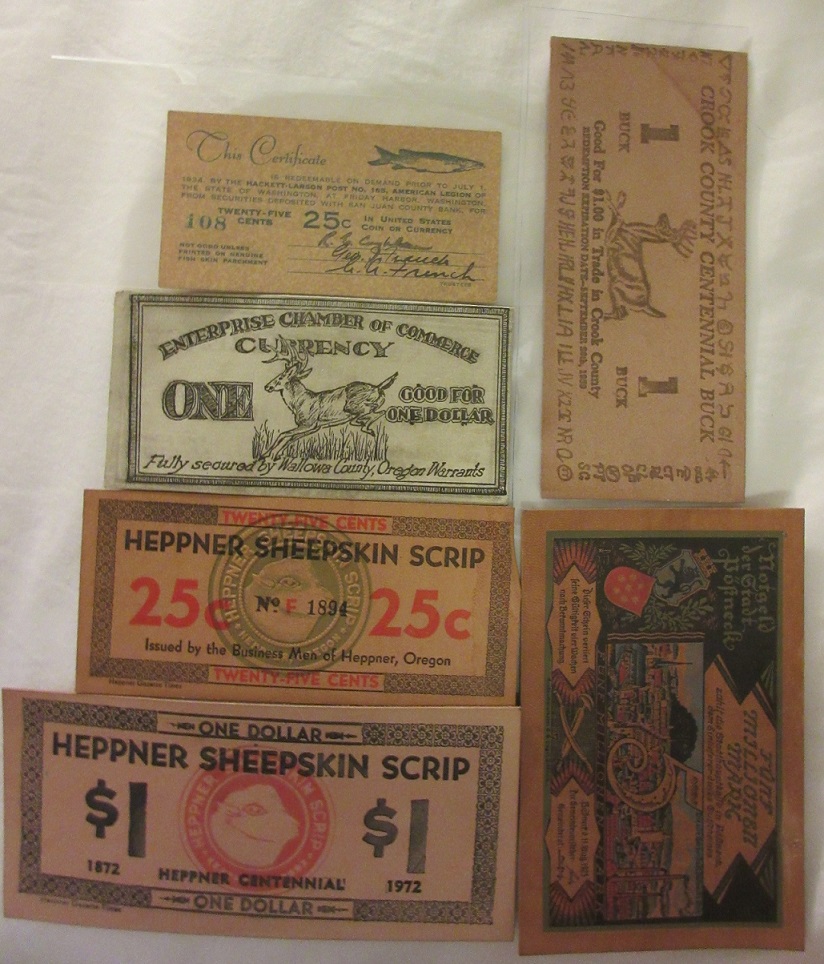 |
|
Valued Member
United States
333 Posts |
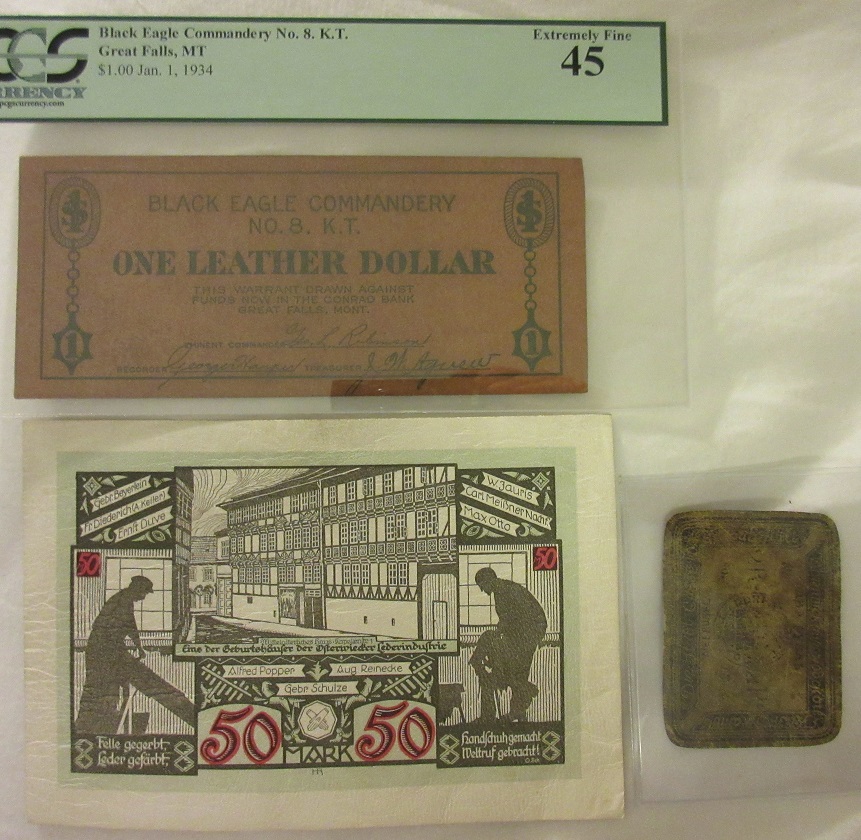 I really would at some point like to find out if one can consistently distinguish the different leathers without being told. The Austrian (white) notgelds, I've read they were made with chamois (goat), but Heritage recently put some overpriced ones out there and just labelled them as suede. The Estonian one smells enough that it makes me think it's sheepskin, but I don't really know that. Our own Black Eagle Commandery one has the color and grain to be sheepskin, but I ain't opening it to find out! On another note, I saw a pair of Islamic glass jetons at the show in Philadelphia. They were really beautiful and it made me regret they weren't coins proper. |
|
Moderator
United States
196278 Posts |
Good stuff, nautilator! |
|
Pillar of the Community
United States
574 Posts |
@nautilator,
Those are some pretty interesting leather currency notes. Thanks for posting them! I like the idea of set composed of all of the different kinds of leather used as money but that is bit beyond the scope of the circulating coins/tokens materials set that I am finishing up now.
In regards to the glass tesserae again. The reason that I don't consider them to be proper coins is not because I don't think that they were used as coins but the fact that I think that they inherently lack the ability to qualify as ancient coins. The reason for this is because in my opinion in order for them to qualify as ancient coins the attributed face value would have to be backed up by the intrinsic value of the material that the coin was made of. Since the glass in the tesserae had no real intrinsic value they can't be classified as proper coins but were instead classified as tesserae (tokens).
Edited by casualcoincollector
09/02/2018 01:51 am
|
|
Valued Member
United States
333 Posts |
Look what I found! 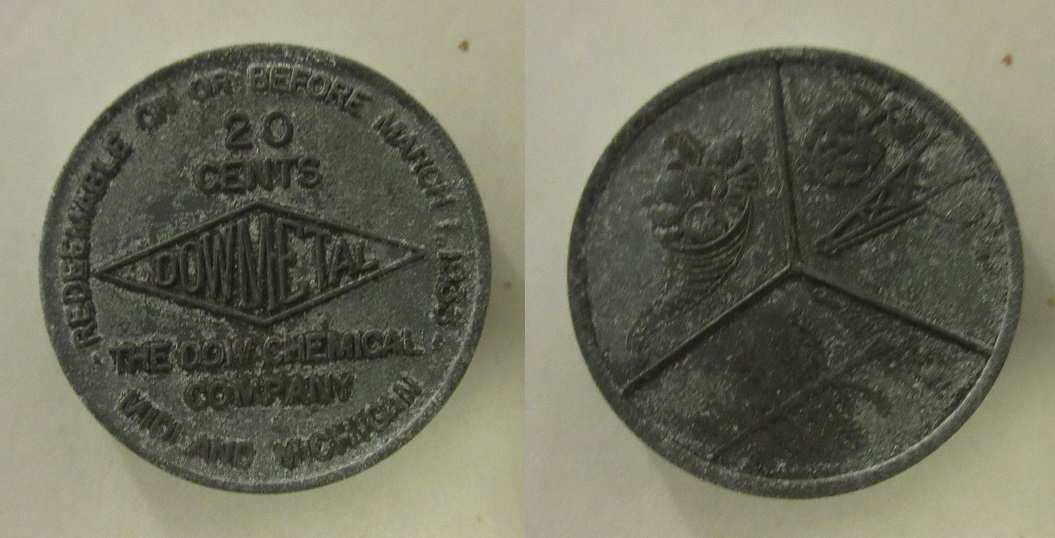 Of the handful of dowmetal pieces, this is the only one that has a face value on it. (There's also a transportation token; the rest are medals.) It's listed as depression-era scrip in Mitchell-Shafer. |
|
Pillar of the Community
United States
574 Posts |
That's awesome! Thanks for posting it! I wasn't aware that there were any dowmetal items that had a face value. It's in really good shape for being primarily made out of magnesium. It should be very light weight. Do you happen to know the size and weight of it? Also, I wonder why they chose the face value of 20 cents and not a quarter. I found the token catalog reference for it: http://tokencatalog.com/token_recor...on_id=364962Edited by casualcoincollector
09/07/2018 8:45 pm
|
| |
Replies: 480 / Views: 54,248 |








 First Page
 Previous Page


 Posted 08/29/2018 11:43 am


