| Author |
 Replies: 147 / Views: 24,716 Replies: 147 / Views: 24,716 |
|
|
|
Bedrock of the Community
United States
10284 Posts |
 Thanks, I had to look up where Guernsey was and found a map printed in 1899! It's in the English Channel next to Jersey. I would venture to guess that's where we get those breed of cows. 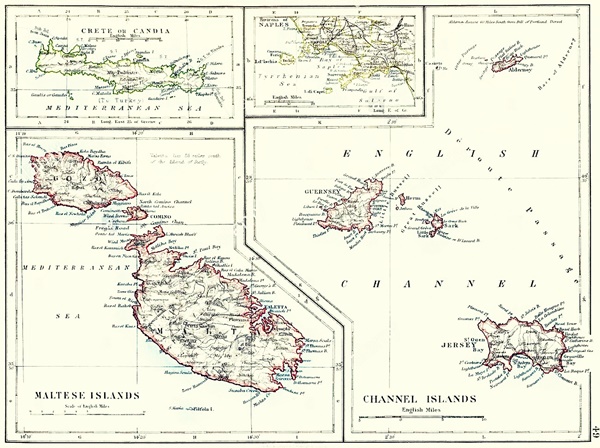 |
|
Bedrock of the Community
United States
12477 Posts |
When this coin was made... 1357 (1978) Afghanistan 1 afghani 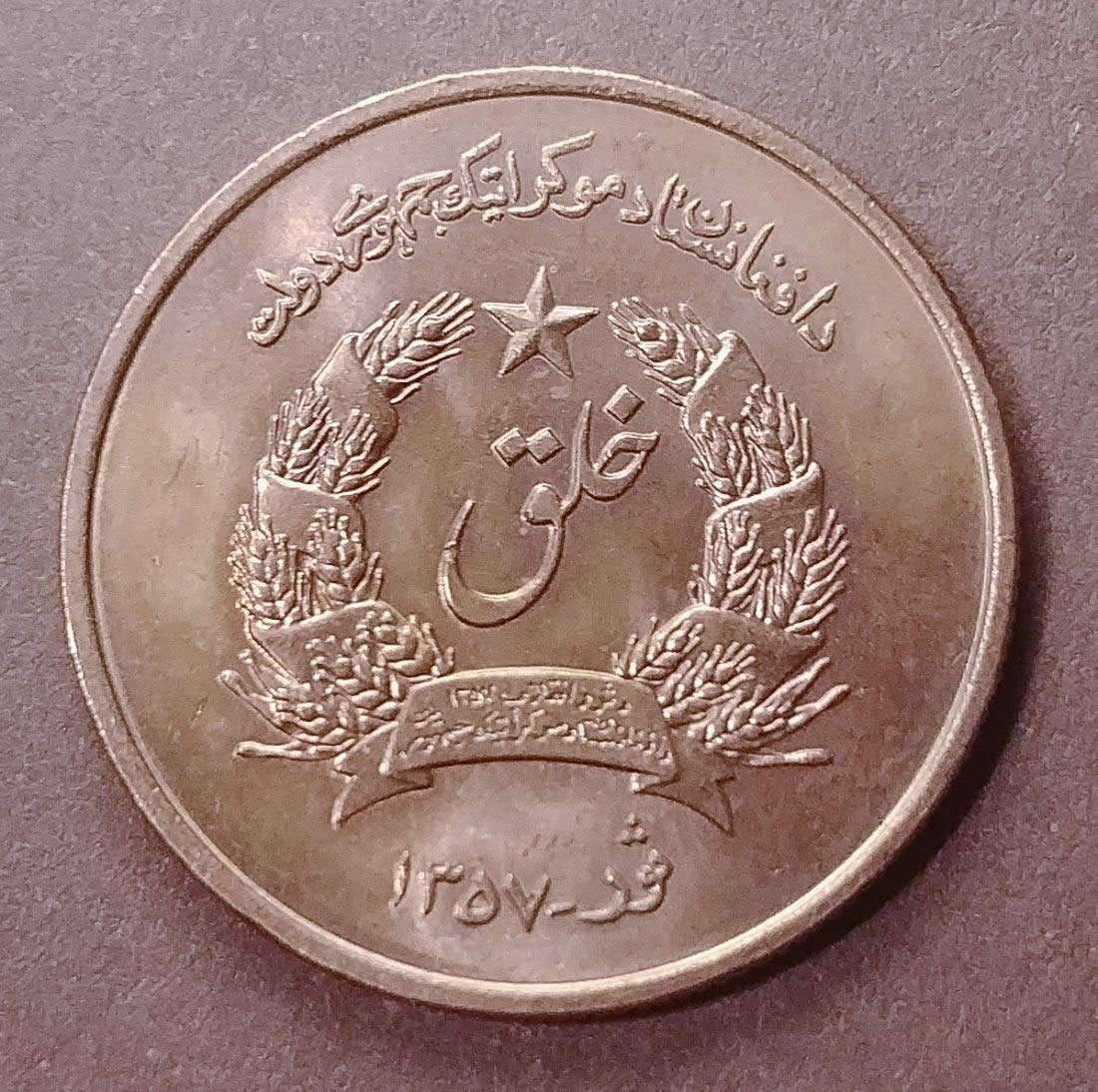 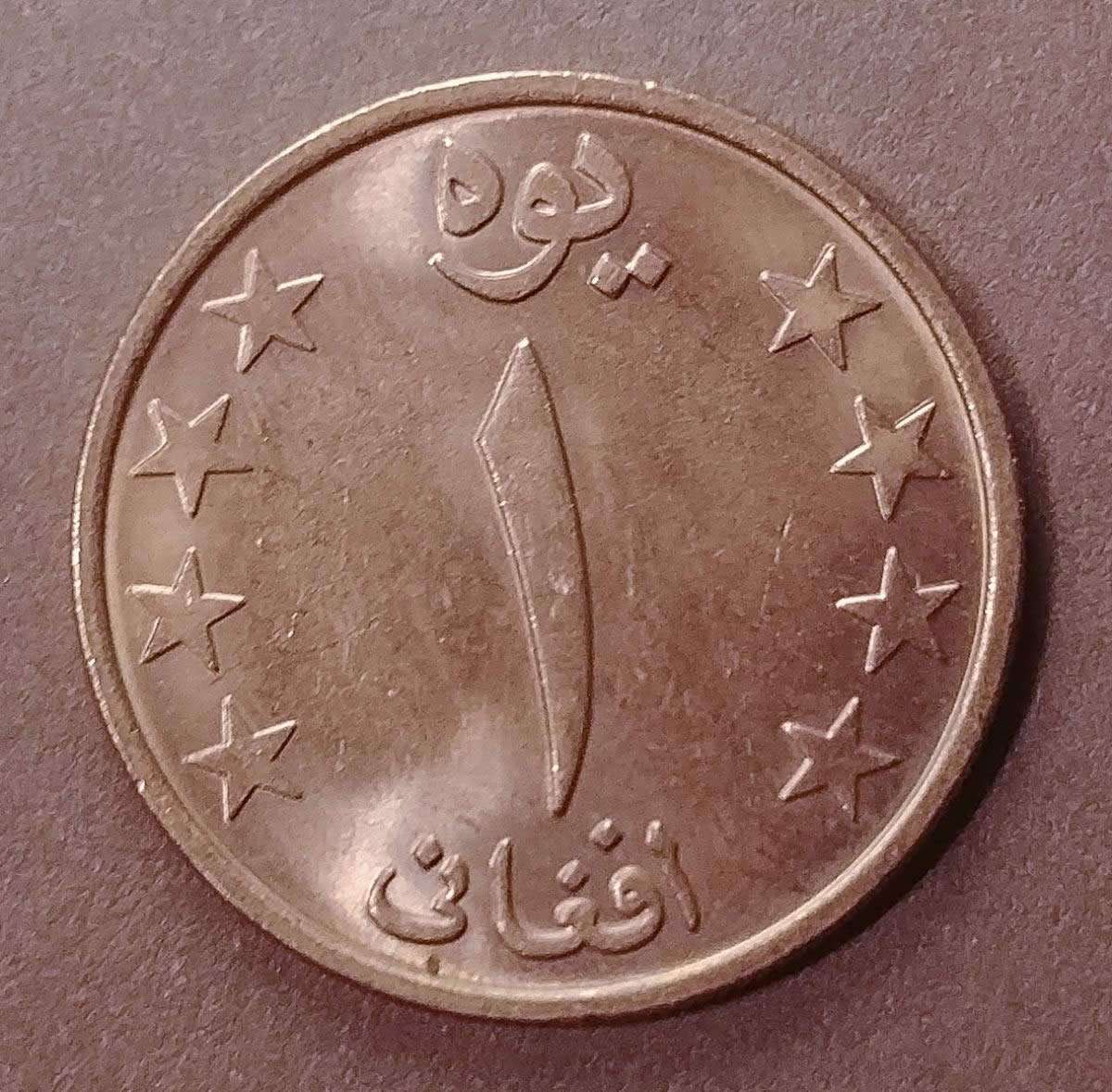 ...The War in Afghanistan began. The War in Afghanistan began on 27 April 1978, when the People's Democratic Party of Afghanistan (PDPA) took power in a military coup, known as the Saur Revolution. But!...that's not what this post is about.  In 1978, NASA hired their first female astronauts! 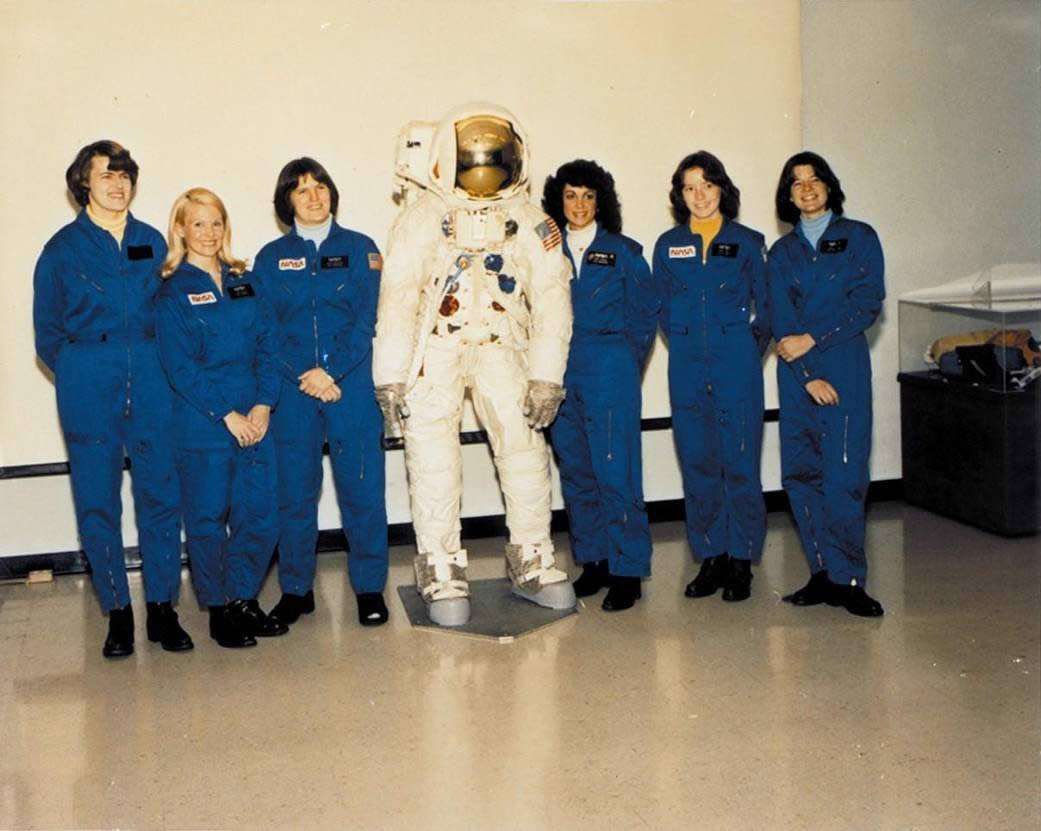 (L to r) NASA astronauts Shannon W. Lucid, Margaret Rhea Seddon, Kathryn D. Sullivan, Judith A. Resnik, Anna L. Fisher and Sally K. Ride. These six women were the first official female astronaut candidates, although 12 women underwent some astronaut training in the 1960s. (L to r) NASA astronauts Shannon W. Lucid, Margaret Rhea Seddon, Kathryn D. Sullivan, Judith A. Resnik, Anna L. Fisher and Sally K. Ride. These six women were the first official female astronaut candidates, although 12 women underwent some astronaut training in the 1960s.The picture above shows the six female astronauts in January 1978, at the start of their training period. All six women would eventually fly on at least one mission. In 1983, Sally Ride (far right) became the first American woman to fly in space:  The astronaut class of 1978 (NASA's Astronaut Group 8) was the first new group of astronauts selected since 1969. Ride would become the first American woman in space; Judith Resnik was the first Jewish-American astronaut; Kathryn Sullivan was the first American woman to perform a spacewalk; Shannon Lucid was the first American woman to visit the Mir space station; Sullivan and Ride were also the first two female astronauts to fly on a mission together. Resnik flew her first mission in 1984, and was killed in the Challenger disaster in 1986. That's a lot of firsts! The best part: In 2013, NASA announced its newest class of astronauts, consisting of eight candidates, four of whom are women. This is the largest percentage of women in an astronaut class in history. In Memory of Crazyb0 12-26-1951 to 7-27-2020
In Memory of Tootallious 3-31-1964 to 4-15-2020
In Memory of T-BOP 10-12-1949 to 1-19-2024
|
|
Moderator
 United States
196572 Posts |
Excellent post, spruett001.  |
|
Pillar of the Community
 United States
6130 Posts |
I'll cross post this one that I just wrote up for the Ancients board. Likely one of my rarest and most historically significant coins. Judaea, Herodian Tetrarchy Herod Antipas AE 23mm / 11.03g ("Full denomonation" or perhaps dupondius) TIBE/PIAC in two lines, surrounded by wreath (Tiberias mint) (Other side obliterated, would have been palm frond surrounded by HRWDOU TETRARCOU) Ref: Hendin 512 https://www.acsearch.info/search.ht...t=1&images=1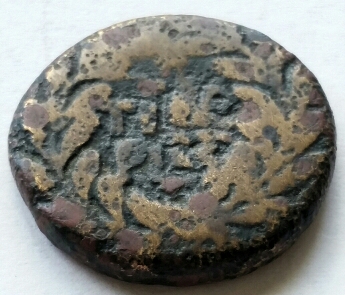 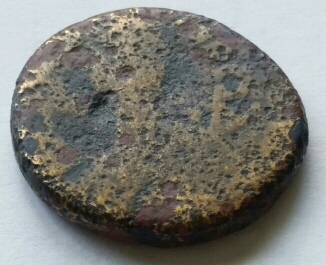 Herod Antipater (or Antipas as he was commonly known) was born in c. 20 BC, the youngest child of Herod the Great by one of his five wives. Upon the death of Herod in 4 BC, his kingdom was split in four, and Antipas was given control of Galilee and Perea as a pseudo-autonomous client king under Augustus, although he never officially held the title of "king".  (Antipas' territory in purple) During the reign of Tiberius, Antipas began construction of his new capital, named Tiberias, which still exists today: https://en.m.wikipedia.org/wiki/TiberiasAt some point early in his reign, Antipas entered into a political marriage with Phasaelis, the daughter of Nabatean king Aretas IV. While this union brought stability to the region, Antipas was not happy with his wife, and began to desire Herodias, the wife of his half brother and older Tetrarch Herod II. After having an affair while vacationing in Rome, Herodias convinced Antipas to divorce her wife and marry her. They each divorced their spouse, prompting Phasaelis to flee to her father in Nabatea, and relations between the kingdoms quickly soured. This was a major breach of Jewish mores, prompting criticism from John the Baptist, whom Antipas had arrested. Jesus scathingly denounced Antipas' actions and continued his teachings. The gospels of Mark and Matthew give roughly the same account of John's death on the orders of Antipas: Quote:
For it was Herod who had sent and seized John and bound him in prison for the sake of Herodias, his brother Philip's wife, because he had married her. For John had been saying to Herod, "It is not lawful for you to have your brother's wife." And Herodias had a grudge against him and wanted to put him to death. But she could not, for Herod feared John, knowing that he was a righteous and holy man, and he kept him safe. When he heard him, he was greatly perplexed, and yet he heard him gladly.
But an opportunity came when Herod on his birthday gave a banquet for his nobles and military commanders and the leading men of Galilee. For when Herodias's daughter came in and danced, she pleased Herod and his guests. And the king said to the girl, "Ask me for whatever you wish, and I will give it to you." And he vowed to her, "Whatever you ask me, I will give you, up to half of my kingdom." And she went out and said to her mother, "For what should I ask?" And she said, "The head of John the Baptist." And she came in immediately with haste to the king and asked, saying, "I want you to give me at once the head of John the Baptist on a platter." And the king was exceedingly sorry, but because of his oaths and his guests he did not want to break his word to her. And immediately the king sent an executioner with orders to bring John's head. He went and beheaded him in the prison and brought his head on a platter and gave it to the girl, and the girl gave it to her mother. When his disciples heard of it, they came and took his body and laid it in a tomb.  (Caravaggio, 1610) Following the death of John, Jesus continued preaching up until his arrest. Luke details that upon learning that Jesus hailed from Galilee, Pilate attempts to send him to the court of Antipas for trial: Quote:
Then Pilate announced to the chief priests and the crowd, "I find no basis for a charge against this man."
5 But they insisted, "He stirs up the people all over Judea by his teaching. He started in Galilee and has come all the way here."
6 On hearing this, Pilate asked if the man was a Galilean. 7 When he learned that Jesus was under Herod's jurisdiction, he sent him to Herod, who was also in Jerusalem at that time.
8 When Herod saw Jesus, he was greatly pleased, because for a long time he had been wanting to see him. From what he had heard about him, he hoped to see him perform a sign of some sort. 9 He plied him with many questions, but Jesus gave him no answer. 10 The chief priests and the teachers of the law were standing there, vehemently accusing him. 11 Then Herod and his soldiers ridiculed and mocked him. Dressing him in an elegant robe, they sent him back to Pilate. 12 That day Herod and Pilate became friends—before this they had been enemies. 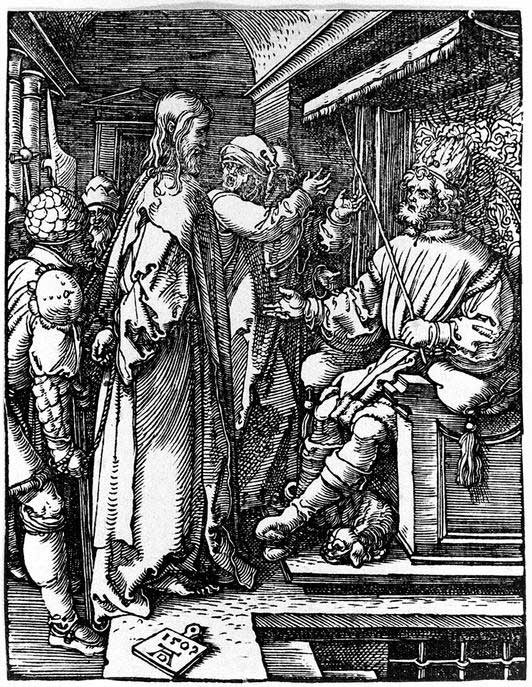 (Dürer, 1509) The Biblical narrative ends there; Roman histories mention that in about 34, tensions between Antipas and Aretas IV boiled over into war, and Antipas was nearly totally defeated. He appealed to Tiberius for help, but Tiberius had died and been replaced by Caligula, who was not as sympathetic toward the Tetrarch, who had sided against his nephew (and Caligula's close friend) Herod Agrippa. Agrippa convinced Caligula that Antipas was involved in a conspiracy against him, and Caligula stripped Antipas of all of his property, handed it over to Agrippa, and exiled him to Gaul. Antipas is never again mentioned in history after 39. |
|
Bedrock of the Community
United States
10284 Posts |
I absolutely love that post Finn. Thank you very much. This topic meets my needs for meditation for the day.
This time in history is of great importance to me personally.
|
|
Moderator
United States
196572 Posts |
This thread is casting a wide net in history. I am enjoying it. |
|
Pillar of the Community
United States
6130 Posts |
I was hoping that this would have gotten here in time for the anniversary, but oh well: Titus, as Augustus 79-81 IMP TITVS CAES VESPASIAN AVG PM - Laureate head right TR P VIIII IMP XIIII COS VII Radiate figure (Sol?) standing on rostral column, holding spear. Rome mint, July-September(?) 79 RIC 10 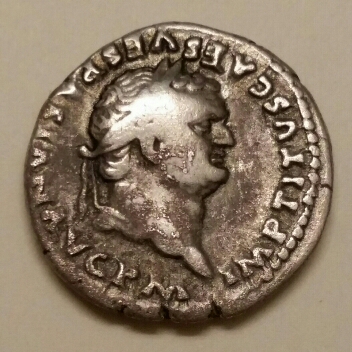 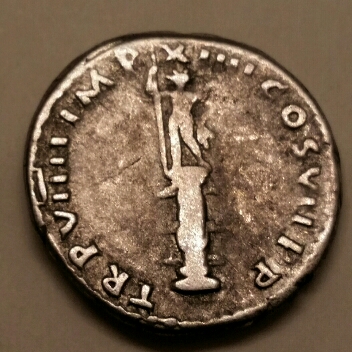 On August 24, 79 AD...  Mount Vesuvius began its eruption at about 1 PM on August 24 over the sleepy resort villas at Pompeii and Herculaneum. The eruption took about 20 hours in total, finally ceasing on August 26, 79 with the entire countryside under several feet of ash and pumice. Due to the relatively slow nature of the eruption, many inhabitants were able to evacuate, although casualties still numbered in the thousands. Titus was heavily involved in rescue operations, although few survivors were to be found due to at least two pyroclatic flows which had levelled buildings and heated many areas to several hundred degrees. The only surviving first hand account was that of the historian and naturalist Pliny the Younger, who was 17 at the time and studying under the tutelage of his uncle Pliny the Elder. Pliny the Elder was in command of a small fleet of the Roman navy at the time, and set out at once to give aid and evacuate those in the path of the volcano. However, due to a strong wind, his ships became stranded. After spending much of the night trying to rally survivors, Pliny collapsed and died, possibly the effect of noxious gas either triggering an asthma episode or heart attack. His companions were able to march to safety, and were able to return to recover his body. Across the bay in Misenium, Pliny the Younger was soon in the path of falling ash, and gives a haunting account while attempting to flee with his mother: Quote:
We had scarcely sat down to rest when darkness fell, not the dark of a moonless or cloudy night, but as if the lamp had been put out in a closed room. You could hear the shrieks of women, the wailing of infants, and the shouting of men; some were calling their parents, others their children or their wives, trying to recognize them by their voices. People bewailed their own fate or that of their relatives, and there were some who prayed for death in their terror of dying. Many besought the aid of the gods, but still more imagined there were no gods left, and that the universe was plunged into eternal darkness for evermore.   Of the cities destroyed, Pompeii was unique in that it received several feet of ash before the pyroclastic flows arrived, killing all survivors in a split second in temperatures exceeding 500 degrees F. The victims then fell into the thick ash and were completely buried. As they decomposed, they left an imprint in the ash, showing their exact posture right down to facial expression when they died. During excavations, these voids were filled with plaster, or more recently resin, allowing archaeologists to preserve their final moment. Herculaneum was hit more directly and sooner, leaving only skeletons:  In addition to the victims, the eruption preserved the single best snapshot of 1st century Roman life, as well as some of the only Roman paintings and fully furnished building interiors: 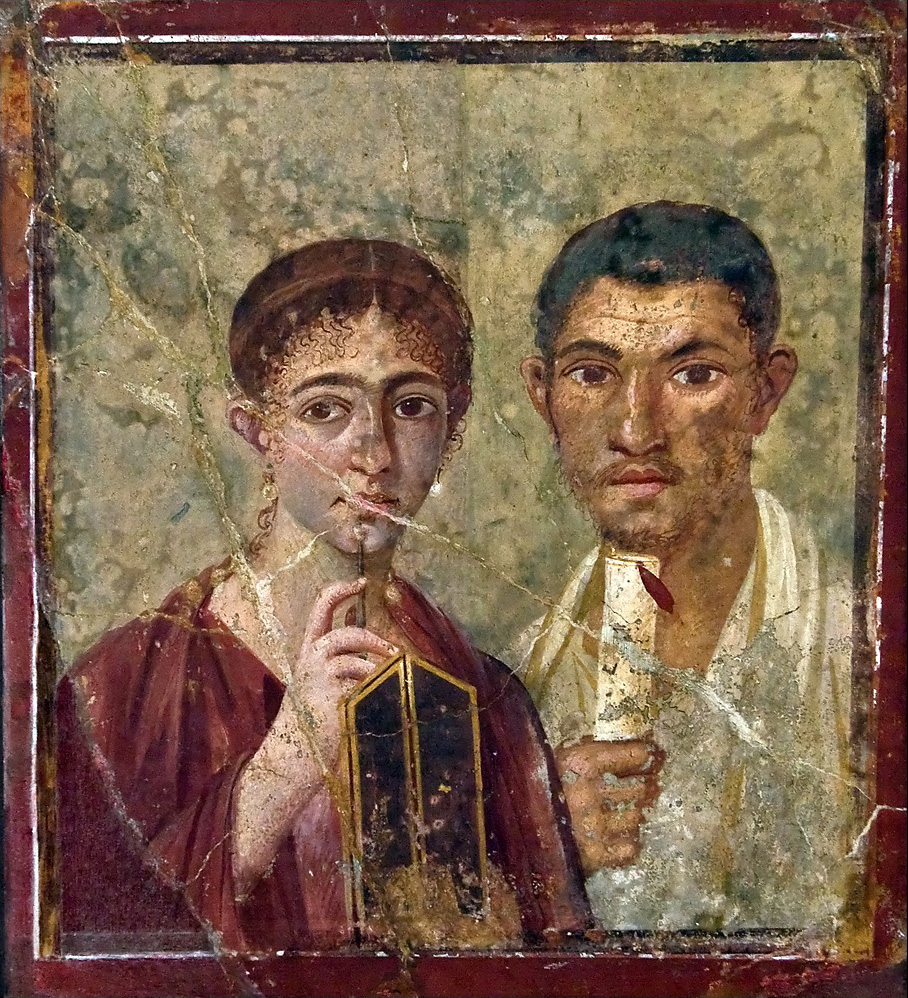  In the aftermath, Titus personally travelled to the countryside to organize and oversee the relief efforts. Many of the dead owned valuable estates but had no heirs, and Titus ordered those estates sold and the proceeds used to assist the survivors with relocating. There were however persistent rumors that Titus was being punished by the Jewish god for his actions in sacking and destroying the Second Temple. The Colosseum would not be opened for several months after this coin was made. Some interesting notes on how this coin is dated. The reverse of this coin lists out all of the titles that Titus had earned; in the early Empire (and really until the rise of Diocletian) the Emperor was called Princeps, or "First Citizen". Augustus established the office of Emperor as a single person holding the traditionally most powerful positions in the Republic, and legally Rome never stopped being a republic. The titles on this coin are TR P VIIII - 9th award of the Tribunicia Potestas, Tribunician Power. The holder of this title could introduce or approve legislation affecting the Plebians, or free non-aristocrats. Generally granted once per year by the Senate. IMP XIIII - 14th Imperial Acclamatio, a title bestowed by the Army upon their leader, usually after a triumph. Only the imperial family could hold this title; for a military leader to accept it would be to become a usurper. COS VII - 7th Consulship - An office shared annually by two people at the head of the Senate. The timeline of these titles is variously known either explicitly (records exist detailing the how and why of the title was conferred) or implicitly, as in this case, we know Titus signed a letter using IMP XV that was dated to September of his first year, so this coin must precede that. Fascinatingly, hard evidence found at Pompeii highlights an important error made by whomever transcribed Pliny's letter between 79 and the middle ages. One of the victims was carrying a purse stuffed with denarii, among which was a single denarius of Titus citing IMP XV. Coupled with evidence that the fall harvest had already taken place, the scholarly consensus is that Vesuvius erupted on either October 24 or November 23, 79. Some more reading here: https://www.google.com/amp/s/gareth...ulaneum/amp/ |
|
Pillar of the Community
United States
2645 Posts |
An excellent addition! Thank you!
|
|
Bedrock of the Community
United States
12477 Posts |
When this coin was made: 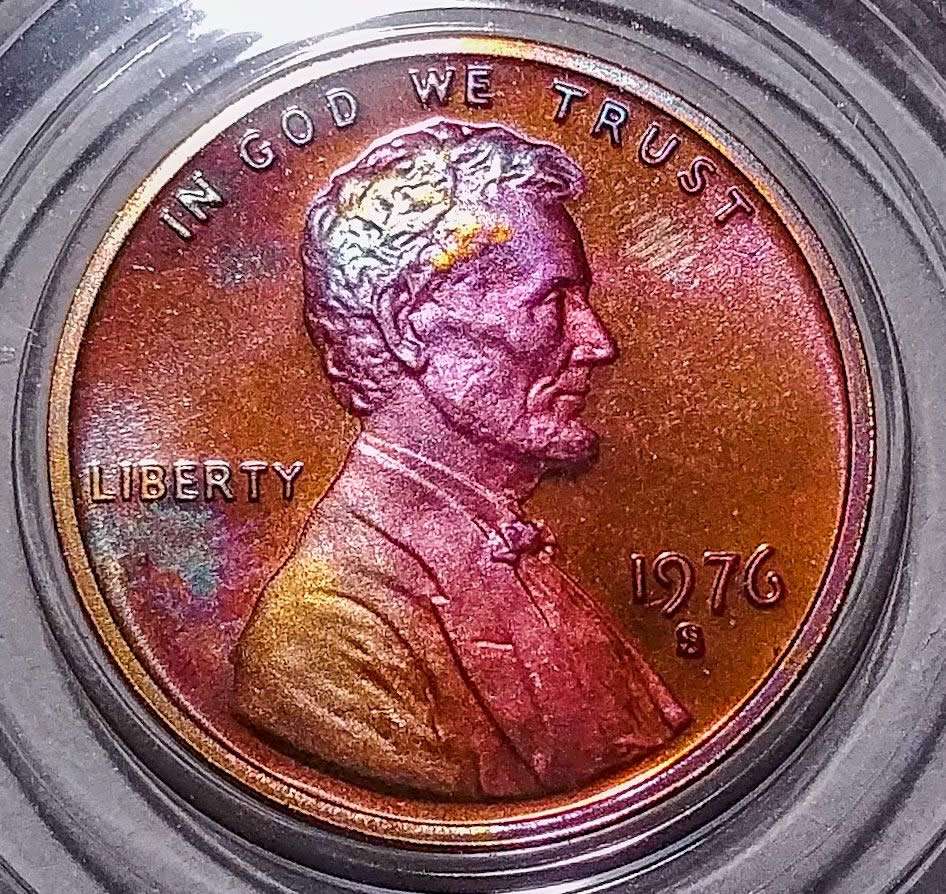 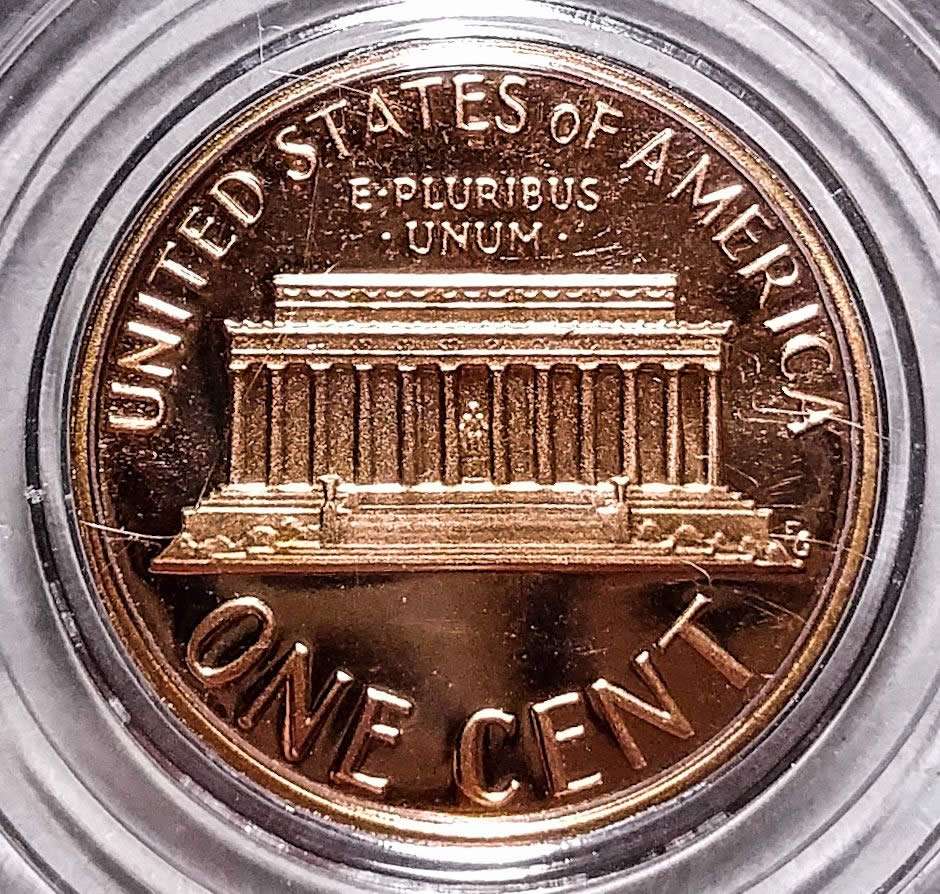 This... 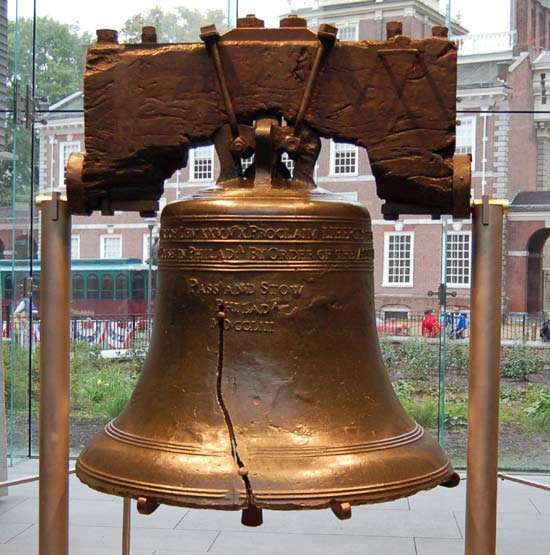 ...was permanently moved from its home atop Independence Hall (formerly the Pennsylvania State House) for the first time in over 200 years. It was allowed to leave periodically for exhibition before but, always returned to its home. It has since been moved again to the Liberty Bell Center in 2003. The parts of the Liberty Bell story I find most interesting:Isaac Norris, speaker of the Pennsylvania Provincial Assembly, gave orders to the colony's London agent, Robert Charles, to obtain a "good Bell of about two thousands pound weight". Charles dutifully ordered the bell from Thomas Lester of the London bellfounding firm of Lester and Pack (known subsequently as the Whitechapel Bell Foundry) for the sum of £150 13s 8d, ( equivalent to £21,351.87 today) including freight to Philadelphia and insurance. It arrived in Philadelphia in August 1752. Norris wrote to Charles that the bell was in good order, but they had not yet sounded it, as they were building a clock for the State House's tower. The bell was mounted on a stand to test the sound, and at the first strike of the clapper, the bell's rim cracked. The episode would be used to good account in later stories of the bell; in 1893, former President Benjamin Harrison, speaking as the bell passed through Indianapolis, stated, "This old bell was made in England, but it had to be re-cast in America before it was attuned to proclaim the right of self-government and the equal rights of men." Philadelphia authorities tried to return it by ship, but the master of the vessel which had brought it was unable to take it on board. So, it was recast...twice:Two local founders, John Pass and John Stow, offered to recast the bell. Though they were inexperienced in bell casting, Pass had headed the Mount Holly Iron Foundry in neighboring New Jersey and came from Malta, which had a tradition of bell casting. Stow, on the other hand, was only four years out of his apprenticeship as a brass founder. At Stow's foundry on Second Street, the bell was broken into small pieces, melted down, and cast into a new bell. The two founders decided that the metal was too brittle, and augmented the bell metal by about ten percent, using copper. The bell was ready in March 1753, and Norris reported that the lettering (which included the founders' names and the year) was even clearer on the new bell than on the old. City officials scheduled a public celebration with free food and drink for the testing of the recast bell. When the bell was struck, it did not break, but the sound produced was described by one hearer as like two coal scuttles being banged together. Mocked by the crowd, Pass and Stow hastily took the bell away and again recast it. When the fruit of the two founders' renewed efforts was brought forth in June 1753, the sound was deemed satisfactory, though Norris indicated that he did not personally like it. The bell was hung in the steeple of the State House the same month. The Case of the Improper Alloy Mix:The reason for the difficulties with the bell is not certain. The Whitechapel Foundry, still in business today, takes the position that the bell was either damaged in transit or was broken by an inexperienced bell ringer, who incautiously sent the clapper flying against the rim, rather than the body of the bell. In 1975, the Winterthur Museum conducted an analysis of the metal in the bell, and concluded that "a series of errors made in the construction, reconstruction, and second reconstruction of the Bell resulted in a brittle bell that barely missed being broken up for scrap". The Museum found a considerably higher level of tin in the Liberty Bell than in other Whitechapel bells of that era, and suggested that Whitechapel made an error in the alloy, perhaps by using scraps with a high level of tin to begin the melt instead of the usual pure copper. The analysis found that, on the second recasting, instead of adding pure tin to the bell metal, Pass and Stow added cheap pewter with a high lead content, and incompletely mixed the new metal into the mold. The result was "an extremely brittle alloy which not only caused the Bell to fail in service but made it easy for early souvenir collectors to knock off substantial trophies from the rim". FBL Sights Set Too High?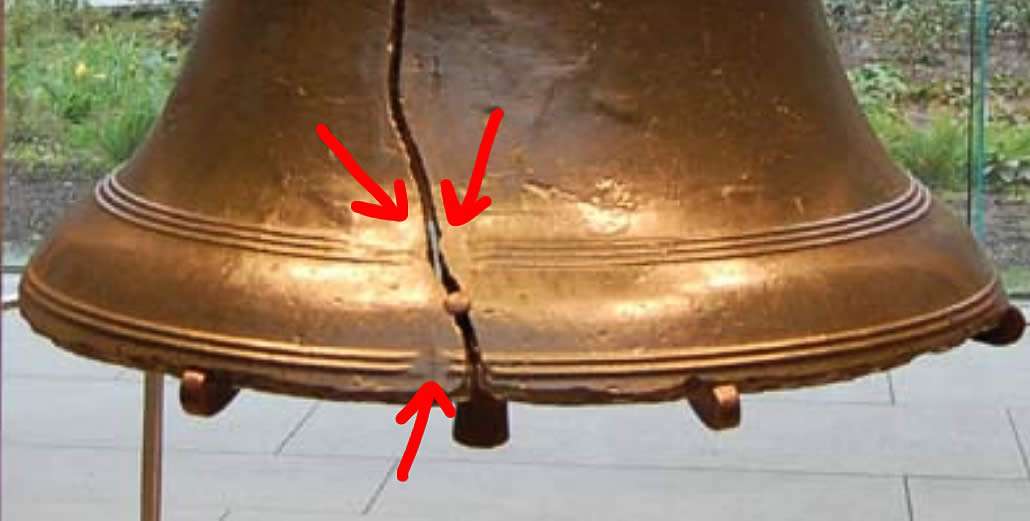 In Memory of Crazyb0 12-26-1951 to 7-27-2020
In Memory of Tootallious 3-31-1964 to 4-15-2020
In Memory of T-BOP 10-12-1949 to 1-19-2024
|
|
Bedrock of the Community
United States
10284 Posts |
Awesome account of the Mount Vesuvius Volcano. Titus was one of the good guys.
Thanks Spruuuu I had almost forgot about this thread. Nice post. Never did worry too much about FBL's.
|
|
Bedrock of the Community
United States
12477 Posts |
Quote:
Never did worry too much about FBL's. As well you shouldn't. The real deal doesn't qualify. In Memory of Crazyb0 12-26-1951 to 7-27-2020
In Memory of Tootallious 3-31-1964 to 4-15-2020
In Memory of T-BOP 10-12-1949 to 1-19-2024
|
|
Moderator
United States
196572 Posts |
An excellent write-up! |
|
Pillar of the Community
United States
6130 Posts |
Thanks for giving this thread a little pick-me-up! I had started a post a while ago, but lost my train of thought and didn't pick it up again. Been meaning to post this one though: Macedon, Alexander III "The Great" 336-323 BC AE Chalkous (1/48 drachm) Youthful head of Apollo right Free horse galloping right, ALEXANDROU above, monogram below 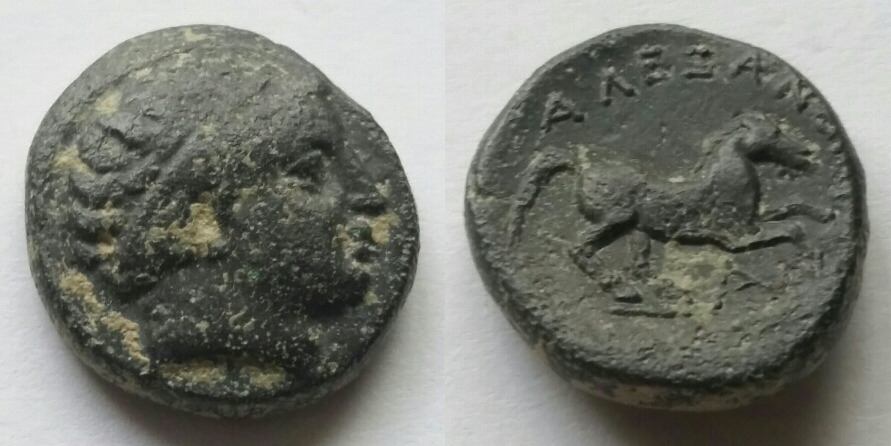 While Alexander's silver coins (mostly drachms and tetradrachms) are among the most studied coins in existence, his bronzes are less well understood, as they were made locally for mundane purchases, not soldiers' payroll. They are also host to a much more diverse series of imagery. Although not firmly attested, the "free horse" is likely a homage to the story of how Alexander tamed his famous war steed, Bucephalus: Quote:
[6.1] Philonicus the Thessalian brought the horse Bucephalus to Philip, offering to sell him for thirteen talents. But when they went into the field to try him, they found him so very vicious and unmanageable, that he reared up when they endeavored to mount him, and would not so much as endure the voice of any of Philip's attendants.
[6.2] Upon which, as they were leading him away as wholly useless and untractable, Alexander, who stood by, said, "What an excellent horse do they lose for want of address and boldness to manage him!"
[6.3] Philip at first took no notice of what he said; but when he heard him repeat the same thing several times, and saw he was much vexed to see the horse sent away, "Do you reproach," said he to him, "those who are older than yourself, as if you knew more, and were better able to manage him than they?"
[6.4] "I could manage this horse," replied he, "better than others do."
"And if you do not," said Philip, "what will you forfeit for your rashness?"
"I will pay," answered Alexander, "the whole price of the horse."
[6.5] At this the whole company fell a-laughing; and as soon as the wager was settled amongst them, he immediately ran to the horse, and taking hold of the bridle, turned him directly towards the sun, having, it seems, observed that he was disturbed at and afraid of the motion of his own shadow;
[6.6] then letting him go forward a little, still keeping the reins in his hands, and stroking him gently when he found him begin to grow eager and fiery, he let fall his upper garment softly, and with one nimble leap securely mounted him,
[6.7] and when he was seated, by little and little drew in the bridle, and curbed him without either striking or spurring him.
[6.8] Presently, when he found him free from all rebelliousness, and only impatient for the course, he let him go at full speed, inciting him now with a commanding voice, and urging him also with his heel. Philip and his friends looked on at first in silence and anxiety for the result, till seeing him turn at the end of his career, and come back rejoicing and triumphing for what he had performed, they all burst out into acclamations of applause; and his father shedding tears, it is said, for joy, kissed him as he came down from his horse, and in his transport said, "O my son, look thee out a kingdom equal to and worthy of thyself, for Macedonia is too little for thee."  (Schommer, late 1800s) That narrative by Plutarch is probably mostly fictional, but the horse himself is very well attested, and was Alexander's favorite charger for his campaigns. The name Bucephalus literally means "Bull-head" and is said to refer to a branding mark carried by the horse, although some accounts remark on his enormous head, which leads me to believe that he is the subject of this coin, rather than a generic horse. Bucephalus died in battle against the armies of the Indian king Porus in May 326 BC, in what today is Pakistan. Alexander founded the city of Bucephala at the site, and pressed on with his campaign before being forced to turn back by his troops. Alexander regrouped in Babylon and was planning to resume his campaign when he died suddenly of illness in 323 BC. As for the coin itself, most bronzes are believed to be lifetime issues, contrasting with the silver issues (especially tetradrachms) that continued in the same style for more than 150 years. Until Alexander's death, it was considered taboo for a monarch to place his image on a coin. The image of Apollo here further attests a lifetime issue.as for the timing of its minting, not much can be said with certainty. It could have been made while Bucephalus was alive, or it could have been a commemorative after his death. If this is indeed a depiction of Bucephalus, that makes it the oldest surviving depiction of that horse, who would feature a prominent role in Seleucid numismatics as well as classical art. |
|
Moderator
United States
196572 Posts |
Well done. |
|
Bedrock of the Community
United Kingdom
18969 Posts |
Great Britain 1834 shilling of King William IV: 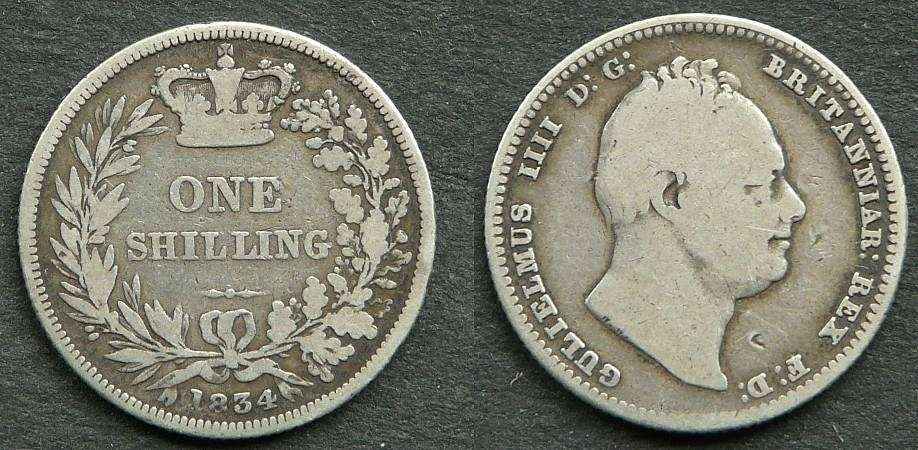 Around the time this coin was minted, in The Royal Mint at Tower Hill in the East End of London, a fire broke out in the West of London that was going to have huge consequences for the UK and would ultimately result in London obtaining its most recognizable landmark. In 1834 the British Houses of Parliament were a rambling series of buildings that had originally been the Royal Palace of Westminster. The House of Commons met in a former chapel, and the Lords in a building called the White Chamber. On October 16, 1834, some old accounts records (which were traditionally kept by cutting notches on wooden sticks) were being burned, and a chimney caught fire. Within a short time the fire spread to the Houses of Lords and Commons, and by the next morning, the old Palace of Westminster was a smoking ruin: 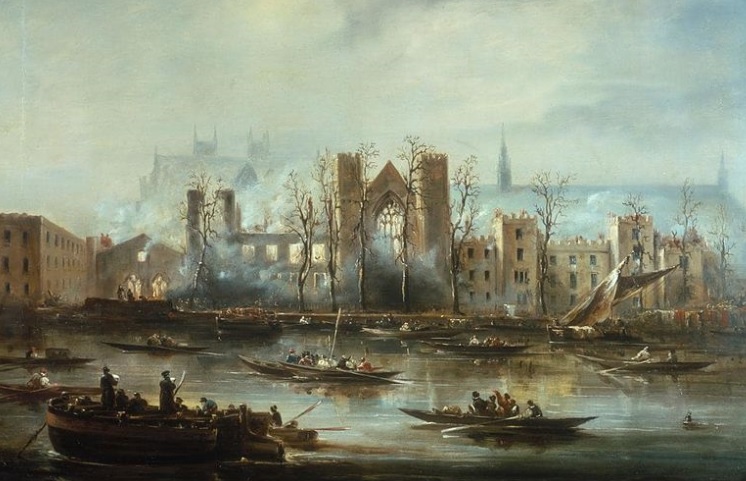 The decision was taken to replace the ruined palace by a purpose-built Parliamentary building, in the Gothic Revival style. Two architects were appointed: the Protestant Charles Barry worked largely on the exterior, while the Catholic Augustus Welby Pugin, a great enthusiast for Gothic architecture, was employed on the interior. Construction of the new Houses of Parliament started in 1837, and the building was finished in 1859 when the Clock Tower was completed. 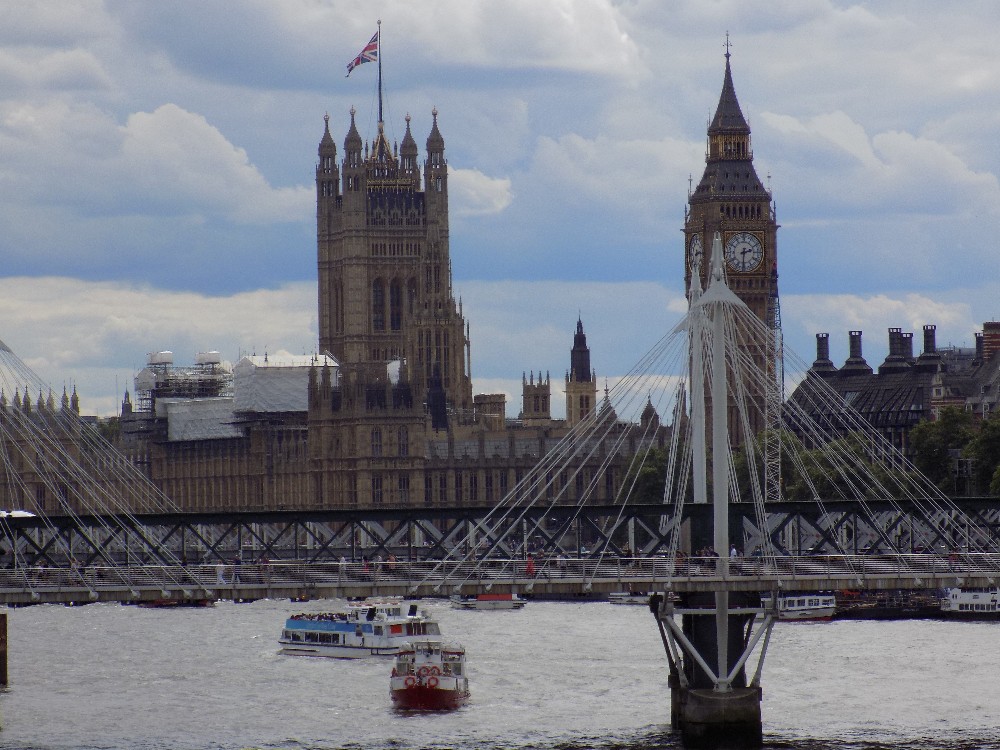 Many visitors to London assume that the Clock Tower, or the clock itself, is called Big Ben, but strictly speaking this name belongs to the great bell inside the tower that chimes the hours. The tower is 320 feet high and the four clock faces are 22 feet 6 inches in diameter. The hour hands are 9 feet and the minute hands 14 feet long. The bell itself weighs almost 14 tons. After operating continuously since May 31, 1859, the clock was stopped at 12 noon on August 21 this year for renovation and essential maintenance. CCF members may be interested to know that old pennies (weighing one-third of an ounce) are used as weights to adjust the clock's mechanism if it is running slightly too fast or too slow. I don't know if there are any rare dates among them! If an accidental fire had not broken out in 1834, Breat Britain may never have acquired one of its greatest cultural icons! |
| |
Replies: 147 / Views: 24,716 |
To participate in the forum you must log in or register.
Disclaimer: While a tremendous amount of effort goes into ensuring the accuracy of the information contained in this site, Coin Community assumes no liability for errors. Copyright 2005 - 2026 Coin Community Family- all rights reserved worldwide. Use of any images or content on this website without prior written permission of Coin Community or the original lender is strictly prohibited.
Contact Us | Advertise Here | Privacy Policy / Terms of Use
|
| Coin Community Forum |
© 2005 - 2026 Coin Community Forums |
| It took 0.73 seconds to rattle this change. |
 |
|








 First Page
 Previous Page


 Posted 09/06/2017 12:41 am


