So I sold most of mine and traded up for gold

Valentinian III, 425-455 AD
AV Tremissis
DN VALENTINIANVS PF AVG, Diademed bust right
VICTORIA AVGVSTORVM / CONOB, Victory facing, head left, holding wreath and globus cruciger, star to right
RIC 274?
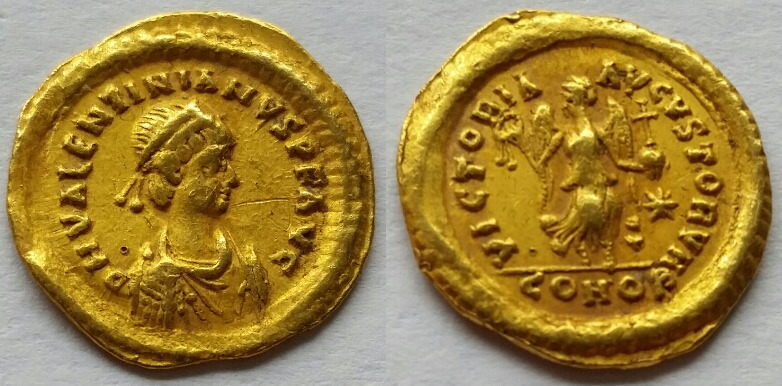
Valentinian III was Rome's final chance for redemption, and he blew it. Ascending to the throne from a young age under the regency of his mother, he was a spineless emperor--outwardly pious, but obsessed with magic and divination. He allowed his Germanic generals to exert greater and greater power while he indulged in worldly pleasures. Through his inaction, he lost Spain to the Vandals, setting the stage for their takeover of Africa which cut off the Roman grain supply. Only his bodyguard and second in command, Aetius, seemed to try to push the young emperor into action, and was murdered in cold blood by Valentinian for it. Valentinian was assasinated by the next plot against his life, only six months later.
I bought this one because I was unhappy with all the Valentinian III bronzes I had ever owned, and a gold tremissis was not much more expensive than a halfway acceptable bronze. It wasn't until I was researching this coin to post that I realized it is in fact a great rarity, probably a mule with a Theodosius II reverse. ACSearch only lists 14, several of which are the same coin at multiple auctions.
Zeno, 474-491
AV Tremissis
DN ZENO PERP AVG, Diademed bust right
VICTORIA AVGVSTORVM / CONOB, Victory facing, head left, holding wreath and globus cruciger, star to right
RIC 914
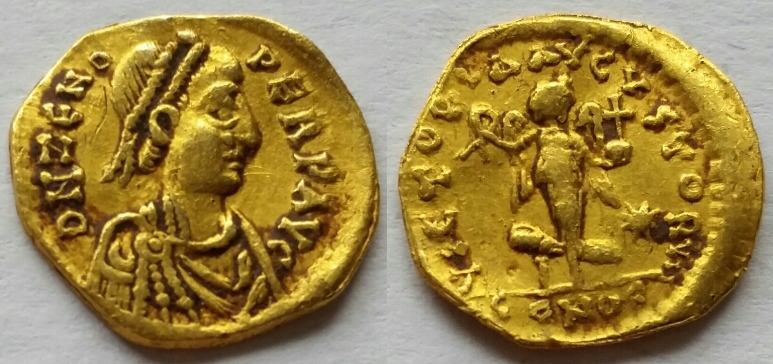
I actually have my doubts this is an official coin given the bust; it might be a Germanic issue, although I am not sure how to tell?
Zeno is perhaps most famous for being the Eastern emperor when the West fell to the barbarians. Born in about 425 in Isauria, Zeno embarked on a military career and was quickly distinguished as a capable leader. He was widowed from his first wife in the early 460s, and married Ariadne, daughter of emperor Leo. Although looked down upon by the aristocracy as a barbarian, he enjoyed success in his career. Ariadne gave birth to a son, Leo II in 467, and Zeno enjoyed continued success in his military endeavors.
Leo II was nominated as Caesar in late 473, and Leo I died early the next year. Since Leo II was only seven years old, he elevated his father to co-emperor, but died of illness later the same year.
Zeno was disliked by his mother in law Verina, who sought to supplant Zeno with her new lover. With the aid of her brother Basiliscus, Zeno was driven into exile, but manage to escape with the entire imperial treasury and a small force of Isaurian bodyguards. Basiliscus claimed the purple for himself, but desperate for funds, he resorted to excessive taxation and support for him evaporated. Unable to drive Zeno from his stronghold, Basiliscus was on shaky ground. Zeno managed to muster enough troops to lay siege on Constantinople, and was welcomed back by the population that had just driven him out. Basiliscus surrendered on the condition that Zeno would not spill their blood; Zeno agreed and had them chained in a cistern to die of exposure.
In late 476 Zeno received a messenger from Italy who bore the imperial regalia of the Western Roman empire, informing him that the loyal Julius Nepos had been usurped by the teenaged Romulus, who lost the ancient city to the Germanic king Odoacer. This event is generally taken as the end of Classical Antiquity.
Zeno dealt with a large number of revolts and usurpers for the remainder of his reign, but managed to hold his empire together until his death in 491. Having no heir, Zeno's widow appointed the court official Anastasius to the throne.
Anastasius, 491-518
AV Tremissis
DN ANASTASIUS PP AVG, Diademed bust right
VICTORIA AVGVSTORVM / CONOB, Victory standing, head left, holding wreath and globus cruciger, star to right
SB 8
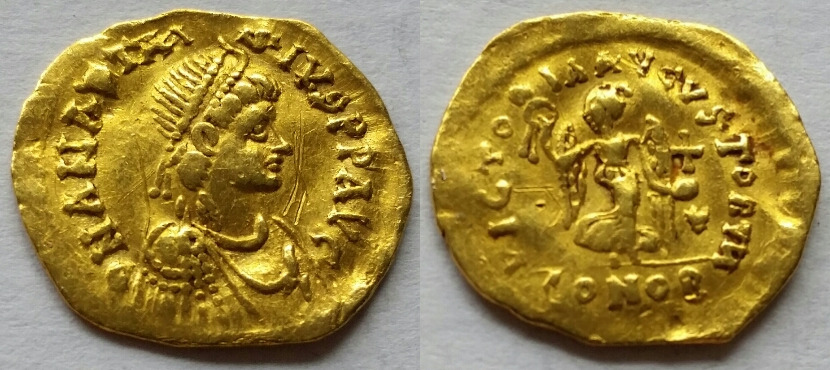
From a numismatic standpoint, the reign of Anastasius is usually seen as the official beginning of Byzantine coinage. Upon the death of Zeno in 491, the populace demanded an Orthodox Christian emperor. Rather than elevating Zeno's brother, his widow elevated elderly politician Anastasius. After dealing with a number of rebellions orchestrated by Zeno's brother and supporters, Anastasius notably stabilized the Eastern empire, reformed the currency to introduce the large copper Follis and its fractions, and adjusted taxes to alleviate the stress placed on the poor while building a treasury. Anastasius also died without an heir, and appointed Justin I, uncle of Justinian.






 Posted 07/26/2018 1:02 pm





