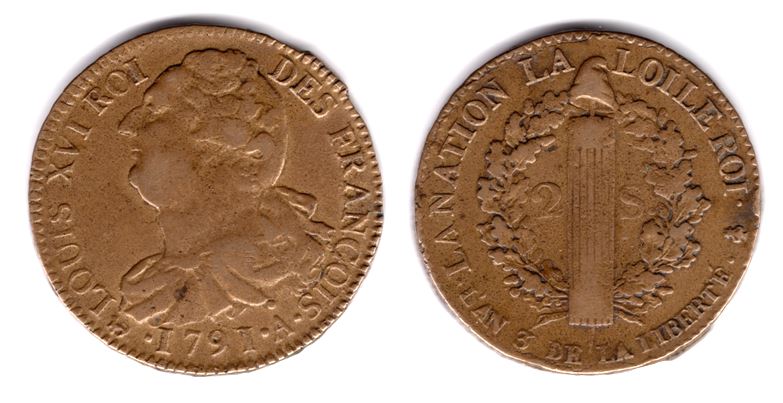
One can follow the developments during the French revolutionary years by studying the large silver coins minted and how their motives and inscriptions change. Four different types of coins in this category were minted.
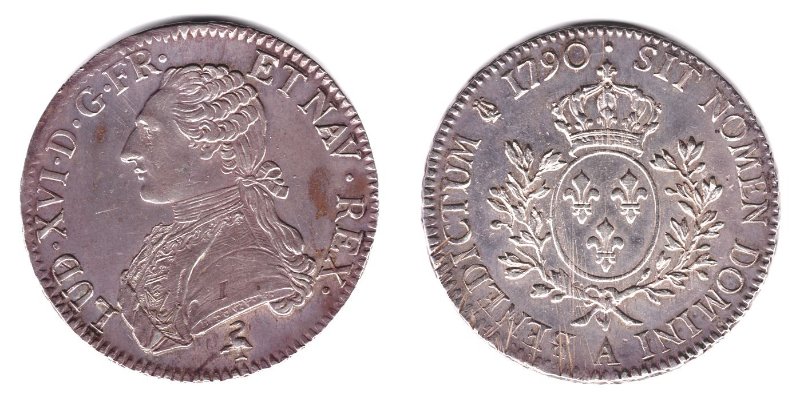
1 ecu 1790, Paris (A), 917/1000 silver, 29.3 g
Obverse: Portrait of the king, made 16 years earlier. Inscription: LUDovicus XVI Dei Gratia FRanciae ET NAVarrae REX (Louis XVI, by Grace of God King of France and Navarre).
Reverse: French royal arms surrounded by olive branches. Inscription: SIT NOMEN DOMINI BENEDICTUM (Blessed be the Name of the Lord).
Edge inscription: DOMINE SALVUM FAC REGEM (Lord save the King).
Constitutional monarchy (1789-92). King Louis XVI remains on the throne, but no longer with the absolute power he had under the old regime. The coins from the old regime are still minted though, with the old portrait and same text stating the king to have his position by the grace of God.
***************************************************************************
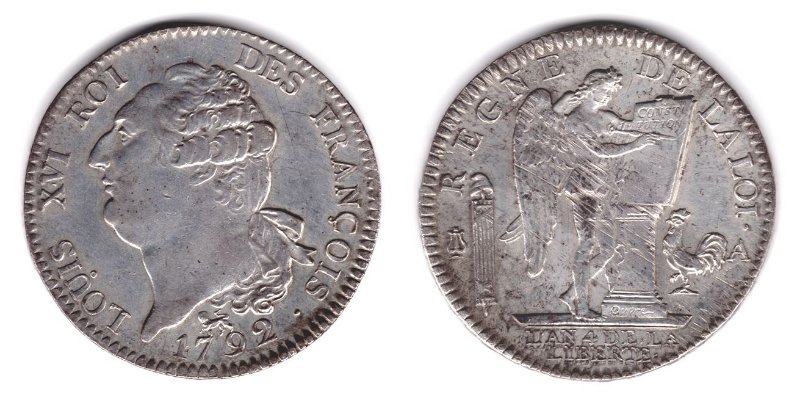
1 ecu 1792, Paris (A), 917/1000 silver, 29.2 g
Obverse: Portrait of the king, as he looks at the time. Inscription: LOUIS XVI ROI DES FRANÇOIS (Louis XVI, King of the French)
Reverse: The genius/spirit of France writing CONSTITUTION on a tablet, surrounded by the fasces with a phrygian cap and the French rooster. Inscription: REGNE DE LA LOI (Rule of the Law) / L'AN 4 DE LA LIBERTe (Year 4 of Freedom).
Edge inscription: LA NATION LA LOI ET LE ROI (The Nation the Law and the King)
Still in the constitutional monarchy, and now the coins start to reflect the new regime. The king's portrait is still there (updated to current looks), but he is now king of the French, which should be read as that he sits on the mandate of the people, not of God. The reverse spells it out even more, pointing out that it is now the law that rules (not the king), and there is a constitution, and there has been 4 years of freedom. The monetary livre-sol-denier system remains, with the ecus valued at 6 livres.
***************************************************************************
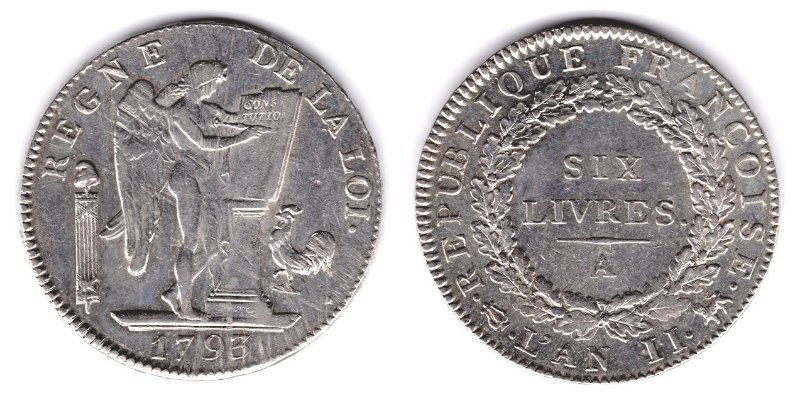
6 livres an 2/1793, Paris (A), 917/1000 silver, 29.3 g
Obverse: The genius/spirit of France writing CONSTITUTION on a tablet, surrounded by the fasces with a phrygian cap and the French rooster. Inscription: REGNE DE LA LOI (Rule of the Law).
Reverse: SIX LIVRES, surrounded by oak branches. Inscription: REPUBLIQUE FRANÇOISE / L'AN II.
Edge inscription: LIBERTE EGALITE (Freedom Equality).
The republic is proclaimed in September 1792, the king is executed in January 1793. The first phase of the republic, the
Convention, lasts 1792-95. The start of the convention, Sept 22nd 1792, is also the start of the revolutionary calendar and the year (an) according to that will be used until year 14 (1805-06), when Napoleon reverts to the old calendar. During part of year 2, the year 1793 is also shown on coins. The old monetary system remains, but the coins now carry their denomination - 6 livres in this case. The phrase
Liberte egalite also starts to appear on coins, here on the edge.
***************************************************************************
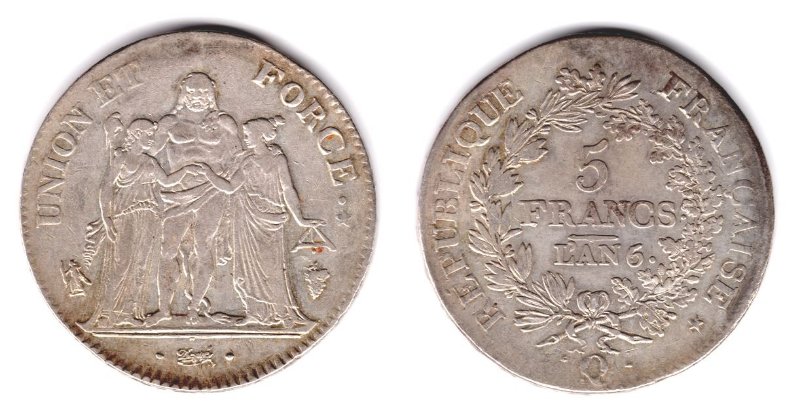
5 francs an 6 (1797-98), Perpignan (Q), 900/1000 silver, 24.8 g
Obverse: Hercules, with Republic and Justice standing beside. Inscription: UNION ET FORCE (Unity and Strength).
Reverse: 5 FRANCS / L'AN 6, surrounded by oak and laurel branches. Inscription: RePUBLIQUE FRANÇAISE.
Edge inscription: GARANTIE NATIONALE (National Guarantee).
The second phase of the republic is the
Directorate, replacing the bloody regime under Robespierre and lasting 1795-99. The new monetary system with francs replacing livres is introduced 1795. 1 franc = 1 livre 1 sol 3 deniers, so 5 francs is a little less than 6 livres and the 5 francs coin is consequently smaller than the 6 livres coin. It is the only silver coin and the only coin larger than 20 centimes until 1803. The edge inscription refers to that the value of the coin is backed by the state.
Garantie nationale is a recurring statement during the French revolutionary years when it comes to expressing government supported monetary values (alas, generally unsuccessful).
The motives with the genius of France and Hercules are the results of competitions. The genius motive is used on coins of various denominations until 1914, the Hercules motive shows up now and then until 1980 (and even later on euro commemorative coins)!











 Posted 07/14/2019 3:02 pm