| Author |
 Replies: 638 / Views: 59,844 Replies: 638 / Views: 59,844 |
|
|
|
Pillar of the Community
 United Kingdom
1168 Posts |
Quote:
Looking forward to seeing more. There are indeed more to come Paul. I had no idea that there were so many animals, birds, and Mythical Creatures on these ancient coins. Every day I see something new, though most of them are beyond my budget. Quote:
Although not so little at this point. Since joining this community my direction has changed completely Bob, as I saw what a wide variety of beautiful ancient coins was out there. I did feel drawn to the ancient Greek and Seleucid coins, with their often simplistic charm. Many of my purchases don't have an animal connection either, so the collection is becoming rather large! For instance, I recently secured an Antiochos VII coin with a lily on one side and an anchor on the other. Jim |
|
Pillar of the Community
United Kingdom
1168 Posts |
There isn't a great deal of detail left on this little coin, but I found it interesting nonetheless. Situated on the Hellespont, south of Abydos, Dardanos was an Aiolian colony. The modern name of the Hellespont (Dardanelles) is derived from this city. Dardanos used the cockerel as its symbol on its early coinage, perhaps because of that animal's relation to the sunrise or because of a lost myth connecting it with the Dardanians, an ancient people who supposedly lived in this area and were closely connected to the Trojans (Tros was the grandson of their eponymous founder, Dardanos). 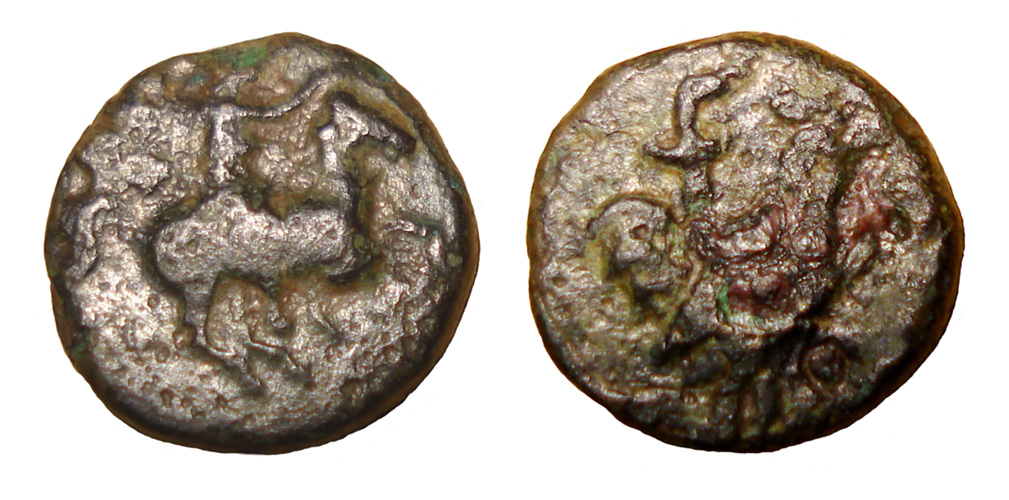 Troas, Dardanos, ca. 350 BC. Obverse: Male rider, cloak floating behind, on horse prancing right. Reverse: Cockerel standing right, race torch above. Bronze. Diameter: 10 mm. Weight 1.25 gr. Lindgren I 356v; Sear 4081v. The original note states: "Collected at Maltepe, North Shore of Turkey." |
|
Pillar of the Community
United Kingdom
1168 Posts |
This coin from Mysia has a rather nicely crafted bull on the reverse, and a gorgon's head on the obverse. The gorgon's head is surrounded by snakes, so another two in one I guess. In ancient times the gorgon's hair was never depicted as being made of living snakes. If any snakes were shown they were around the gorgon's head, or in later times, sometimes in the hair. 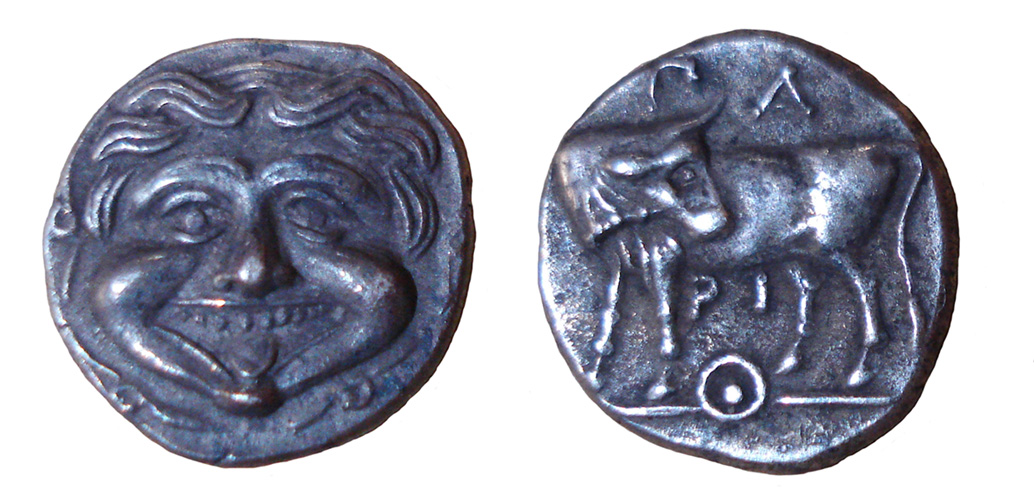 Parion, Mysia, AR hemidrachm. Circa 4th Century BC. Obverse: Head of Gorgoneion facing. Reverse: Bull standing left, head turned back, patera below. ("Θ" for patera). ΠΑ-ΡΙ above and below bull. Diameter: 13 mm. Weight: 2.4 gr. BMC 31. |
|
Pillar of the Community
United States
7067 Posts |
Outstanding coin, Jim. That Mysia bull may be your best animal to date, IMO.
|
|
Pillar of the Community
United Kingdom
1168 Posts |
I swither between the Troas horse and this one Bob.
The coin was missing for a long time, till I found it a few days ago in with the ancient Chinese coins. I have to be more careful.
Jim
|
|
Pillar of the Community
 Spain
2752 Posts |
Very nice coin Jim!...... Apart from the good detail, what I really like about it is how well centred both sides are and lovely toning....Cool coin! Quote:
I found it a few days ago in with the ancient Chinese coins I'm gonna go and check out my Chinese coins... darn I haven't got any.... |
|
Pillar of the Community
United Kingdom
1168 Posts |
The Chinese coins are ones I've had for a very long time Paul.
I was in an antiques and curio shop in Edinburgh as a young boy, armed with a sixpence. The kindly old gentleman who owned the shop let me have them for that princely sum! I later spent many hours in Edinburgh Museum, comparing them to the ones they had on display.
Jim
|
|
Pillar of the Community
Spain
2752 Posts |
Lovely story Jim....A blast from the past... Quote:
armed with a sixpence I do remember the day when I went with my father to the bank, as he had to change all the old currency into its decimal equivilant (1971), I was 7 years old. I recall being really worried about how many sweets I could buy with this strange 2 pence piece!.... |
|
Pillar of the Community
United Kingdom
1168 Posts |
Quote:
I recall being really worried about how many sweets I could buy with this strange 2 pence piece! As any sensible lad would. I remember struggling with the new currency for many years. Gergis (later named Kerge) was a town in ancient Troas, on the north of the Scamander River. The old town of Gergis was believed by some to have been the birthplace of the Sibyl Herophile, and the coins bear her image. In the time of Xenophon, Gergis was an important town; it had an acropolis, strong walls, and was one of the chief towns of the Dardanian princess Mania. There appears to be a limited number of coins minted in Gergis, and all but one has the head of the Sibyl on the obverse. The odd one out, a silver Hemidrachm, has the head of a Gorgoneion. All reverses show a Sphinx. Though not in great condition, I hadn't seen one of these coins before, so added it to the collection. 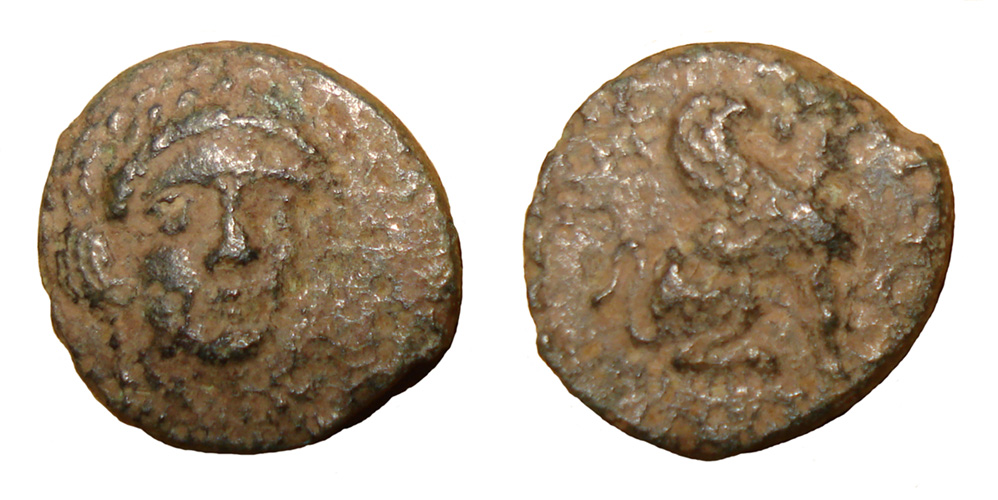 Troas, Gergis, mid 4th cent. BC. Obverse: Three-quarter facing head of Sibyl Herophile, turned slightly right. Reverse: Sphinx sitting right. ΓEΡ off flan. Diameter 12 mm. Weight: 1.54 gr. |
|
Valued Member
Germany
141 Posts |
Quote:
I hadn't seen one of these coins before, so added it to the collection. These are beautiful! I'd love to have one... Congratulations! |
|
Pillar of the Community
United Kingdom
1168 Posts |
Quote:
These are beautiful! I'd love to have one... You may find one @DirtyHarry. Fingers crossed. The forepart of the lion on this coin of Lysimachos caught my eye. The coin was minted in Lysimachia, the city Lysimachos built in 309 BC, on what is now known as the Gallipoli peninsula. https://en.wikipedia.org/wiki/Lysimachia_(Thrace)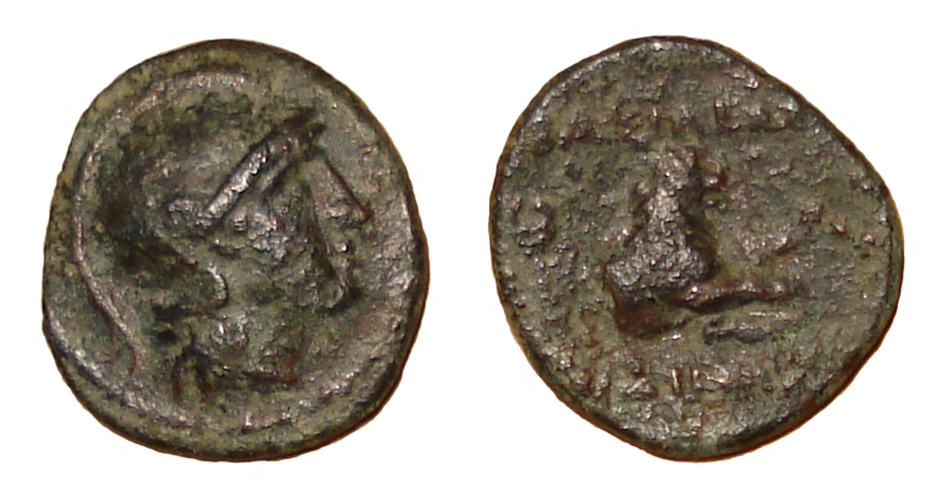 Lysimachos, Kingdom of Thrace - Lysimachia. 305-281 BC Obverse: Helmeted head of Athena right. Reverse: Forepart of lion right, spearhead below, caduceus and EAM monogram before. Reverse Inscription: BAΣIΛEΩΣ ΛYΣIMAXOY. Bronze. Diameter: 14 mm. Weight: 1.9 gr. Reference: Mueller 75; McClean 4500; Mionnet I, 130 |
|
Pillar of the Community
United Kingdom
1168 Posts |
Born around 320 BC, Antigonus Gonatas, the son of Demetrius Poliorcetes, was a descendant of the Diadochi. He was married to Phila the daughter of Seleucus. He won fame after defeating the Gauls at the Battle of Lysimachia. He had two reins, from 277-274 BC and from 272-239 BC. In 239 BC Antigonus died aged around 80. In 294 BC, his father Demetrius seized the throne of Macedonia from Alexander, the son of Cassander. The Macedonians however began to resent the extravagance and arrogance of Demetrius, and In 287 BC, when Pyrrhus took the Macedonian city of Beroea, Demetrius's army deserted and went over to the enemy. In 285 BC, a broken man, Demetrius surrendered to Seleucus. In 282 BC, Seleucus declared war on Lysimachus and the next year defeated and killed him at the Battle of Corupedium in Lydia. He then crossed to Europe to claim Thrace and Macedonia, but Ptolemy Keraunos, the son of Ptolemy, murdered Seleucus and seized the Macedonian throne. Ptolemy's control of Macedonia did not last long, and in the winter of 279 BC, a great horde of Gauls under the leadership of Brennus, descended on Macedonia from the north, crushed Ptolemy's army, and killed him in battle. In 277 BC, Antigonus defeated an army of Gauls under the command of Cerethrius at the Battle of Lysimachia, and claimed the Macedonian throne. I like the Macedonian helmet countermark on the obverse of this coin, and the massively out of scale head on the horse on the reverse. 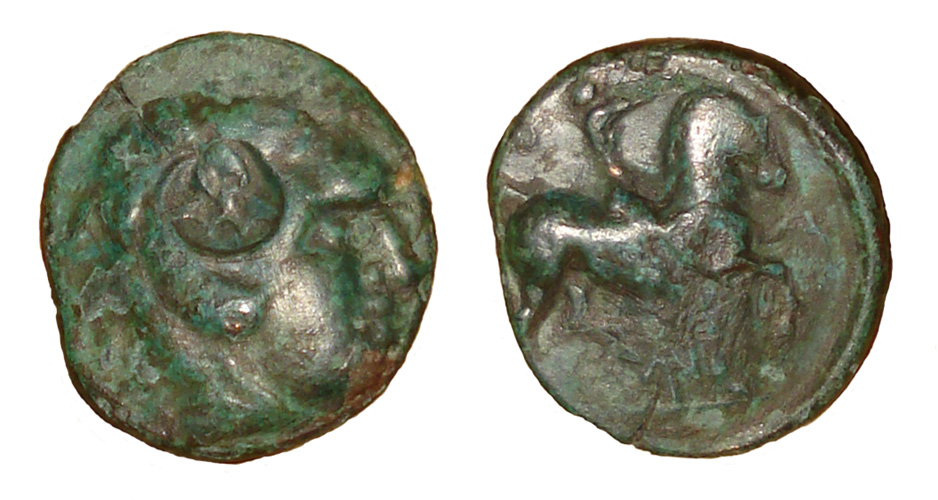 Antigonos II Gonatas. Kingdom of Macedonia. 277-239 BC. Obverse: Head of Herakles right wearing lionskin headdress. Macedonian helmet countermark. Reverse: Horseman right, ANT monogram below, B-A above. Bronze. Diameter: 18 mm. Weight: 3.8 gr. Reference: Sear #: 6787, SNG Cop 1216 |
|
Pillar of the Community
United States
7067 Posts |
Great write-up, Jim. Nice coin too. Particularly stern looking Herakles.
|
|
Pillar of the Community
Spain
2752 Posts |
Nice coins Jim!  ....Really like the Antigonos II coin with a nice green patina. Thanks for the write up, as it put some areas in perspective that I hadn't quite understood before!... The reverse almost seems like the horse is carrying a trophy rather than a rider.....And the c/m is really cool! This is an area of numismatics that I'm not very familiar with so thanks for sharing and teaching me something....Lovely addition to your collection..Paul |
|
Pillar of the Community
United Kingdom
1168 Posts |
Quote:
Particularly stern looking Herakles. I wonder if it was intentional Bob? All the other busts of Herakles I've seen had nowhere near such a stern countenance. Thanks for the comments Paul. Antigonos was not a character that I was familiar with, but the more I read about him, the more I warmed to him. He was the exact opposite to his father, who was apparently a cruel and ruthless man, who cared little for his men. During the siege of Thebes, though there was little chance of capturing the city, Demetrius forced his men to attack, with massive loss of life. Antigonus asked his father: "Why do we allow these lives to be thrown away so unnecessarily?" Showing complete contempt for his own men, Demetrius replied, "We don't have to find rations for the dead." Apart from his victory over the Gauls, Antigonas was not a particularly skilled military man, but was very skilled politically. It was said that he gained the affection of the people by his honesty, and cultivation of the arts. |
| |
Replies: 638 / Views: 59,844 |








 First Page
 Previous Page


 Posted 08/14/2020 9:46 pm


