| Author |
 Replies: 638 / Views: 59,845 Replies: 638 / Views: 59,845 |
|
|
|
Pillar of the Community
 United Kingdom
1168 Posts |
Another swan from Ionia. This time from Leukai, and in slightly better condition. Leukai was a small town in ancient Ionia, in the neighbourhood of Phocaea. According to Diodorus, the Persian admiral Tachos founded this town on an eminence on the sea coast in 352 BC. The existence of the small town is known only thanks to its coins. It is a rare mint, and only five varieties of coins are listed in Wildwinds, four bronze, and one silver. 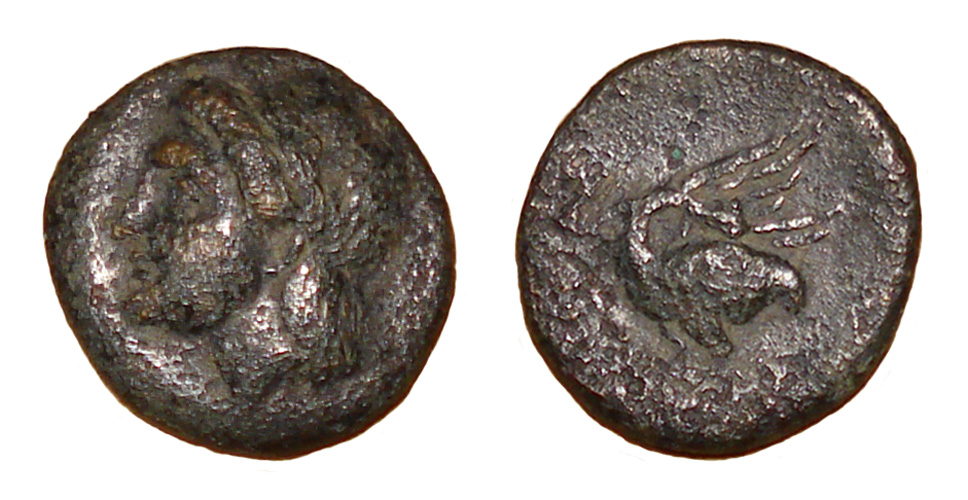 Ionia, Leukai, 350 - 300 BC. Obverse: Laureate head of Apollo left. Reverse: Swan standing left, head turned back preening its feathers, wings spread. Bronze. Diameter: 16 mm. Weight: 2.4 gr. Sear 4472. |
|
Pillar of the Community
 Spain
2752 Posts |
Interesting coin Jim.  ...Any idea what the relevance of the swan is?.... |
|
Pillar of the Community
United Kingdom
1168 Posts |
It is probably more to do with the association of swans with Apollo than anything else Paul. In Greek mythology, the swan is a bird sacred to Aphrodite and Apollo. When Zeus' wife Hera discovered that Leto was pregnant, she banned her from giving birth on terra firma. The unborn Apollo informed his mother about a floating island named Delos which had once been Asteria. When Apollo was born, swans circled the island seven times and the nymphs sang in delight. A number of young men in Greek myth had the name Cycnus, or Swan. One was the son of Apollo by Hyrie (or Thyrie). Swans drew the chariot in which Apollo flew south every year, and swans sing only once, at their death. Socrates argued that swans sang because, as Apollo's birds, they could foresee the joys of the afterworld. 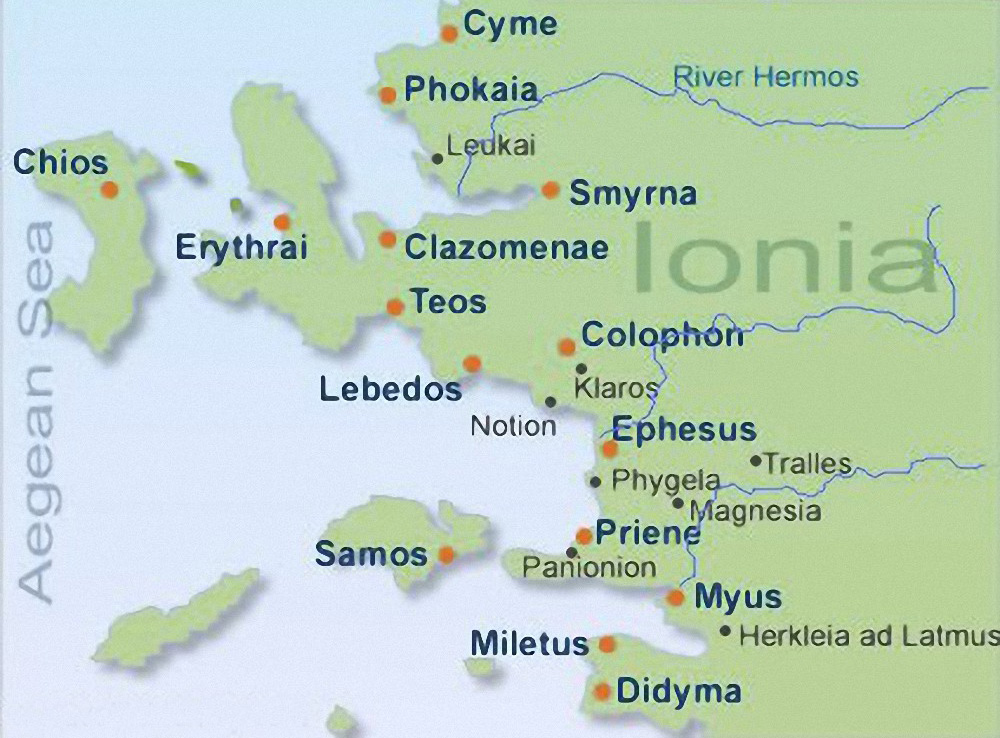 Leukai is just along the coast from Klazomenai (Clazomenae), and the principal god of Klazomenai is Apollo. Perhaps Leukai, being a small town, associated it's coinage with the larger Klazomenai? |
|
Pillar of the Community
Spain
2752 Posts |
Quote:
the association of swans with Apollo Yes I should have remembered  I had it my head the swan was linked to Aphrodite...Lovely story though and completely agree with the coinage link to the larger town. Thanks...Paul |
|
Pillar of the Community
United Kingdom
1168 Posts |
Another simplistic coin with Pegasos, this time from the city of Pantikapaion in Thrace. The city is also known as Panticapaeum, Pantikapeion or Panticapæon, and the ruins are located in the modern city of Kerch, in the Ukraine. I haven't found much information regarding Pantikapaion, which was founded by Milesians in the 7th or 6th century BC, and abandoned in approximately 370 AD. In the 5th and 4th centuries B.C., the city was home to the Archaeanactids, and then of the Spartocids dynasties of Thracian kings of Bosporus. The last of the Spartocids left his realm to Mithridates VI Eupator, king of Pontus. Half of a century later, Mithridates himself took his life in Panticapaeum, when, after his defeat in a war against Rome, his own son and heir Pharnaces, and the citizens of Pantikapaion turned against him. Satyrs Pan and Silenos are featured on some coins, with others being graced with the more regular gods. Pan on this coin is minimalist, as is the rendition of Pegasos. 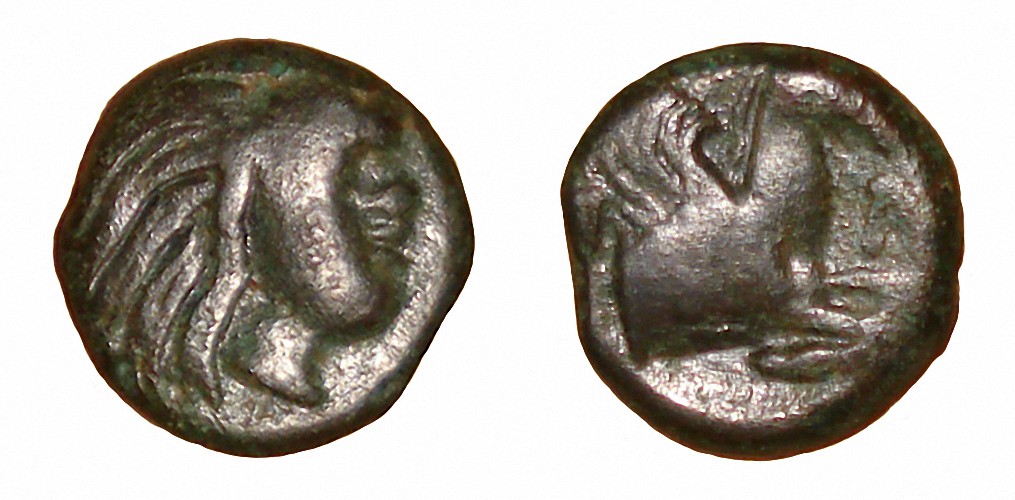 Thrace, Pantikapaion, 4th cent. BC. Obverse: Head of young Pan right. Reverse: ΠΑΝ. Forepart of Pegasos right. (ΠΑ off flan) Sear SG 1702. |
|
Pillar of the Community
Russian Federation
5186 Posts |
Neat! I have a bunch of Pantikapaion coins (they're ludicrously common in Moscow, almost more so than any other ancient Greek coins combined), but I don't recall having any featuring Pegasus (satyrs yes, but with assorted objects on the other side, not animals).
|
|
Pillar of the Community
United Kingdom
1168 Posts |
Quote:
they're ludicrously common in Moscow I wish they were more common here @january1may, as there are some really lovely coins from Pantikapaion. Wildwinds lists some animal reverses with lions, rams, bulls, stags etc, and also one I'd dearly love to find with a griffin. I have been very unlucky with griffins so far, so I don't hold out much hope. |
|
Pillar of the Community
United Kingdom
1168 Posts |
This coin from Adramytteion in Mysia with the head of Zeus facing, and an eagle on an altar caught my eye. The coastal city of Adramytteion (located in modern day western Turkey) was founded in the 6th century BC as a small Athenian colony. Prior to the victory at the Battle of the Granicus in 334 BC of Alexander the Great, Adramytteion was at various times under the control of Mytilene, Lydia, and Persia. During the Hellenstic period, it also changed hands a few times before becoming a possession of the Attalid Kingdom of Pergamon. Adramytteion survived into Roman times, and was said to have been rebuilt by Emperor Trajan after an earthquake devastated it. The city was originally located at the head of the Gulf of Adramyttium, at Ören in the Plain of Thebe, 4 kilometres west of the modern town of Burhaniye, but later moved 13 kilometres northeast to its current location and became known as Edremit. Adramytteion is mentioned in the Acts of the Apostles as being the home port of the ship that St. Paul sailed on, when he journeyed from Caesarea Maritima in Judaea to Myra in Lycia. 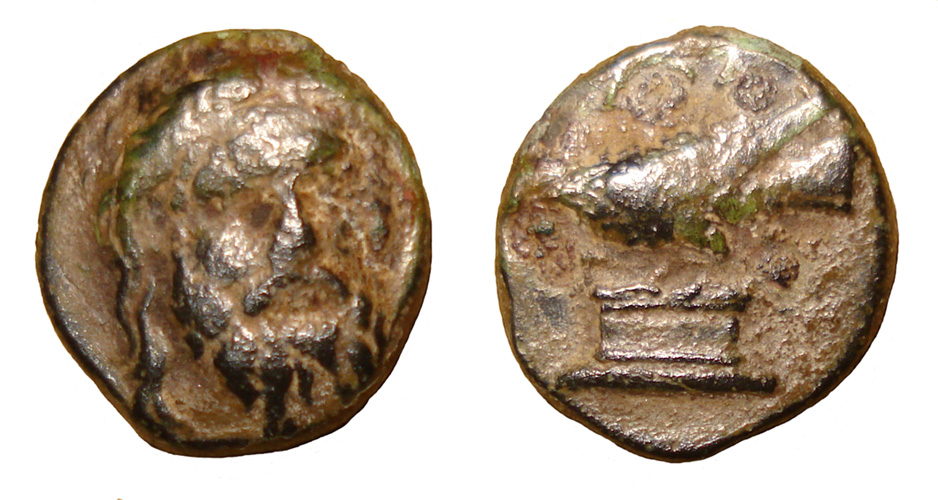 Mysia, Adramytteion, mid-4th cent. BC. Obverse: Head of Zeus 3/4 face to right. Reverse: ΑΔΡΑ above eagle standing left on altar, wings closed. Bronze. Diameter: 12 mm. Weight: 1.68 gm. Sear 3803. VonFritze 6. |
|
Pillar of the Community
Spain
2752 Posts |
That's a nice coin Jim!......
Thanks again 'Adramytteion', another place I'd never heard of...I need to read more!
A front facing Zeus...Great find and not that common....
Thanks for sharing..Paul
|
|
Pillar of the Community
United States
7067 Posts |
Indeed another nice coin and informative post. Missed this one during what was a very busy past week. Glad Paul's reply put it at the top of the forum again. Adramytteion/Adramyttium...not sure there's ever been a coin from there on this board before.
Edited by Kamnaskires
09/07/2020 5:26 pm
|
|
Pillar of the Community
United Kingdom
1168 Posts |
Adramytteion was a place that I hadn't heard of either Paul. I have been fortunate recently that some unusual (to me) coins have come within my budget.
Thanks for the reply Bob. I hope that some of the members found it to be of interest.
|
|
Pillar of the Community
United Kingdom
1168 Posts |
Researching this coin from Cherronesos in Thrace has proved very interesting, as Chersonesos is Greek for "peninsula" and several cities used the name. The actual city in Thracian Chersonesos (the Gallipoli peninsula) that struck these coins is uncertain. The coins may have been struck at Cardia by the peninsula as a league, or perhaps they were struck by the lost city on the peninsula named Chersonesos. Cherronesos, was a town of ancient Caria. It was a member of the Delian League since it appears in tribute records of Athens between 452/1 and 429/8 BC, paying a phoros of two to three talents. It is also mentioned in a tribute decree of Athens dated to 425/4 BC. Coins are preserved that have been dated around 500 BC, bearing the legend "ΧΕΡ", which is attributed to Cherronesos. The actual location of Cherronesos is unknown. However, in an excellent article, Reid Goldsborough states: These coins are sometimes described as being from Tauric Cherronesos or Tauric Chersonese, even by major auction houses, but this is a mistake. "Cherronesos" (also spelled "Cherronesus," "Chersonesos," "Chersonesus," and "Chersonese") is the Greek word for "peninsula," and there were no fewer than 28 geographical areas referred to in the ancient sources as "Cherronesos." Tauric Cherronesos, which is present-day Crimea, Ukraine, is the peninsula in the northern Black Sea on which the city of Pantikapaion/Panticapaeum was situated. Thracian Cherronesos, which today is called the Gallipoli peninsula and is part of Turkey, is the peninsula in the northeast Aegean Sea on which the cities of Kardia/Cardia and Lysimachia were situated. The spellings seen most commonly are "Cherronesos," "Chersonesos," and "Chersonese." Earlier Thracian Cherronesos coins are broadly attributed to Thracian Cherronesos while later ones are attributed more specifically to Kardia/Cardia, those that include the name of this city in the inscription. Kardia was founded as a colony of Miletos in the late seventh century BC. Cherronesos hemidrachms may have been minted in Kardia or by a confederation of cities and towns within the peninsula Cherronesos. The large number of varieties and the frequency of these coins on the market today indicate that Cherronesos hemidrachms were issued in great volume over a long period. They're thought to have been used in ancient times in support of trade with the cities along the coast of the Black Sea. Cherronesos was under the control of Athens from 560 BC to 338 BC, aside from a brief period during this time when it was controlled by Persia. It was taken over by Philip II in 338 BC, Pergamon in 189 BC, and Rome in 133 BC. The area was later controlled by Byzantium, then the Ottoman Turks. Thracian Cherronesos issued bronze coins depicting a lion's head as well. The reverse features a wheat grain (sometimes referred to as corn) and the inscription XEP/PO, which is short for "Of the Cherronesians." 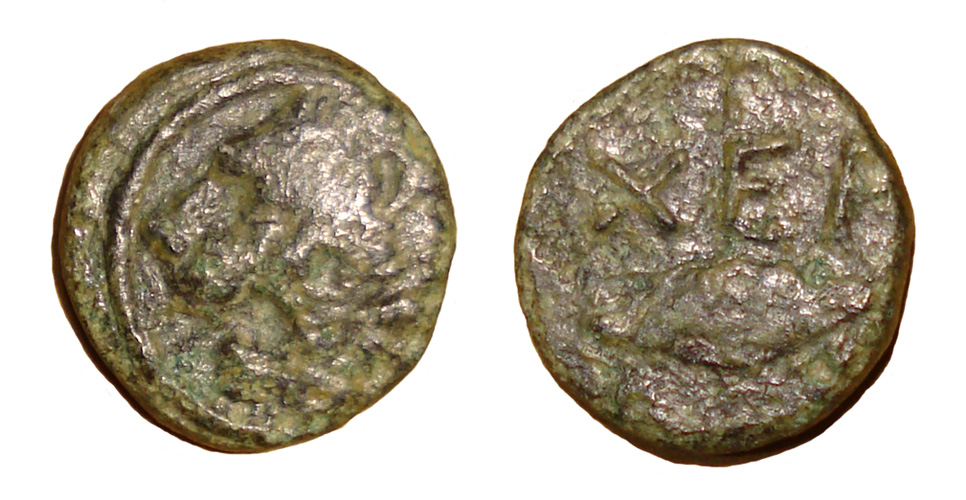 Thrace Cherronesos, 400 - 350 BC. Obverse: Lion's head left. Reverse: XEP/PO above and below corn-grain. Bronze. Diameter: 11 mm. Weight: 1.13 gr. SNG Cop 845; Sear 1607. |
|
Pillar of the Community
United Kingdom
1168 Posts |
The vendor's description for the reverse of this coin from Tarsos, was Heracles standing on a horned and winged lion. However similar coins on Wildwinds have some reverses described as Sandan standing on a horned and winged animal. It is now thought likely that the Lion of Saint Mark on the pillar in the Piazza San Marco in Venice, was in origin a winged lion-griffin from such a monument at Tarsos. Tarsos (Tarsus) in Cilicia was first ruled by the Hittites. Tarsos is derived from the original Hittite name Tarsa, and it is believed that it was representative of the Pagan god Tarku. Assyria ruled next, and from 400 BC on Tarsos was the seat of a Persian satrapy, and the city's patron god was Sandan. Tarsos was largely influenced by the Greek language and culture, and as part of the Seleucid Empire became more and more hellenized. The city was located at the mouth of the Cydnus River, and was the principal city of Cilicia. Incidentally Alexander the Great almost met his death here in 333 BC, after bathing in the Cydnus. Tarsos was also a cultural centre and seat of learning, having over 200,000 books in it's library, a huge number of them being scientific works. The schools in Tarsos were said to rival those of Athens and Alexandria. In 171 BC there was a revolt against Antiochus IV Epiphanes, who had renamed the city Antiochia on the Cydnus (Antiochia ad Cydnum), to distinguish it from Syrian Antioch. There were many cities called Antioch, so the name didn't last long. 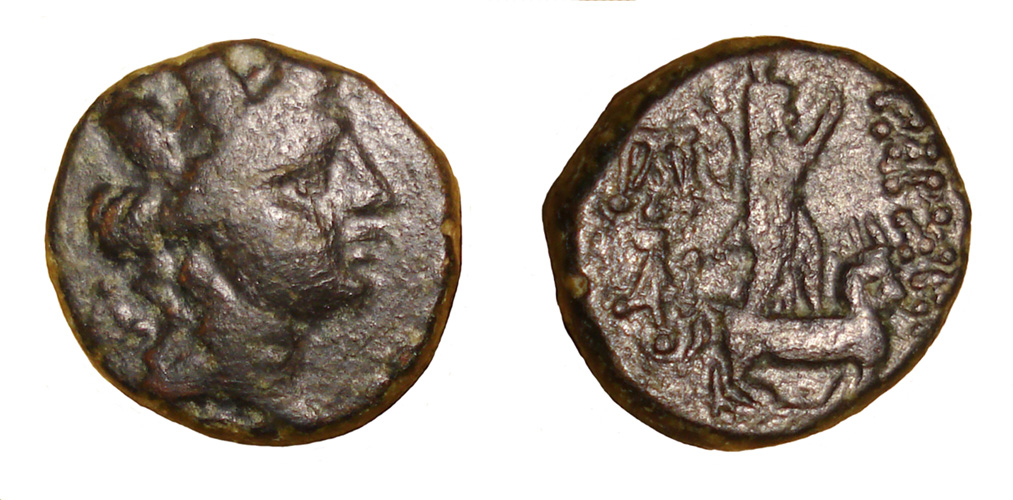 Cilicia, Tarsos, 2nd - 1st cent. BC. Obverse: Turreted head of Tyche right. Reverse: TARSE(ON) to right of Sandan/Heracles standing on horned and winged lion right, 2 monograms in left field. Bronze. Diameter: 15 mm. Weight: 3.54 gr. Sear 5668v. Lindgren III A911av. |
|
Pillar of the Community
Spain
2752 Posts |
|
|
Pillar of the Community
United Kingdom
1168 Posts |
Thanks Paul. I have to admit that the animal looks more like a goat to me, than a lion, but it is probably down to the skill of the engraver. It was not an easy coin to attribute, as every site gave a different description. All part of the fun though, and I did learn a lot about the history of the place. Good luck with the Cherronesos coin. Jim |
| |
Replies: 638 / Views: 59,845 |





 First Page
 Previous Page


 Posted 08/29/2020 6:56 pm





