|
This page may contain links that result in small commissions to keep this free site up and running.

Welcome Guest! Registering and/or logging in will remove the anchor (bottom) ads. It's Free!
To participate in the forum you must log in or register. | Author |
 Replies: 638 / Views: 59,869 Replies: 638 / Views: 59,869 |
|
|
|
Pillar of the Community
 United Kingdom
1168 Posts |
Quote:
Lot of history imbued in that coin. Thanks, Bob. I was amazed to find how much history was available on Rhegion. Even Strabo had a lot more to say about the place than usual. Quote:
Wanton violence, execution of civilians...still seems all too familiar. Indeed, and all through the centuries nothing appears to have changed. It is all too sad. Quote:
As you know I have a similar Hera obverse with lion scalp reverse from Ionia Samos do you happen to know why the scalp was used as a symbol? Thanks, Paul. I had assumed that the lion scalp was associated with Herakles and the Nemean Lion, indicating strength or power. The portraits of Herakles usually show him wearing the lion skin (scalp) headdress. I had not read anything definitive till I found the passages below on the CNG Coins web site. A couple of theories are mentioned, though relating to Rhegion. Extract from CNG Coins: Different theories exist for the lion's head on the coins of Rhegion. The lion's head (or mask as it is sometimes described) first appeared on the coinage of Rhegion at the start of the reign of Anaxilas, in about 494 BC. E.S.G. Robinson, in his article "Rhegion, Zankle-Messana and the Samians" (JHS vol. 66, 1946) argues that the lion was a symbol of Apollo. He makes a comparison to the coinage of the nearby city of Kaulonia, "At Kaulonia Apollo's animal was the deer; if at Rhegion it was the lion, the early appearance and persistence of that type is explained. The lion is a certain, though infrequent, associate of Apollo at all periods." The link, he suggests, is that the lion was associated with the sun, as was Apollo himself. The lion's head could also relate to the exploits of Herakles, who had some significance for the city. The extant sources tell us that Herakles stopped at southern Italy near Rhegion on his return with the cattle of Geryon (Diod. Sic. 4.22.5). It was here that supposedly a bull broke away from the rest of the herd and swam to Sicily (Apollod. 2.5.10). Though but a passing reference in Apollodorus, it is very possible that the Rhegians venerated Herakles. Indeed, Herakles was a very important figure throughout the entire area. Dionysios of Halicarnassus says that "in many other places also in Italy [besides Rome] precincts are dedicated to this god [Herakles] and altars erected to him, both in cities and along highways; and one could scarcely find any place in Italy in which the god is not honoured" (I.40.6). As the skin of the Nemean Lion was one of the main attributes of Herakles, the lion's head may refer to him through metonymic association. |
|
Pillar of the Community
 Spain
2752 Posts |
Thanks Jim, I found the extracts you posted most interesting..
We also have to remember these were not African lions taken from the savanna, although some probably were, but the European lion that was indigenous to the eastern and southern regions of modern day Europe. It disappeared from Macedonia around the first century AD, Thrace 2nd century AD and in Thessaly it hung on until around the 4th century AD....
|
|
Pillar of the Community
United Kingdom
1168 Posts |
This coin from Isinda in Pisidia caught my eye with it's rather noble portrait of Zeus on the obverse, and a horse and serpent on the reverse. I didn't find another coin with the Θ indicating local year 9 apart from a similar one on the Isinda Wikipedia page. (Though that one does appear to be possibly ΘI.) The date is unlisted in BMC. The dating is according to Bibliotheque Nationale de France, Paris Cabinet des Medailles (although LY (local year) 9 is unpublished in SNG BN). Strabo only mentions Isinda once in his Geography, in the paragraph below: "Milya is the mountain-range extending from the defiles near Termessus, and the passage through them to the parts within the Taurus towards Isinda, as far as Sagalassus and the country of Apameia." 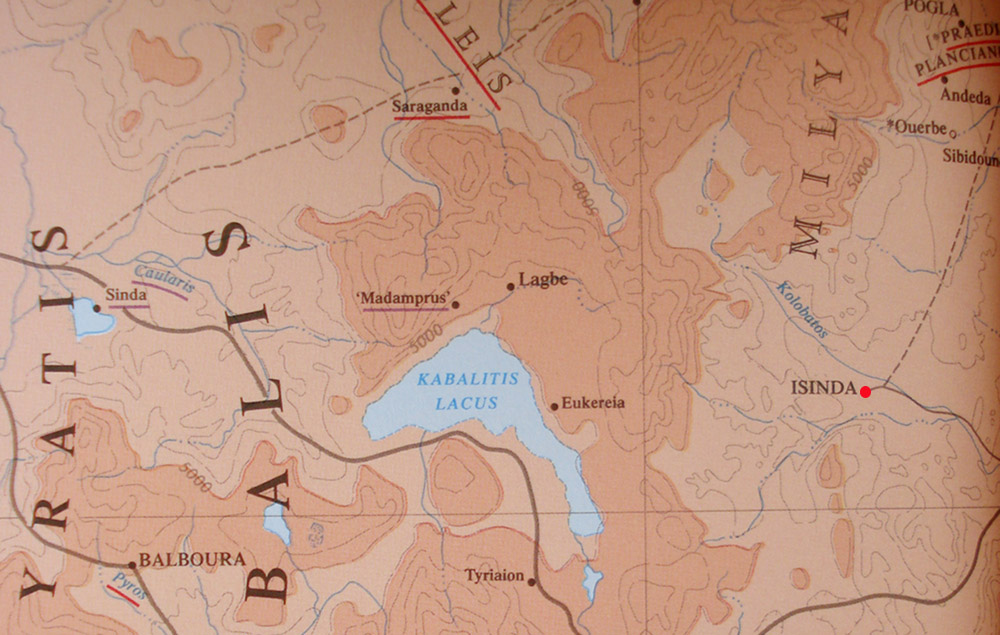 There does not appear to be a large amount of information on Isinda, and there are two locations for Isinda shown in the Barrington Atlas. In the map above the Milya mountain range is close by, so would appear to be the correct location as per Strabo. From "The Princeton Encyclopedia of Classical Sites": "ISINDA (Kisla) Turkey. Site in Pisidia close to Korkuteli (Istanoz), now thought to be Isinda rather than the site at Yazir, formerly so identified. The situation is an important one, on the route from Pamphylia to Caria. In 189 B.C. Manlius Vulso, on his march through Asia, found the Isindians besieged by the Termessians; at their request he raised the siege and fined the Termessians 50 talents. The remains are scanty. On a high craggy hill on one side of a glen are rock cuttings and a rock tomb without inscription; on the lower hills in the vicinity are the ruins of extensive walls of soft stone and burnt brick. An inscription in Kisla village mentions a Clarian festival; this agrees with the claim of Isinda, on her coins, to be an Ionian colony." 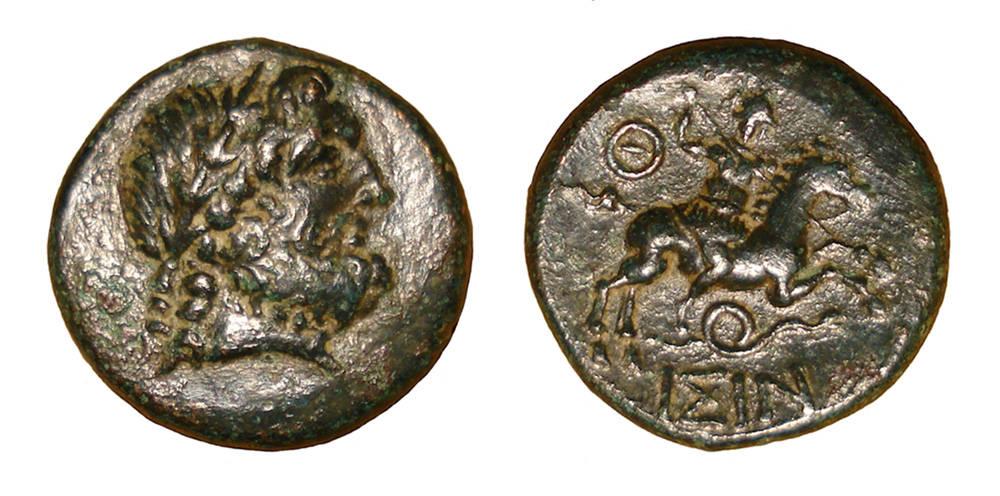 Pisidia Isinda. Civic Issue, LY (Local Year) 9 = 1 B.C./A.D. 1. Tetrachalkon. Obverse: Laureate head of Zeus right. Reverse: Rider on horse galloping right, wielding spear to attack coiled serpent right, below; to upper left, Θ (date), IΣIN (below). Bronze. Diameter: 19-20 mm. Weight: 6.13 gm. Date unlisted in BMC. RPC I, 3512. Edited by Novicius
05/06/2022 10:43 am
|
|
Pillar of the Community
Spain
2752 Posts |
That's a great looking coin Jim  Lovely portrait and super detail on the reverse. Good detective work too... I did find this one (AE19 5.67gr) that the seller has as SNG France 1576? No where near as nice as the op! 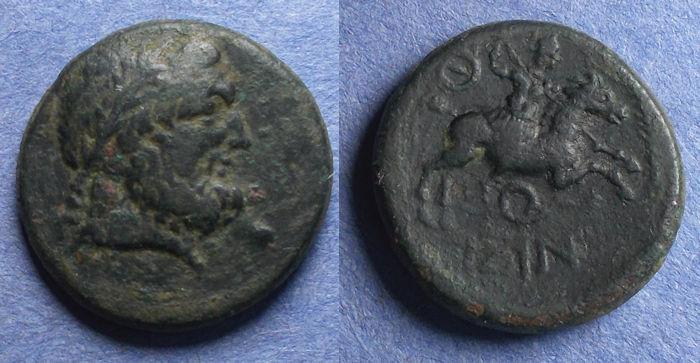 Edited by Palouche
05/05/2022 6:56 pm
|
|
Pillar of the Community
Russian Federation
5186 Posts |
Quote:
Rider on horse galloping right, wielding spear to attack coiled serpent right, below Two thousand years later...  (yes I know that this is St. George, but it's interesting how similar the imagery is) |
|
Pillar of the Community
United Kingdom
1168 Posts |
Thanks, Paul. It looks like you did a good bit of detective work yourself, as I didn't see the SNG France 1576 reference. Both SNG France 1576 and RPC I, 3512 seem to cover all the date variations. RPC I, 3512a starts with an A in the left field and the coin date marks run up to RPC I, 3512t with ΚΑ in the left field. The coin you posted definitely has the Θ date mark too, but it is not included in the above series. There is a variant with the Θ and a palm branch in the right field, and another with the ΘI date mark, but there is not one in the list with Θ on it's own! Another bit of a mystery. I think I'll submit the images of the coin to the university web site and see what they make of it. Thanks again for posting your findings, and it's nice to both both references. |
|
Pillar of the Community
United Kingdom
1168 Posts |
Quote:
(yes I know that this is St. George, but it's interesting how similar the imagery is) Indeed it is, @january1may. The more things change, the more they remain the same.  |
|
Valued Member
United States
319 Posts |
The St.George coin posted by january1may reminded me of the very first "coin" that inspire my interest in the hobby. I put the word 'coin' in quotes because I believe it's a religious medal based on a Georgstaler. 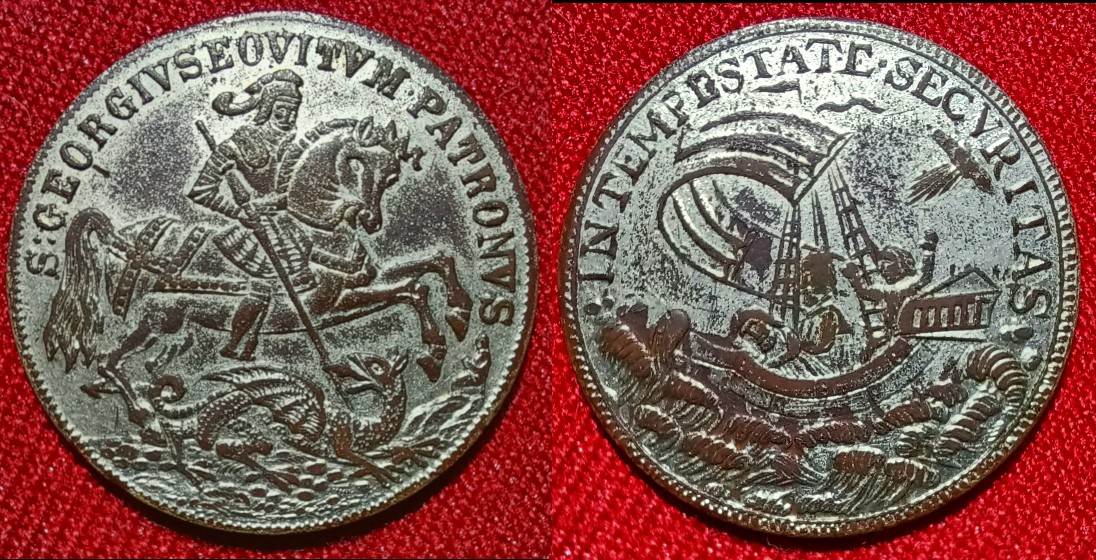 I found this in a neighbor's yard while playing a kid's game of some sort. Knights on horseback slaying dragons. It fired my young imagine and spurred my interest in coin collecting. 24.5mm round...but a thin 1.2mm thick. Still awesome after all these years! |
|
Pillar of the Community
Spain
2752 Posts |
Quote:
I think I'll submit the images of the coin to the university web site and see what they make of it.
...Good idea Jim....I'd be really interested in the feedback.... I was unsure as to where they would class the right field in relation to the positioning of the palm branch ie above the horses head or in front of?...This referenced example shows the A in left field with palm branch in front of the horse's head....Taking this into account I'm pretty sure I can see the remnants of the palm branch on the example I posted but on yours there seems to be nothing? What are you thoughts? 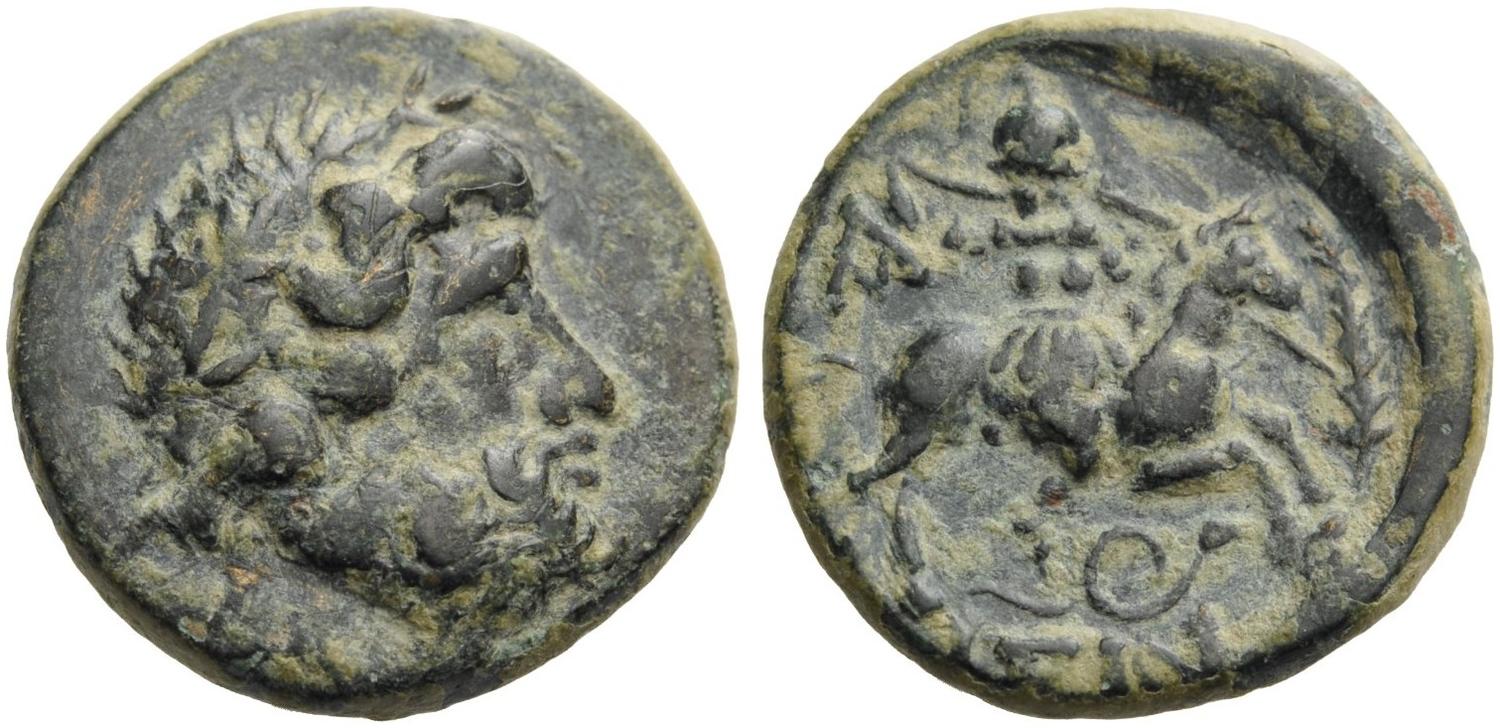 |
|
Pillar of the Community
United Kingdom
1168 Posts |
Quote:
I found this in a neighbor's yard while playing a kid's game of some sort. Knights on horseback slaying dragons. It fired my young imagine and spurred my interest in coin collecting. What a nice story, Mike. I dare say that this is one coin that you will never get rid of. Quote:
Taking this into account I'm pretty sure I can see the remnants of the palm branch on the example I posted but on yours there seems to be nothing? Below is the university's image of the coin reverse showing the palm branch, Paul. On looking at the page again it does say that the mark is for local year 9. Now that you mentioned it, I do see a faint edge of a palm branch on the image you posted. The reverse of my coin does appear to be well centred, and though there is no obvious sign of a palm branch, it is possible that it could be off flan? After all, it is dated to local year 9. 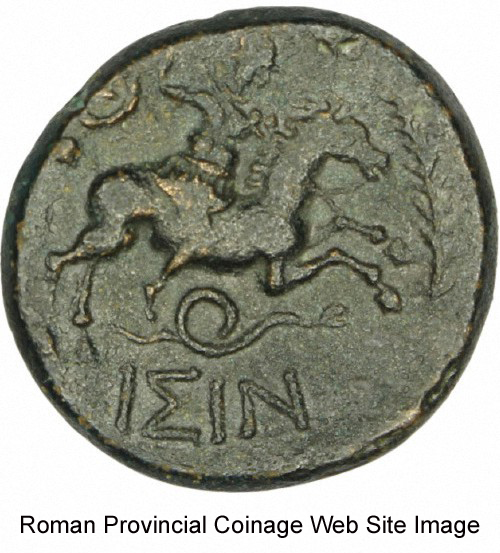 |
|
Pillar of the Community
Spain
2752 Posts |
Yes I agree Jim..
When you zoom into the area just in front of the horse's snout on your coin there seems to be 3 fronds showing?
|
|
Pillar of the Community
United Kingdom
1168 Posts |
With regard to the previous Pisidia Isinda. Civic Issue coin. Quote:
Taking this into account I'm pretty sure I can see the remnants of the palm branch on the example I posted but on yours there seems to be nothing? All things taken into account, I'm going to reference the coin in my database as the following, Paul. SNG France 1576var; RPC I, 3512i (palm branch?) Another coin with a horse reverse, but this time the obverse features a portrait of Alexander the Great, and on the reverse Alexander on his horse Bucephalus. Everyone will be familiar with the story of Philip II being offered a remarkable horse from the stud of Philonicus the Pharsalian for thirteen talents. (A huge amount of money in those days.) As nobody could control the animal Philip wasn't interested, but his son, twelve year old Alexander said that he could, and he surprised everyone by subduing the horse. Bucephalus was to become one of the most famous horses in history, and on his death at around thirty years of age Alexander built a city round his tomb, calling the city Bucephala. The name Bucephalus is a combination of the Greek words "bous," meaning ox and "kephalos," meaning head. There are differing opinions on how Bucephalus got his name. For example: 1) Arrian's History of Alexander's Expedition says: "He was strong, and beautiful in Body, and of a generous Spirit. The Mark by which he was said to have been particularly distinguished, was a Head like an Ox, from whence he receiv'd his Name of Bucephalus: Or rather, according to others, because he being Black, had a white Mark upon his Forehead, not unlike those which Oxen often bear." 2) Pliny (the Elder.) in "The Natural History of Pliny" states: "King Alexander had also a very remarkable horse; it was called Bucephalus, either on account of the fierceness of its aspect, or because it had the figure of a bull's head marked on its shoulder. On the original tag it reads: "Apparently unrecorded but cf. AMNG III 388 (rev. legend); BMC Macedonia p. 23, 105 (same); SNG Hunterian 737 (horse cantering); SNG Cop 1355 (Elagabalus). Ex Dr. Hubert Lanz, Munich." In Wildwinds there is a coin with the obverse and reverse legends the same as my coin with the reference SGI 4808.2. However the reverse description says, "Alexander riding right on Bucephalus, cloak billowing behind, spear raised." There is no sign of a spear on my coin. 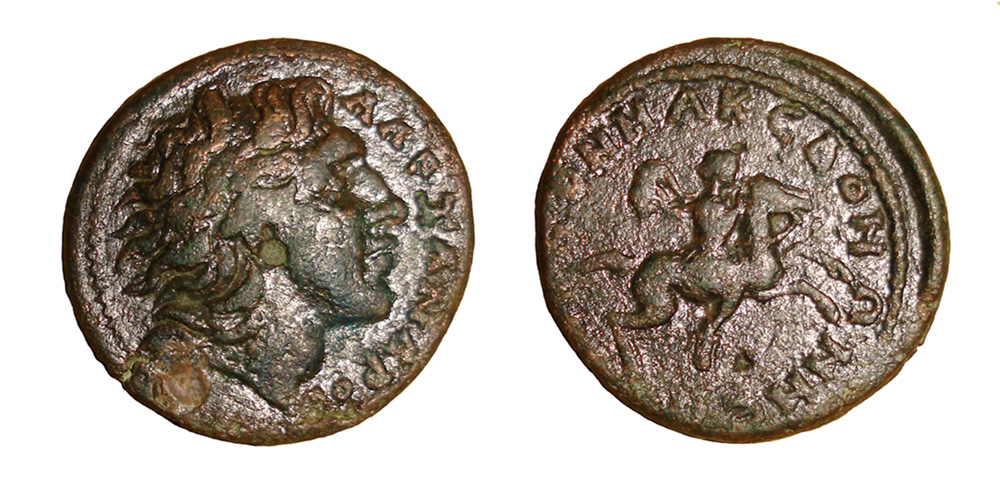 Koinon of Macedon. Autonomous issue of c. A.D. 231-5. Triassarion. Obverse: Diademed head of Alexander the Great. Obverse legend: AΛΕΞΑΝΔΡΟΥ. Reverse: Alexander, cloak flying, riding right on leaping Bucephalus. Reverse legend: KOINON MAKEΔONΩN NEΩ(K). Bronze. Diameter: 27 mm. Weight: 15.34 gr. Reference SGI 4808.2? |
|
Pillar of the Community
Spain
2752 Posts |
Quote:
All things taken into account, I'm going to reference the coin in my database as the following, Paul. SNG France 1576var; RPC I, 3512i (palm branch?) ..Probably a good call Jim..Although even with the bevelling around the edge I still think I can see a few fronds  That's a lovely big bronze Jim with a super portrait.. Nice addition and thanks for the interesting write up as always. |
|
Pillar of the Community
United Kingdom
1168 Posts |
Quote:
Nice addition and thanks for the interesting write up as always. Thanks, Paul. I have admired these small coins from Apollonia (modern day Sozopol), with the head of a Gorgon and the rather elegant anchor for some time. This one fitted the bill with it's near perfect little crayfish on the reverse. The face of Medusa is not as scary as most, and though the description says "hair in ringlets", on close examination each ringlet appears to have a serpent's head. 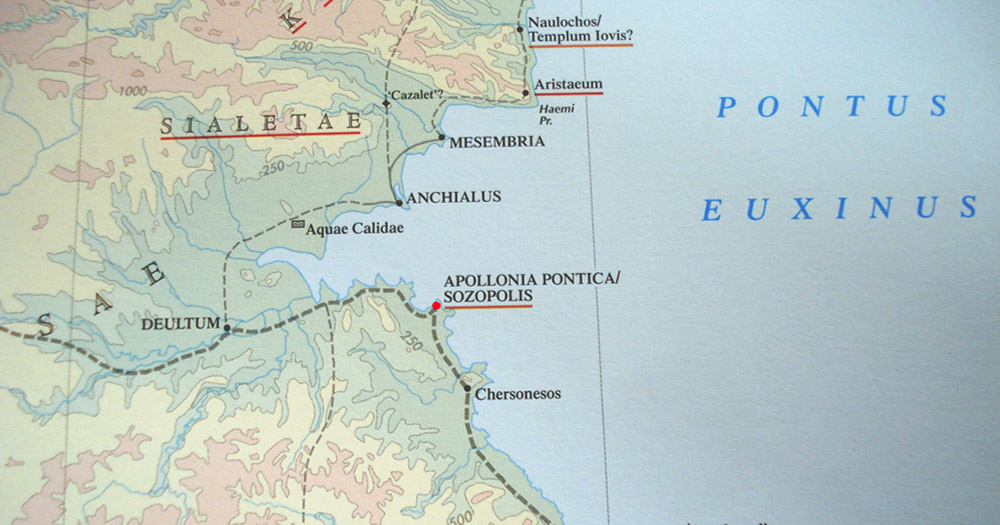 Apollonia Pontica was originally named Antheia when it was founded by Milesians around 610 BC. Ancient authors identify the philosopher Anaximander as the founder of the city. The name was changed after the temple to Apollo was built containing the colossal statue of Apollo by Calamides. Pliny the Elder wrote that it stood 20 cubits, (which would be approximately 9 metres), and cost 500 talents. The statue was taken to Rome after Marcus Lucullus attacked and destroyed the city. For his achievements, he was awarded a triumph which he held in 71 BC. As the anchor would indicate, they had a strong navy with naturally protected harbours, and an extensive maritime trade. Strabo wrote: "If we set out from the Sacred mouth of the Danube, having on the right hand the continuous line of the coast, we find at the distance of 500 stadia, Ister, a small town founded by Milesians; then Tomis, another small town, at the distance of 250 stadia; then Callatis, a city, a colony of the Heracleotæ, at 280 stadia; then, at 1300 stadia, Apollonia, a colony of Milesians, having the greater part of the buildings upon a small island, where is a temple of Apollo, whence Marcus Lucullus took the Colossus of Apollo, the work of Calamides, and dedicated it as a sacred offering in the Capitol." 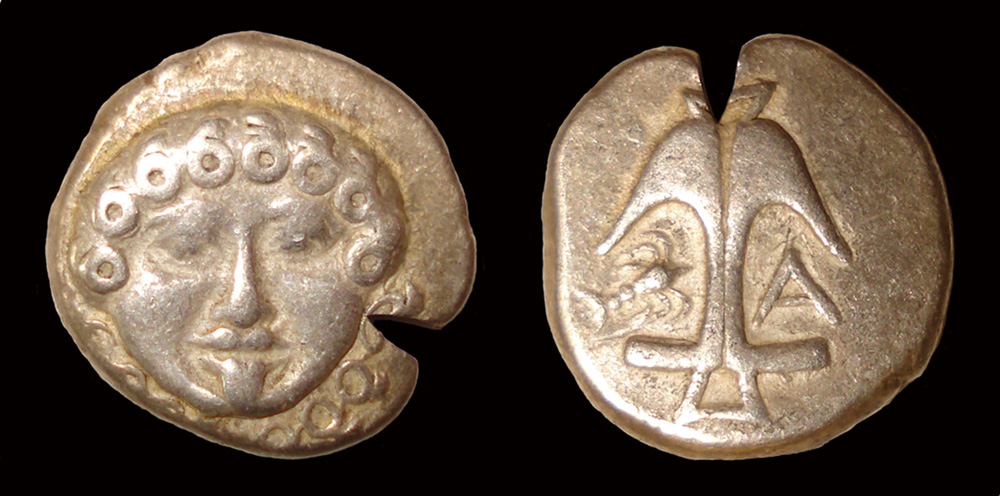 Thrace: Apollonia Pontica, Silver Drachm, c. 390 B.C. Obverse: Head of Medusa facing, hair in ringlets, tongue extended. Reverse: Anchor inverted with crayfish at left. and A (=Apollonia) at right. Silver. Diameter: 12-13mm. Weight: 2.81gm. Note: Ex Professor James Hartley Nichols collection. Very rare variant, unrecorded for this less grotesque portrait and drachm under the Phoenician weight standard of the 4th century. |
|
Pillar of the Community
United States
7067 Posts |
Lovely example, Jim.
Just got caught up on the posts. Great info as always.
|
| |
Replies: 638 / Views: 59,869 |
To participate in the forum you must log in or register.
Disclaimer: While a tremendous amount of effort goes into ensuring the accuracy of the information contained in this site, Coin Community assumes no liability for errors. Copyright 2005 - 2026 Coin Community Family- all rights reserved worldwide. Use of any images or content on this website without prior written permission of Coin Community or the original lender is strictly prohibited.
Contact Us | Advertise Here | Privacy Policy / Terms of Use
|
| Coin Community Forum |
© 2005 - 2026 Coin Community Forums |
| It took 0.46 seconds to rattle this change. |
 |
|
| |
| |







 First Page
 Previous Page


 Posted 04/27/2022 5:15 pm


