| Author |
 Replies: 638 / Views: 59,866 Replies: 638 / Views: 59,866 |
|
|
|
Pillar of the Community
United States
7067 Posts |
I agree, great looking coin.
|
|
Pillar of the Community
 United Kingdom
1168 Posts |
Thanks, Paul and Bob. I understand now why these larger coins are popular, as they are very pleasing in the hand. Quote:
Is it that golden colour in hand? There was no colour correction on the original images, Paul. They were taken on a neutral background. Below is the coin actually "in hand" with no colour correction. It does have a very pleasant patina. 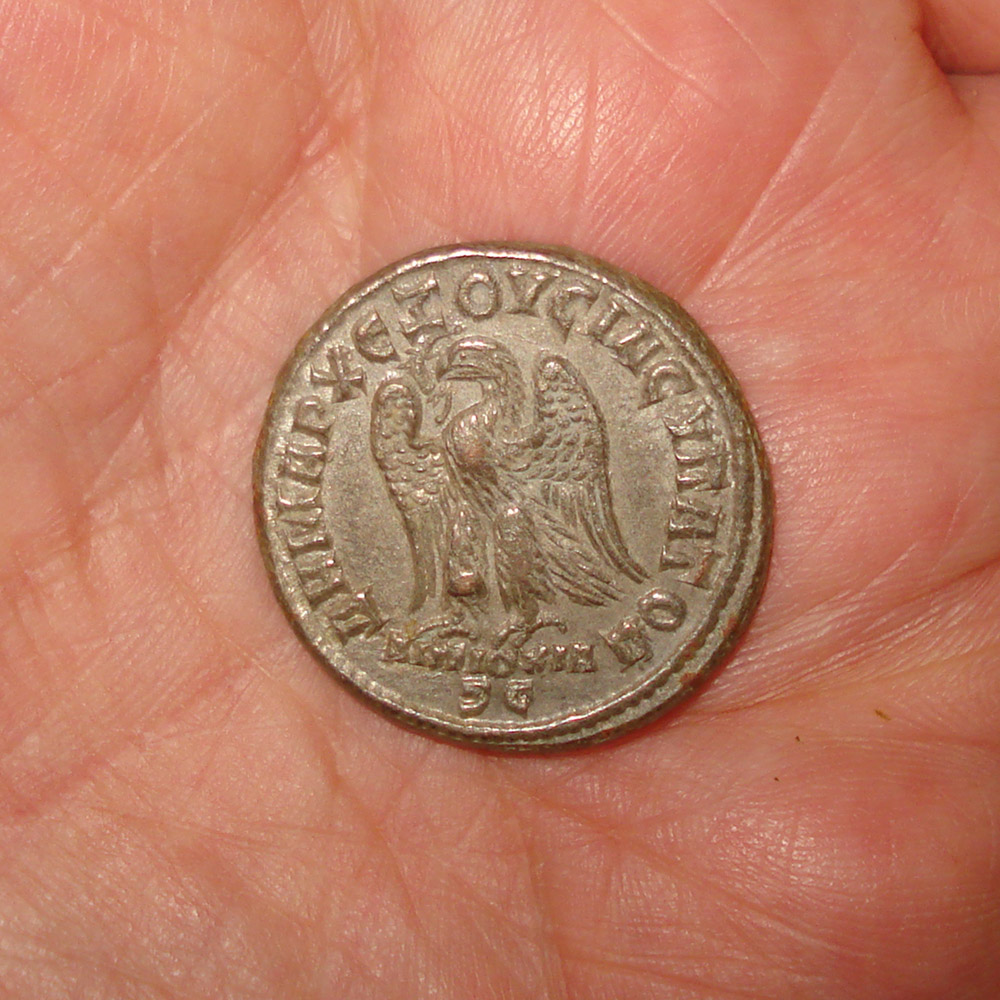 |
|
Pillar of the Community
United Kingdom
1168 Posts |
Another coin I found of interest, with a bull on the reverse for a change. I didn't find much about Miletopolis during online searches and most of the information I did find was similar to the paragraph below from Wikipedia: "Miletopolis or Miletoupolis was a town in the north of ancient Mysia, at the confluence of the rivers Macestus and Rhyndacus, and on the west of the lake which derives its name from the town. It was a Milesian colony. Strabo mentions that a part of the inhabitants of the town were transferred to Gargara at some indeterminate time." 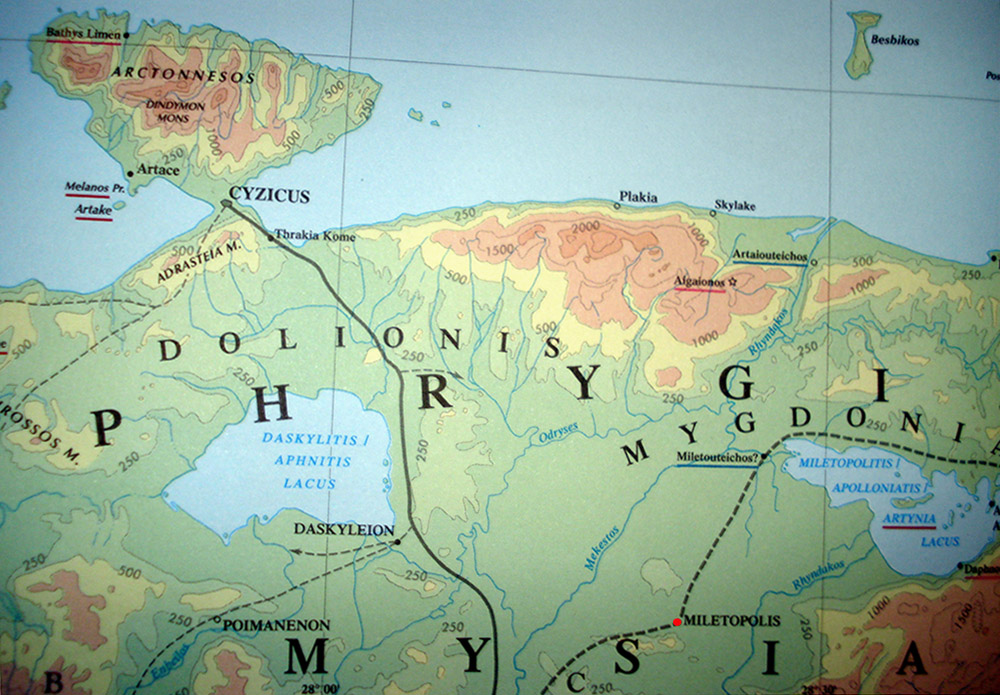 There were a few differing opinions regarding the location of Miletopolis, but the description below from Strabo's Geography ties in pretty well with the location in the Barrington Atlas: "The description of Olympus is as follows. Around it, to the north, live Bithynians, Mygdonians, and Doliones; the rest is occupied by Mysians and Epicteti. The tribes around Cyzicus from Æsepus as far as Rhyndacus and the lake Dascylitis, are called for the most part Doliones; those next to the Doliones, and extending as far as the territory of the Myrleani, are called Mygdones. Above the Dascylitis are two large lakes, the Apolloniatis, and the Miletopolitis. Near the Dascylitis is the city Dascylium, and on the Miletopolitis, Miletopolis. Near a third lake is Apollonia on the Rhyndacus, as it is called. Most of these places belong at present to the Cyziceni." Miletopolis was apparently cleared of it's inhabitants when they were sent to populate Gargara. Also from Strabo's Geography: "Myrsilus says that Assus was founded by Methymæans; but according to Hellanicus it was an Æolian city, like Gargara and Lamponia of the Æolians. Gargara was founded from Assus; it was not well peopled, for the kings introduced settlers from Miletopolis, which they cleared of its inhabitants, so that Demetrius the Scepsian says that, instead of being Æolians, these people became semi-barbarians. In the time of Homer all these places belonged to Leleges, whom some writers represent as Carians, but Homer distinguishes them, "Near the sea are Carians and Pæonians with curved bows, Leleges and Caucones."" 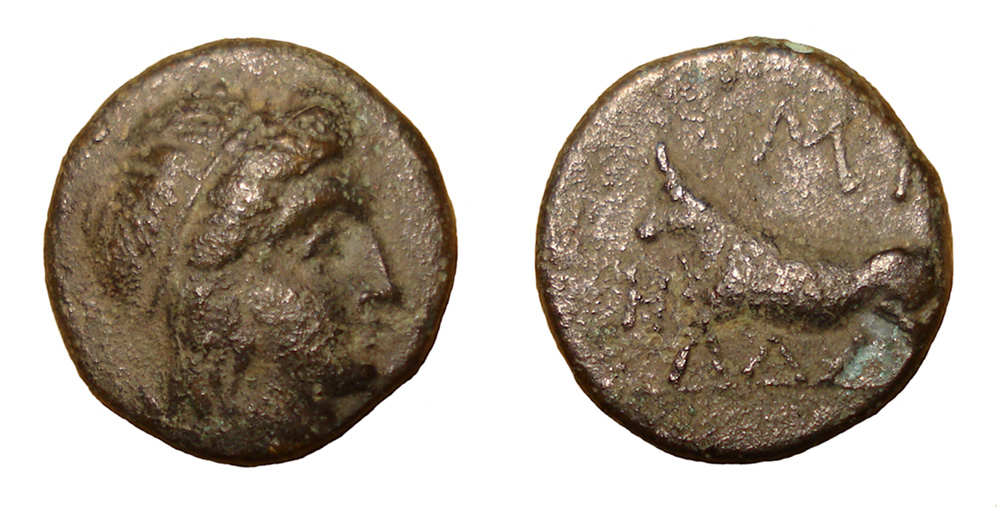 Miletopolis - Mysia. 400-300 BC. Obverse: Laureate head of Apollo right. Reverse: Bull walking left. Reverse Inscription: MI above, H before and Λ below bull. Bronze. Diameter: 11 mm. Weight: 1.5 gr. Reference: SNG France 1301 |
|
Pillar of the Community
 Spain
2752 Posts |
Informative write up as always Jim.
Interesting how Miletopolis was disbanded to repopulate another city, was this a regular occurrence back then?
Neat looking coin and especially like the Apollo portrait..
Nice addition...
Paul.
|
|
Pillar of the Community
United Kingdom
1168 Posts |
Thanks, Paul. Quote:
Interesting how Miletopolis was disbanded to repopulate another city, was this a regular occurrence back then? From what I've read so far I couldn't say it was a regular occurrence, but it wasn't a rare occurrence either. I've seen a few accounts of new cities being created for whatever reason, and being populated from other cities. Perhaps this explains why some cities disappeared and their locations are now unknown? I've come across quite a few of them. If entire populations were removed there would be nobody to carry the history or location of the city forward. There have been instances where cities have been taken, the men put to death and the women and children sold into slavery. The city was then repopulated with people from one of the victor's other cities, or an allies city, if it had a military or commercial importance. I have often wondered where Alexander populated Bucephala from after he built the city around the tomb of his horse Bucephalus. All I can find is that, "Alexander settled the new city, which was to house a permanent garrison, with Greek and Iranian veterans, and with local natives. He had large dockyards built, which implies that he intended for the city to become a major centre of commerce." |
|
Pillar of the Community
United Kingdom
1168 Posts |
I was lucky to get this Trajan Dichalkon with the elephant reverse for the menagerie as they aren't exactly thick on the ground. ACSearch turned up 15 coins of the type, but none for regnal year 16, 112-113 AD. There were no regnal year 16 coins in Wildwinds either. Various searches about the elephant reverse turned up some pretty awful information about the killing of wild animals for public entertainment. The elephant possibly represented the thousands of animals killed in the arena in public games held from 108 to 109 AD. The venationes (slaughter of animals) were very popular, but on occasion were so brutal that the spectators couldn't stomach them. One such spectacle organised by Pompey the Great caused the orator Cicero to write: "The last day was that of the elephants, on which there was a great deal of astonishment on the part of the vulgar crowd, but no pleasure whatever. Nay, there was even a certain feeling of compassion aroused by it, and a kind of belief created that the animal has something in common with mankind." Later, Pliny the Elder wrote about the same event: "When [the elephants] had lost all hope of escape, they tried to gain the compassion of the crowd by indescribable gestures of entreaty, deploring their fate with a sort of wailing, so much to the distress of the public that they forgot the general and his munificence carefully devised for their honour, and bursting into tears rose in a body and invoked curses on the head of Pompey." Even though Pompey's elephant hunt spectacle near the end of the Roman Republic caused such an emotional response, it by no means meant the end of venationes. During the early Roman Empire the slaughter of animals reached staggering new heights. Augustus, in his autobiography "Res Gestae", claimed that he had 3,500 African animals killed in 26 venationes. Around a century later, the emperor Titus inaugurated the Colosseum with a hundred days of spectacle in which 5,000 wild animals were killed. Emperor Trajan outdid them all, and in the public games held from 108 to 109 BC, arranged for 11,000 animals to fight in the arena. 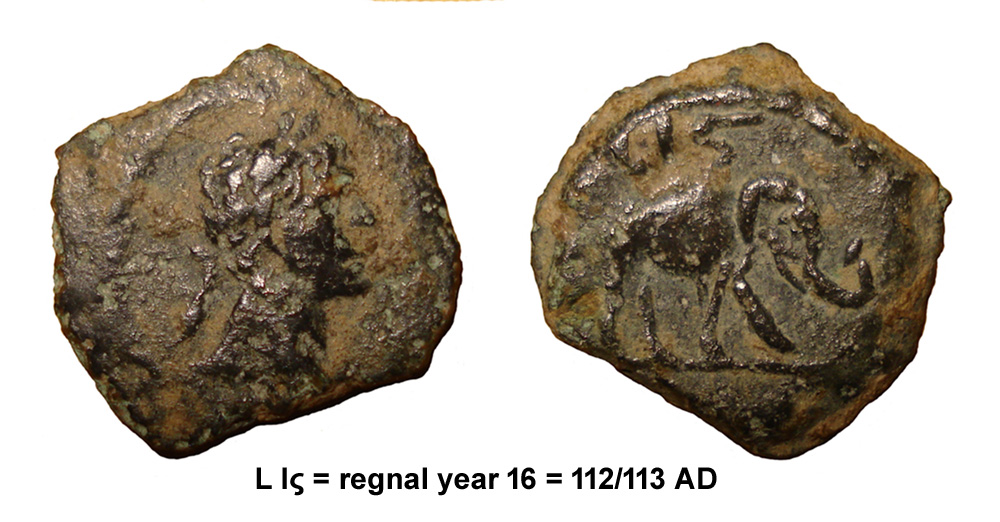 Trajan, Dichalkon of Alexandria, Egypt, 112-113 AD. Obverse: His laureate head right. Reverse: Elephant walking right; above, symbol for regnal year 16. Bronze. Diameter: 13mm. Weight: 1.39gm. Dattari (Savio) 7323. Emmett 701.16 (R5). |
|
Pillar of the Community
United States
7067 Posts |
Excellent additions! I'm just getting caught up. Sure, Jim, that may be a "Λ below bull" on the Miletopolis coin, as you listed it. But how cool it would have been if you had described it as a hitherto-unknown six-legged bull-god. Imagine the increase in value...
|
|
Pillar of the Community
United Kingdom
1168 Posts |
Quote:
But how cool it would have been if you had described it as a hitherto-unknown six-legged bull-god. Imagine the increase in value... Cheers, Bob. I laughed so hard my ribs hurt.  Quote:
...Good idea Jim....I'd be really interested in the feedback.... Update on the Isinda Pisidia Zeus/Horseman coin on Page 31, Paul. I made a submission to the RPC site and the coin has been added to the year 9 page as type RPC 1, 3512i. https://rpc.ashmus.ox.ac.uk/coins/1/3512iPS. Bibliography should read Ex Private New York coll. |
|
Pillar of the Community
Spain
2752 Posts |
Quote:
Update on the Isinda Pisidia Zeus/Horseman coin on Page 31, Paul. I made a submission to the RPC site and the coin has been added to the year 9 page as type RPC 1, 3512i.
... That's great news Jim a lovely specimen..Congrats. |
|
Pillar of the Community
United Kingdom
1168 Posts |
Quote:
That's great news Jim a lovely specimen..Congrats. Thanks, Paul. It was great to get the confirmation. I've had this coin from Aigeai (Aegeai) for a while, but am not convinced regarding the attribution of Sear 5515. The legends and devices fit the bill, but the weight is a fair bit lighter than expected at 3.9gr. It was purchased from a reliable source from a private collection, and it does appear and feel genuine. Could it be a fake? Can anyone help to pin this one down? Thanks. https://www.acsearch.info/search.html?id=1039291 as 5515 it does appear to be a match, but the weight is 7.34gr. https://www.acsearch.info/search.html?id=6012390 is much nearer to the weight at 3.5gr, but is smaller in diameter at 17mm, and has a different attribution. https://www.wildwinds.com/coins/gre...oesch_57.jpg (Sear 5513-5515) is not a match. https://www.wildwinds.com/coins/gre...nce_2300.jpg is very similar, but heavier at 7.48gr. https://www.wildwinds.com/coins/gre...i/sg5515.jpg is heavier again at 8.7gr. 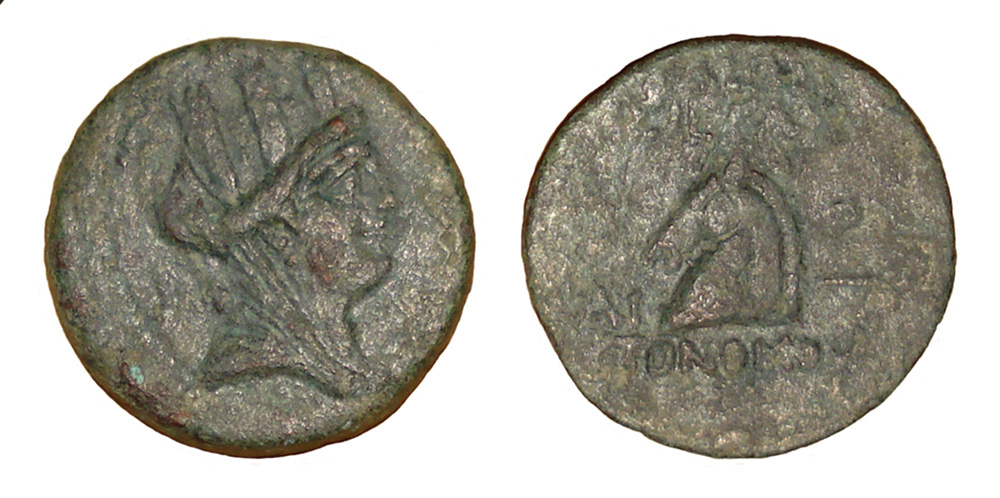 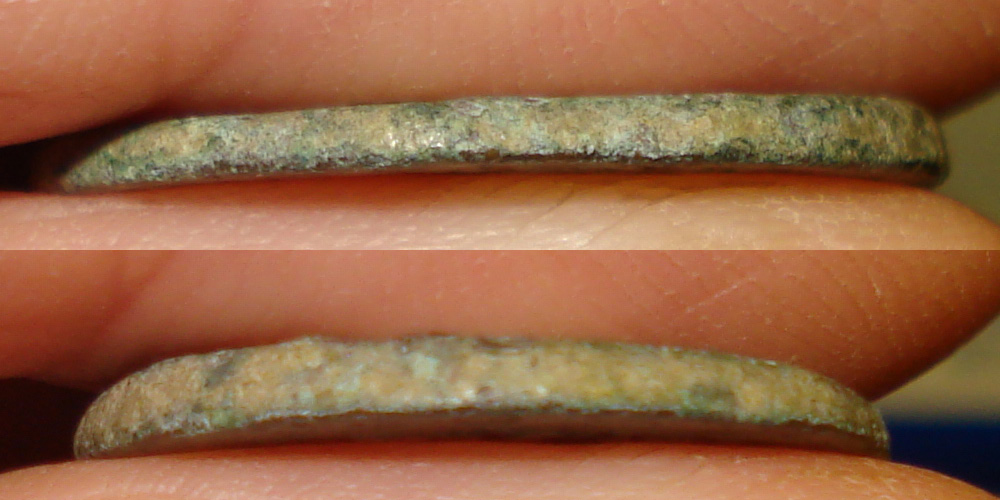 Original description: Cilicia, Aigeai, 2nd - 1st cent. BC. Obverse: Turreted head of veiled Tyche right. Reverse: Horse's head left; ΑΙΓΕΑΙΩΝ / ΤΗΣ ΙΕΡΑΣ above, ΚΑΙ / ΑΥΤΟΝΟΜΟΥ below. Monogram in right field. Bronze. Diameter: 20mm. Weight: 3.9 gm. Reference: Sear 5515. |
|
Pillar of the Community
Spain
2752 Posts |
Jim, nothing screaming fake here imo.
I've searched a lot!,but as you say the weight is light.
The edge looks good but I just can't find an example as low as 4 grams....Hopefully Bob will come up with something?
Imo...The coin is legit..
|
|
Pillar of the Community
Spain
2752 Posts |
Jim, nothing screaming fake here imo.
I've searched a lot!,but as you say the weight is light.
The edge looks good but I just can't find an example as low as 4 grams....Hopefully Bob will come up with something?
Imo...The coin is legit..
Good luck....
|
|
Pillar of the Community
United Kingdom
1168 Posts |
Quote:
Imo...The coin is legit.. Thanks for taking the time to check it out, Paul.  The weight appears to be the deciding factor, and I am now leaning towards it being the "Turreted and veiled bust of Tyche r. R/ Horse's head left; monograms flanking. SNG BnF 2297 var. (monogram); SNG Levante 1657; SNG von Aulock 5445 var. (monogram).", even though this one is 17mm. As you say, there isn't another as light as 4gr so I can't see it being anything else. |
|
Pillar of the Community
Spain
2752 Posts |
Jim here's one I stumbled across on vcoins with Marc.R.Breitsprecher at 3.44grams. Title: Cilicia. Aigeai Æ20 / Horse Head Attribution: SNG France 2282 Date: Circa 160-120 BC Obverse: Turreted head of Tyche right Reverse: Horse's head left Size: 20.26mm Weight: 3.44 grams Description: nearing VF 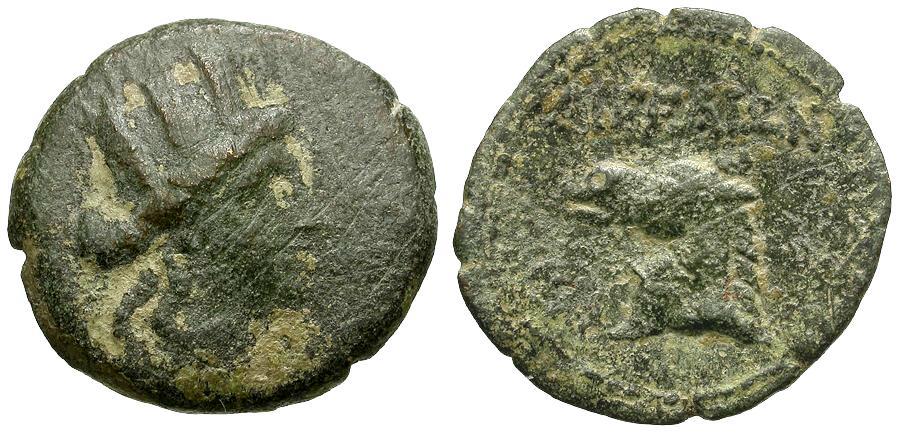 |
|
Pillar of the Community
United Kingdom
1168 Posts |
Quote:
Jim here's one I stumbled across on vcoins with Marc.R.Breitsprecher at 3.44grams. Thanks for this, Paul. With this latest coin having dimensions of 20.26mm and 3.44gr, and the 17mm coin from the ACsearch weighing 3.5gr, they compare more favourably with the original coin at 20mm and 3.9 gm. The attributions of the first two coins above are SNG France 2297 and SNG France 2282, so are both close in the same series. It does appear that the original coin has been attributed incorrectly. Thanks, Jim |
| |
Replies: 638 / Views: 59,866 |






 First Page
 Previous Page


 Posted 08/19/2022 6:35 pm


