|
This page may contain links that result in small commissions to keep this free site up and running.

Welcome Guest! Registering and/or logging in will remove the anchor (bottom) ads. It's Free!
To participate in the forum you must log in or register. | Author |
 Replies: 638 / Views: 59,865 Replies: 638 / Views: 59,865 |
|
|
|
Pillar of the Community
 Spain
2752 Posts |
You're welcome Jim...I'm just sorry the MRB example isn't a little bit more detailed....You are finding some interesting coins....Congrats
|
|
Pillar of the Community
 United Kingdom
1168 Posts |
Quote:
I'm just sorry the MRB example isn't a little bit more detailed. Thanks, Paul. All help is greatly appreciated. Following on from the Miletopolis coin posted on the previous page where the population was moved to Gargara, here is a rather attractive little coin from Gargara. Looking at the map, it was quite a trek from Miletopolis to Gargara. Gargara it's self was said to have been moved from the mountaintop Palaigargara (Old Gargara) to the more hospitable coast. 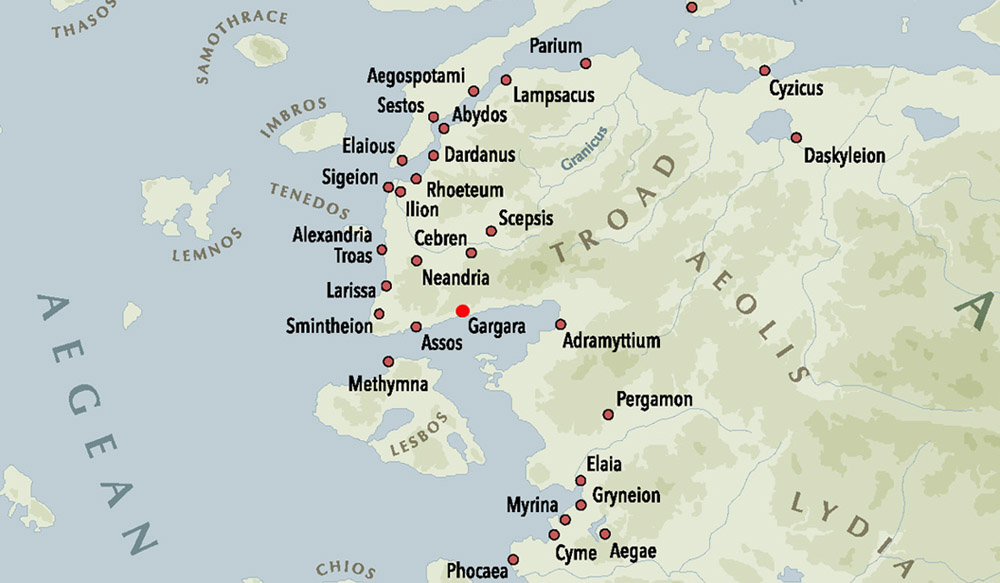 From, "Hansen & Nielsen - Lexique Poleis" "Gargara was founded from Assos (Strabo 13.1.58), although the indigenous population was Lelegian (Strabo 13.1.58, interpreting Hom. Il. 10.428). Gargara was a member of the Delian League. It belonged to the Ionian district and is recorded from 452/1 to 428/7 a total of eight times, twice completely restored, paying a phoros of either 4,500 dr. or 4,660 dr. It was assessed for tribute in 410/9. In C4l it was a member of the confederation of Athena Ilias (Michel 522). The site was relocated from Palaigargara on a mountain peak to a coastal site at an unspecified period, either before C5 (so ATL i. 477) or in the Hellenistic period later than the composition of the epigram of Aratos (Anth. Pal. 9.437; so Leaf (1923) 262). Demetrios of Skepsis apud Strabo 13.1.58 reports that colonists were brought from Miletoupolis by the kings, so that the population became semi-barbarous rather than Aiolic. This was presumably in the Hellenistic period. Gargara minted silver and bronze coins. Silver, c.420-400: denominations: tetrobol, diobol, hemiobol, tritartemorion: obv. male head (Apollo?); rev. bull grazing, or galloping horse, or ram's head, or spokes of wheel. Silver and bronze, c.400-284: denominations: tetrobol and small fractions: obv. Apollo laureate; rev. same types, no wheel. Legend: ΓΑΡΓ or ΓΑΡ expanded to ΓΑΡΓΑΡΕΩΝ on imperial coins (Head, HN2 545; SNG Cop. Troas314-31)." 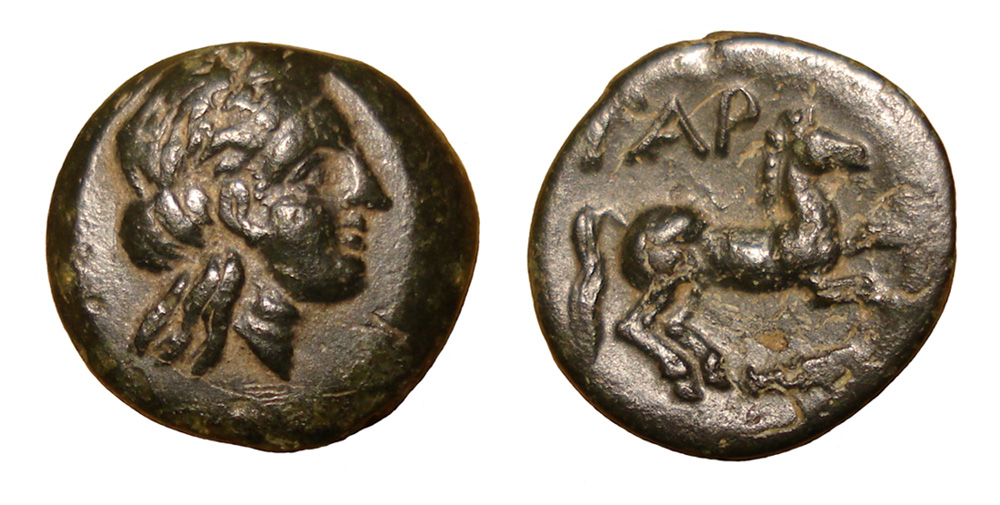 Troas: Gargara. Mid-4th Century B.C. Chalkon. Obverse: Laureate head of Apollo right. Reverse: ΓΑΡ. Horse running right.; below, fulmen. Bronze. Diameter: 11mm. Weight: 1.89gm. Reference: BMC 5. Rare. Edited by Novicius
10/06/2022 8:27 pm
|
|
Pillar of the Community
Sweden
2124 Posts |
Three horse coins in a row!  I especially like the Gargara one, its horse is beautifully rendered. And the tinyness of it, I never cease to be amazed at the skill of the ancient die cutters ... My own stable of Celtic horses on Gallic coins never becomes full  . Hopefully I have one more galloping into my mail box any day now, not totally unlike the Gargara coin in its design composition. Will show it here, of course. |
|
Pillar of the Community
United Kingdom
1168 Posts |
Thanks, @erafjel. It is amazing how these ancient die cutters managed to convey the impression of motion in the animals, especially the horses. The next one to be posted has the head of a bull on the reverse. It isn't so detailed, but it is only 7mm in diameter. Quote:
Hopefully I have one more galloping into my mail box any day now, not totally unlike the Gargara coin in its design composition. Will show it here, of course. I look forward to seeing your latest Celtic horse acquisition. 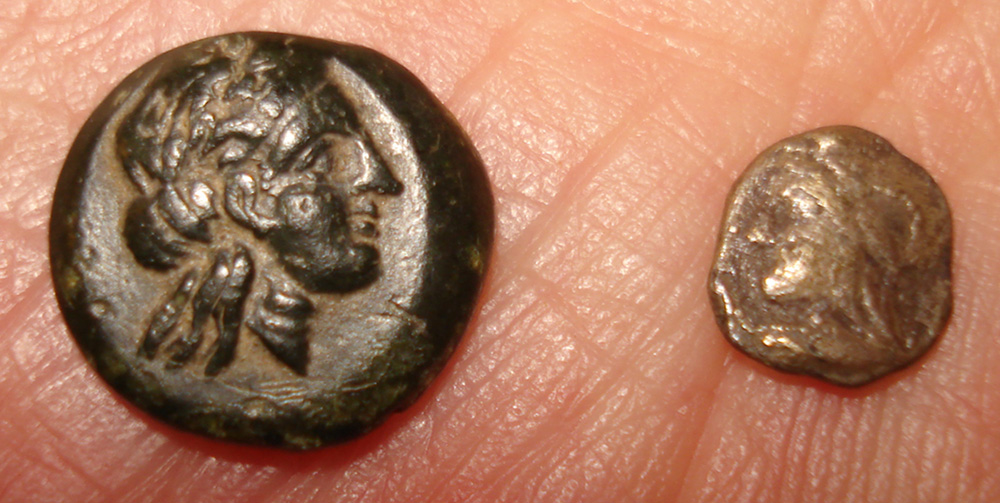 |
|
Pillar of the Community
United Kingdom
1168 Posts |
Another tiny coin from Cyzicus (Kyzikos) with a bull's head on the reverse. The obverse features the head of a god I was unfamiliar with, the vegetation god Attis representative of plants that die in winter and return in spring. Apparently an Attis cult began around 1250 BC in Dindymon. He was originally a local semi-deity of Phrygia, and some searches revealed quite a story. From Britannica com: "Attis, also spelled Atys, mythical consort of the Great Mother of the Gods (q.v.; classical Cybele, or Agdistis); he was worshipped in Phrygia, Asia Minor, and later throughout the Roman Empire, where he was made a solar deity in the 2nd century AD. The worship of Attis and the Great Mother included the annual celebration of mysteries on the return of the spring season. Attis, like the Great Mother, was probably indigenous to Asia Minor, adopted by the invading Phrygians and blended by them with a mythical character of their own. According to the Phrygian tale, Attis was a beautiful youth born of Nana, the daughter of the river Sangarius, and the hermaphroditic Agdistis. Having become enamoured of Attis, Agdistis struck him with frenzy as he was about to be married, with the result that Attis castrated himself and died. Agdistis in repentance prevailed upon Zeus to grant that the body of the youth should never decay or waste. Other versions also exist, but they all retain the essential etiological feature, the self-castration. Attis was fundamentally a vegetation god, and in his self-mutilation, death, and resurrection he represents the fruits of the earth, which die in winter only to rise again in the spring. In art Attis was frequently represented as a youth, with the distinctive Phrygian cap and trousers." Though the above quote says that Attis is also spelled Atys, other authors state that they are separate entities. Theoi com quotes Pausanias, Description of Greece 7. 19. 9-12 (trans. Jones) (Greek travelogue C2nd A.D.): "The people of Dyme [in Akhaia (Achaea)] . . . have as well a sanctuary built for the Dindymenian mother [Kybele (Cybele)] and Attis. As to Attis, I could learn no secret about him, but Hermesianax, the elegiac poet, says in a poem that he was the son of Galaos (Galaus) the Phrygian, and that he was a eunuch from birth. The account of Hermesianax goes on to say that, on growing up, Attis migrated to Lydia and celebrated for the Lydians the orgies of the Mother; that he rose to such honor with her that Zeus, being wroth at it, sent a boar to destroy the tillage of the Lydians. Then certain Lydians, with Attis himself, were killed by the boar, and it is consistent with this that the Gauls who inhabit Pessinos (Pessinus) abstain from pork. But the current view about Attis is different, the local legend about him being this. Zeus [i.e. the Phrygian sky-god identified with Zeus], it is said, let fall in his sleep seed upon the ground, which in course of time sent up a Daimon, with two sexual organs, male and female. They call the Daimon Agdistis. But the gods, fearing Agdistis, cut off the male organ. There grew up from it an almond-tree with its fruit ripe, and a daughter of the river Saggarios (Sangarius), they say, took of the fruit and laid it in her bosom, when it at once disappeared, but she was with child. A boy was born, and exposed, but was tended by a he-goat. As he grew up his beauty was more than human, and Agdistis [now the goddess Kybele] fell in love with him. When he had grown up, Attis was sent by his relatives to Pessinos, that he might wed the king's daughter. The marriage-song was being sung, when Agdistis appeared, and Attis went mad and cut off his genitals, as also did he who was giving him his daughter in marriage. But Agdistis repented of what he had done to Attis, and persuaded Zeus to grant that the body of Attis should neither rot at all nor decay. These are the most popular forms of the legend of Attis." 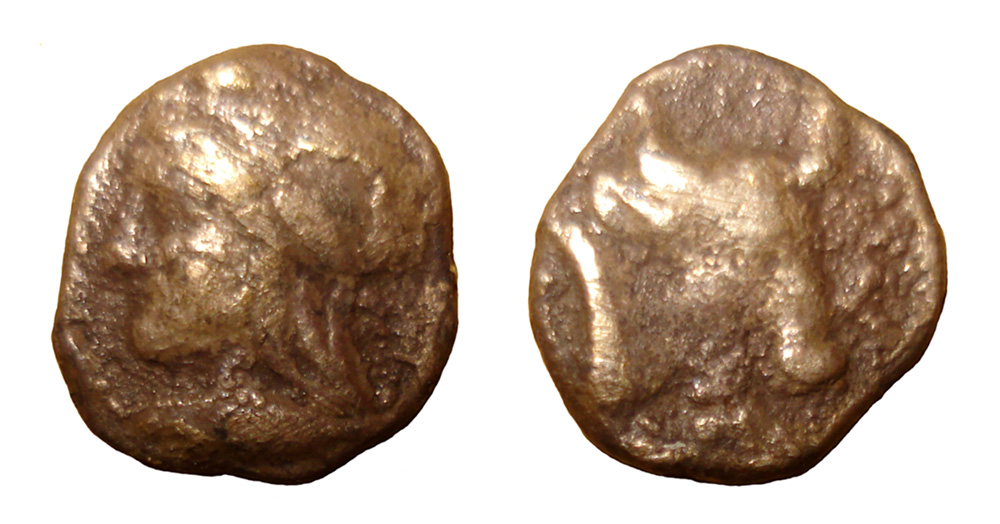 Cyzicus Mysia. Circa 410 - 400 BC. AR Hemiobol Obverse: Head of Attis left, wearing Phrygian cap. Reverse: Bull's head facing slightly right. Silver. Diameter: 7mm. Weight: 0.31gm. Reference: Von Fritze II 23. Klein 268. SNG von Aulock 7336. |
|
Pillar of the Community
Spain
2752 Posts |
Another neat addition to your well researched collection Jim Interesting write up Thanks.. |
|
Pillar of the Community
Sweden
2124 Posts |
Those are some juicy myths, indeed. And the wonderful workmanship of that 7 mm coin is clearly recognizable. At my end, it has arrived, my most recent capture for my Gallic stable!  Coriosolites, ca 56-51 BC, stater. Billon, 6.3 g, 21 mm. Obverse: Face with hair in three curls ("pointed nose" type). Reverse: Horse with strongly stylized charioteer (the chariot is missing). Below a wild boar. La Tour 6598, Delestree 2340. 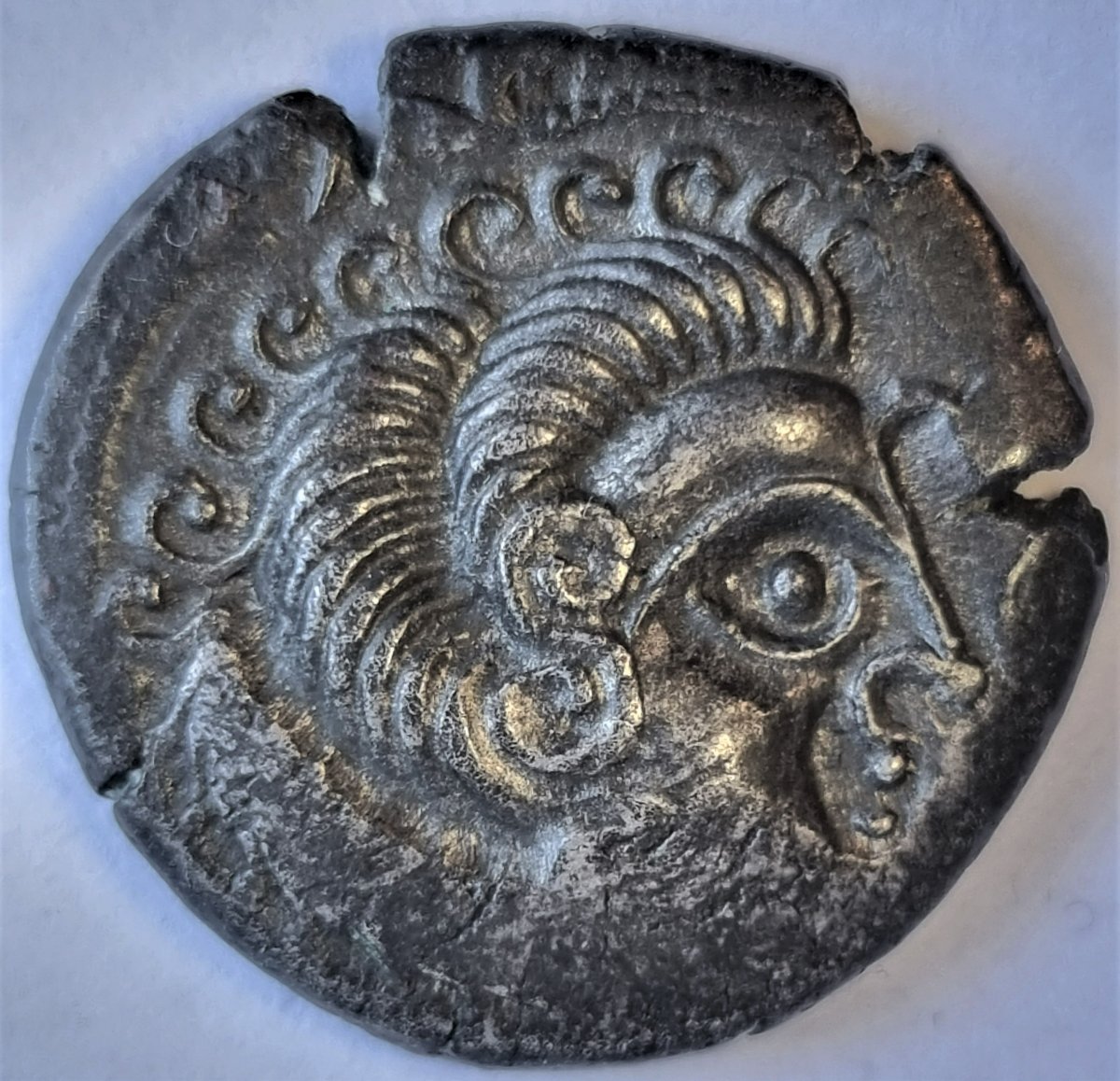 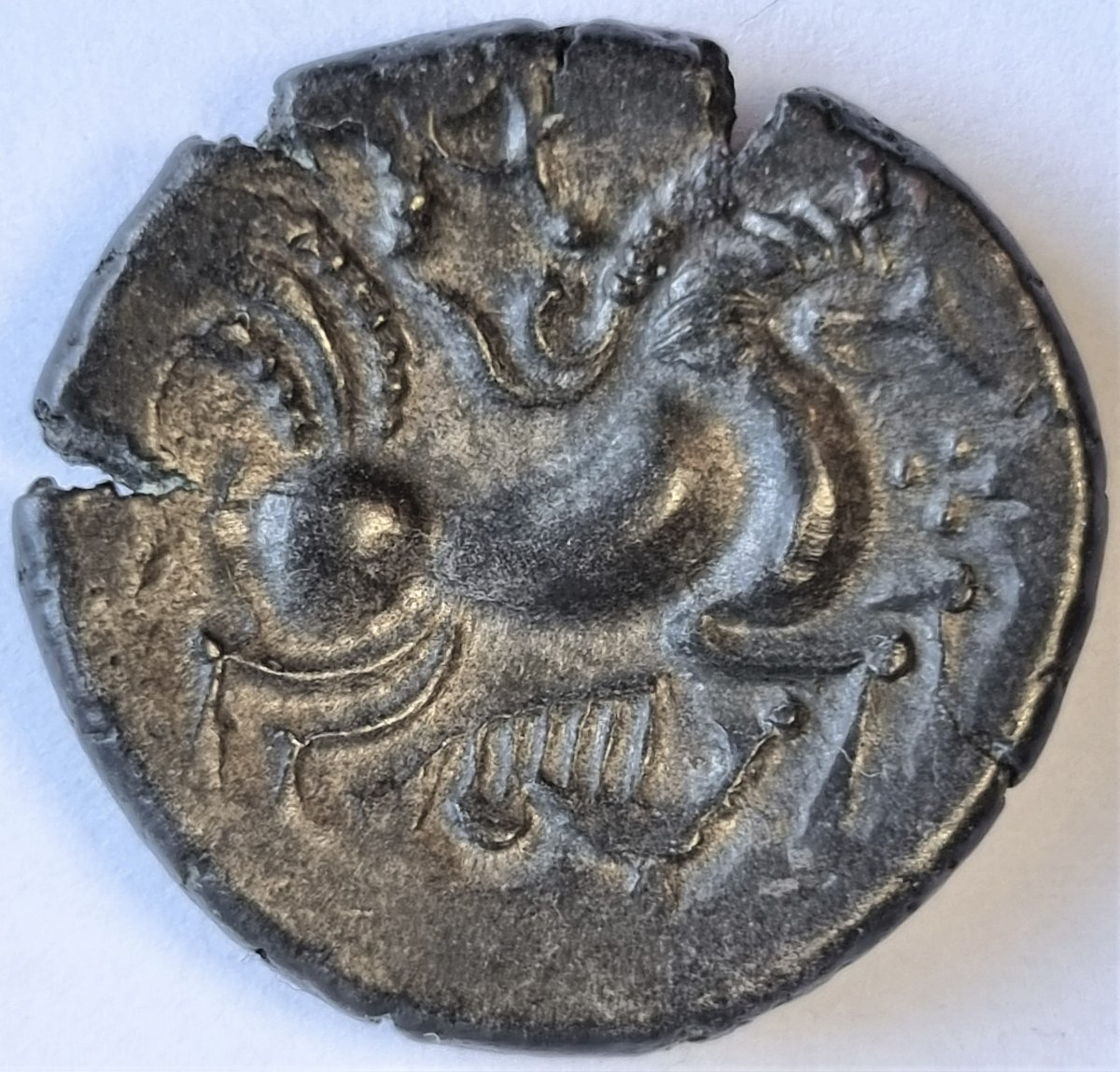 The Coriosolites (different spellings occur) was a Gallic/Celtic tribe living in Armorica, on the north shore of Brittany, with present day town Corseul as center. Not much is known about them. Pliny the Elder and Caesar mention them in passing in their works Natural History resp. Gallic Wars, but without telling much. Their name, Coriosolites, can possibly be derived from Gaulish corio-soli-ti, meaning "those with vigilant troops." They did fight the Romans, and they did mint a lot of coins of the type I show here in conjunction with the Gallic Wars 58-51 BC. A theory is that these were minted to pay soldiers. 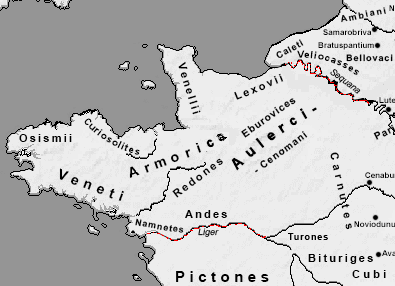 Courtesy of Wikimedia Commons, CC BY-SA 3.0 Courtesy of Wikimedia Commons, CC BY-SA 3.0The staters of this type are believed to have been minted in large numbers during nearly a decade and one can set up a sequence of developments of the motif. Originally the horse was androcephalic, with a human face and the charioteer was more recognizable as such. My coin would then be from a late issue, with degenerated features (see Note). The original motif is in turn an immobilization of the Macedonian staters with Apollo and a chariot, which circulated in Gaul during the 3rd century BC and inspired the local coinage for a long time. Even the Gallic warriors used chariots, so the choice of motif for a "war issue" is fitting. Likewise, the wild boar was a symbol of strength and vigor and there was a belief that it could protect in battle. The particular hairstyle with three big curved curls is specific to the Coriosolites and the Veneti (another Brittany tribe) and not seen on any of the numerous other immobilizations. Maybe it was a local fashion? In any event, it makes these coins very characteristic and, in my view, attractive. Note: There are also studies showing a variation of silver content in different issues, ranging from 10 to 30 %. Assuming that this reflects a decrease over time (as can be expected in times of crises and need for "more" money), that also supports that this type is of a later, probably the last issue, with a silver content of about 10 %. One theory is that this last issue took place in conjunction with an (unsuccessful) campaign against the Romans in 56 BC, where Viridovix, chief of the Venelli tribe, led a coalition of Gallic tribes. Considering the vast amount of coins of this type found - in the order of 10,000 (most in worse condition that the one I show here, though) - I doubt that the Coriosolites had the capacity to mint them all in a single year; I give it a span of a few years. |
|
Pillar of the Community
United Kingdom
1168 Posts |
Quote:
Another neat addition to your well researched collection Jim. Thanks, Paul. Sometimes the most uninteresting looking little coins can have a fascinating story to tell. There is another Roman eagle reverse on the way now. My budget is getting really strained!  Quote:
Those are some juicy myths, indeed. And the wonderful workmanship of that 7 mm coin is clearly recognizable. Thanks, Erafjel. Your latest Coriosolites coin is in beautiful condition and is a real piece of eye candy. Super interpretation of the horse.  The Gallic engravers appear to have been very futuristic in comparison to most of that time period. The Picasso's of the ancients, perhaps? Thanks for the accompanying write-up too. I do enjoy reading (and learning) about subjects that were unknown to me. I think I'll have to acquire one of these Celtic issues now myself, and am seriously looking at one of the Sequani coins. It is nowhere near in as nice condition though. Thanks guys, Jim |
|
Pillar of the Community
Sweden
2124 Posts |
Thank you, @Novicius. I really do like the coin - the moment I saw it, I thought "I must have it!" and I was lucky enough to win the auction. Celtic (for me, specifically Gallic) coins is a fascinating collection theme. So many peoples, each with their own style. So much written about it, yet so much still unknown. The Celtic universe of religion and symbols was apparently very rich and in many respects different from the Greek and Roman counterparts. Although the Celts had a rich oral tradition, they did not have a literary tradition and did not write anything down (what we know about them is based on archeological finds and what Greek and Roman authors have told us). The deeper knowledge was a well kept secret guarded by the druids. Thus much of the symbolic meaning of the motifs on their coins remain unknown or only vaguely known to us, and subject to conjecture. But that doesn't make it any less interesting . Be careful with that first Celtic coin, Novicius, you may be bitten by the Celtic bug.  |
|
Pillar of the Community
United States
7067 Posts |
Outstanding coin, erafjel. And great write-ups on the Gargara and Kyzikos additions, Jim. I particularly like the rendition of that running/prancing Gargara horse. Reminds me some of the stylized horses from one of my oil paintings many years ago.
|
|
Pillar of the Community
United Kingdom
1168 Posts |
Quote:
Celtic (for me, specifically Gallic) coins is a fascinating collection theme. Your coins and write-ups have been very interesting, @erafjel. It would be nice to start a small collection, but as I'm still struggling with the Greek coins it might be too much for my old brain! Quote:
Be careful with that first Celtic coin, Novicius, you may be bitten by the Celtic bug. Unfortunately that is a distinct possibility. Thanks again, Bob. Quote:
Reminds me some of the stylized horses from one of my oil paintings many years ago. Was this painting your own work, Bob? Is there an image you could share? That would be cool. |
|
Pillar of the Community
United States
7067 Posts |
Quote:
Was this painting your own work, Bob? Is there an image you could share? I shared it in another thread years back, but here's a detail of the horses. The Gargara horse reminded me, in particular, of the lower horse in this image. It was an oddball painting for me - not the norm. 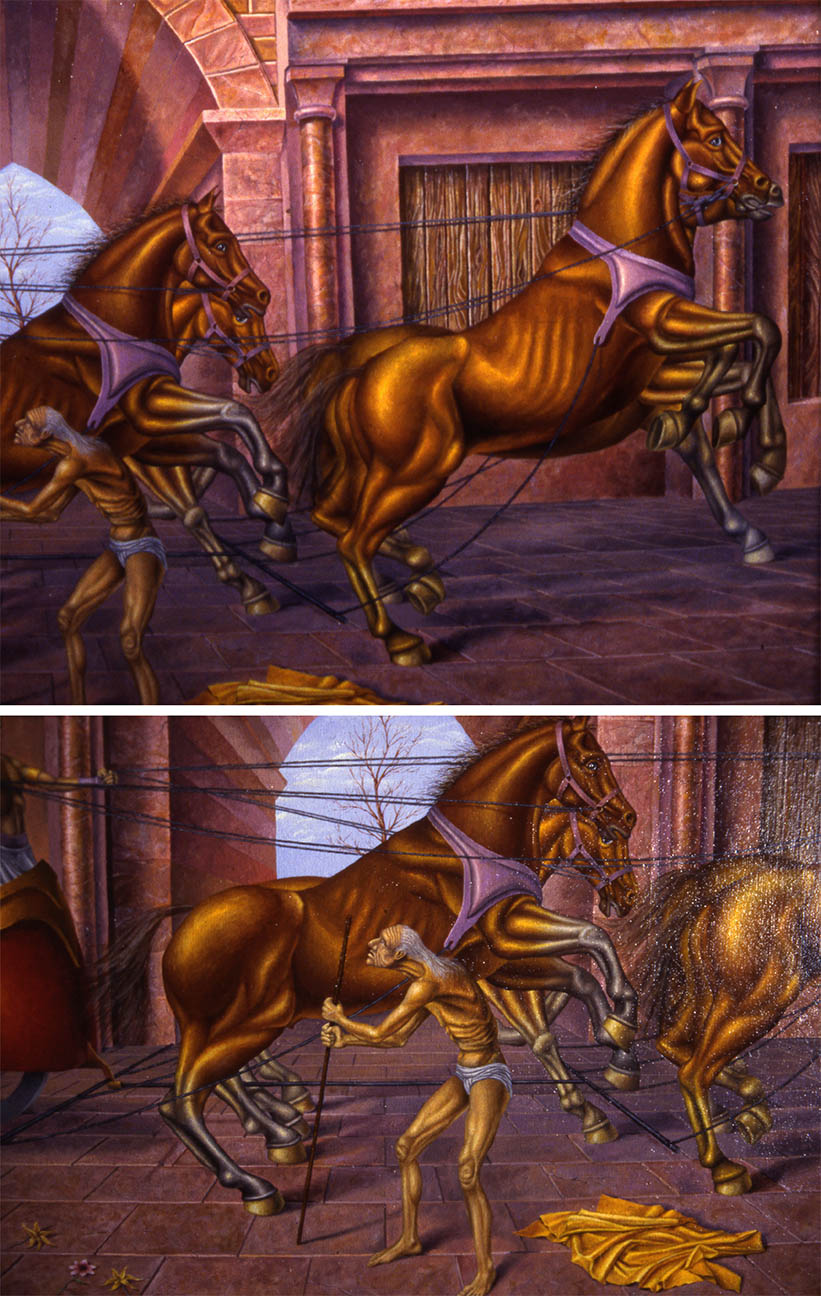 |
|
Pillar of the Community
United Kingdom
1168 Posts |
Quote:
The Gargara horse reminded me, in particular, of the lower horse in this image. Yes, Bob, the similarity is striking. The colours in the painting are very pleasing to the eye, and the implied motion of the horses bring it to life. There is also a luminosity that I would not expect to see in an oil. You have a rare gift. |
|
Pillar of the Community
United Kingdom
1168 Posts |
Definitely getting hooked on these eagles, and here is another Philip II eagle reverse. It is similar to the Philip II coin on page 32 of this thread, but this time he is looking left. Knowing how well the engravers can capture the rulers portraits, even to them ageing, I wonder why Philip II is portrayed as an adult? He was only twelve years old when he died after all. Did they use his father's image and remove the wrinkle on his forehead? The portrait of Philip I in Paul's (Palouche) thread "Philip I Tetradrachm, Antioch." shows the wrinkle on the forehead clearly. 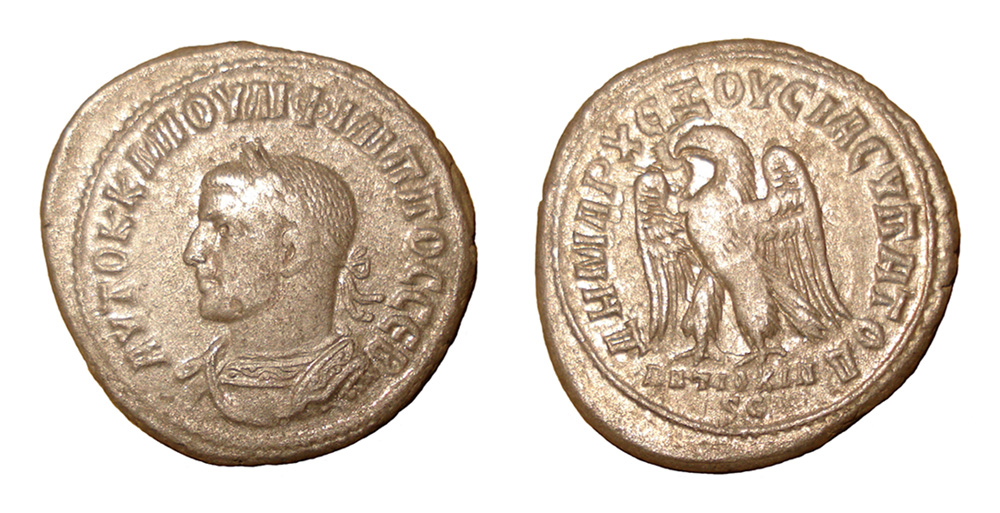 Philip II. BI Tetradrachm of Antioch on the Orontes, AD 249. Obverse: His laureate bust, left, wearing armour with balteus. Inscription: ΑΥΤΟΚ Κ Μ ΙΟΥΛΙ ΦΙΛΙΠΠΟC CEΒ. Reverse: Eagle standing left, wings open, wreath in beak. Inscription: ΔΗΜΑΡΧ EΞΟΥCΙΑC ΥΠΑ ΤΟ Δ; below, ANTIOXIA S C. Silver. Diameter: 27mm. Weight: 12.10gr. Reference: Prieur 461. Previous owners note: A very rare issue with an interesting portrait type. |
|
Pillar of the Community
United Kingdom
1168 Posts |
I didn't expect to find a Claudius coin with his bust and an animal reverse within budget, so getting this one was indeed fortunate. It's not in the best condition, but I'm very happy with it. From the Phoenicia Mint in Berytus. The reverse of the coin shows a veiled figure ploughing right with two oxen. Some say that the veiled figure represents Claudius performing "Sulcus Primigenius", literally the original furrow, referring to the furrow usually ploughed by priests leading two oxen, in an archaic Roman ceremony that established a sacred area in the foundation of a new city. However the original village called Biruta was destroyed by Diodotus Tryphon in 140 BC and rebuilt as Laodicea in Phoenicia some time before 110 BC. The city was then conquered by the Romans of Pompey in 64 BC and renamed Berytus, so Claudius could not have been the founder. The territory did grow under Claudius though, as per the paragraph below from Wikipedia. 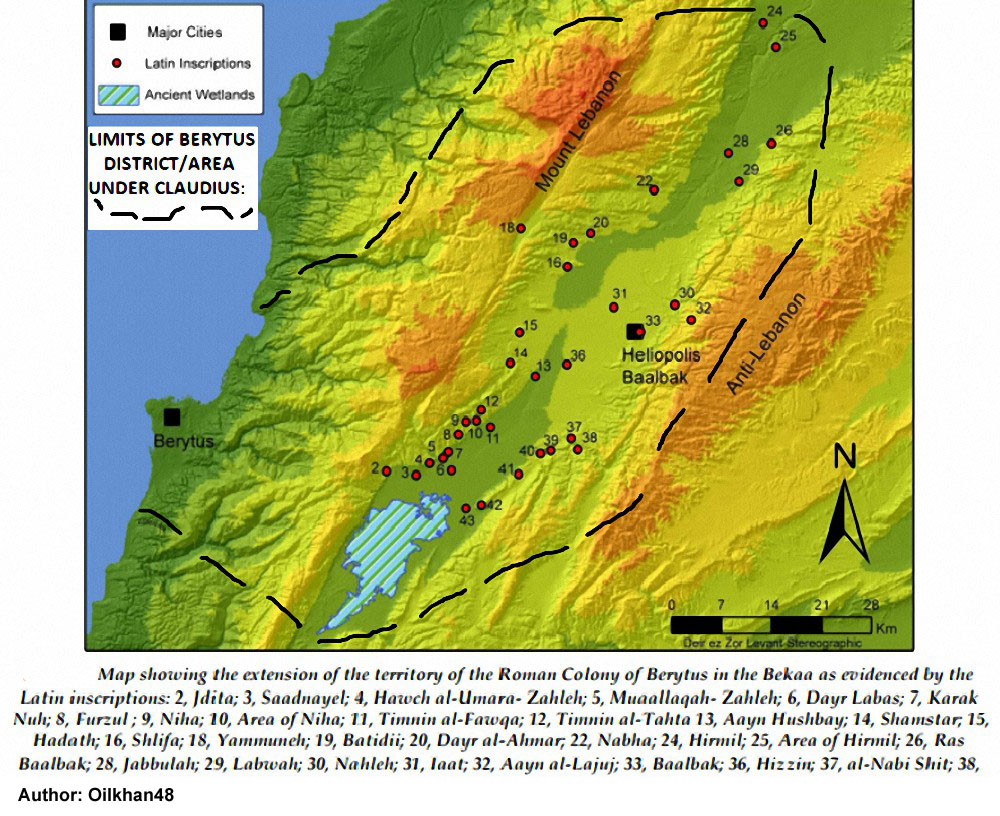 Wikipedia - Berytus: "Its territory/district under Claudius reached the Bekaa valley and included Heliopolis; it was the only area mostly Latin-speaking in the Syria-Phoenicia region, because of the Roman colonists who promoted agriculture in the fertile lands around Yammoune. From the 1st century BC the Bekaa valley served as a source of grain for the Roman provinces of the Levant and even for the same Rome (today the valley makes up to 40 percent of Lebanon's arable land): Roman colonists created there even a "country district" called Pagus Augustus, where are located the famous Niha temples with Latin inscriptions." 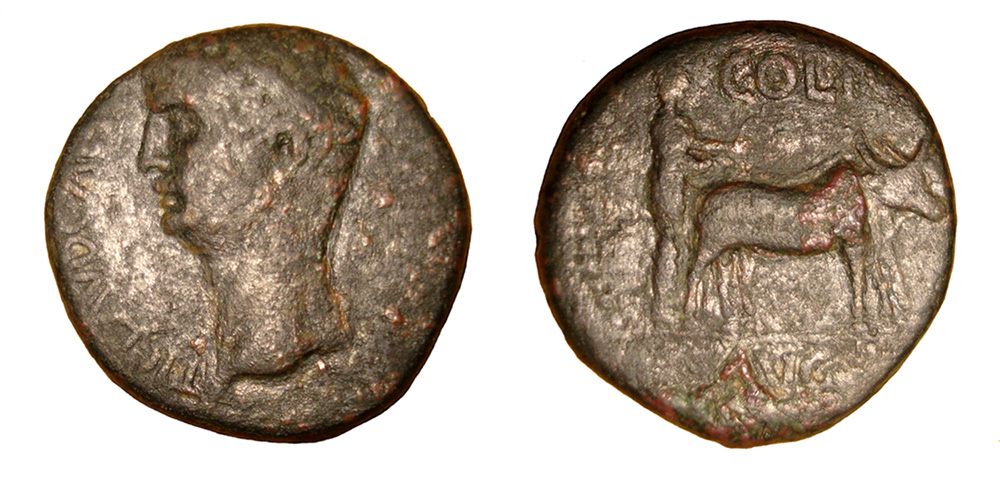 Claudius, Berytus, Phoenicia. AD 41-54. Obverse: Bare head of Claudius, left. Obverse Inscription: TI CLAVD CAESAR AVG GERM IMP. Reverse: Veiled figure ploughing, right, with two oxen. Reverse Inscription: COL IVL AVG. Bronze. Diameter: 23mm. Weight: 12.3gr. Reference: BMC 74, RPC I, 4546. |
| |
Replies: 638 / Views: 59,865 |
To participate in the forum you must log in or register.
Disclaimer: While a tremendous amount of effort goes into ensuring the accuracy of the information contained in this site, Coin Community assumes no liability for errors. Copyright 2005 - 2026 Coin Community Family- all rights reserved worldwide. Use of any images or content on this website without prior written permission of Coin Community or the original lender is strictly prohibited.
Contact Us | Advertise Here | Privacy Policy / Terms of Use
|
| Coin Community Forum |
© 2005 - 2026 Coin Community Forums |
| It took 0.39 seconds to rattle this change. |
 |
|
| |
| |






 First Page
 Previous Page


 Posted 10/06/2022 8:24 pm


