| Author |
 Replies: 638 / Views: 59,825 Replies: 638 / Views: 59,825 |
|
|
|
Pillar of the Community
 United Kingdom
1168 Posts |
Thanks Bob. Quote:
Interesting the different monograms used on the reverse, are these a reference to the cities where the coins were minted? There doesn't appear to be any definitive meaning of the monograms Paul. They were evident in the Mediterranean states in the 5th century BC. A monogram often did indicated a place, possibly where the coins were minted. They have also been attributed to a Magistrate, a mint overseer, or an individual engraver. I don't think it was the same Pythagoras though.  Even though the coin below is earlier and very small, it seems to have survived pretty well. The horse forepart is almost identical to the others. This one is said to be a rare coin. 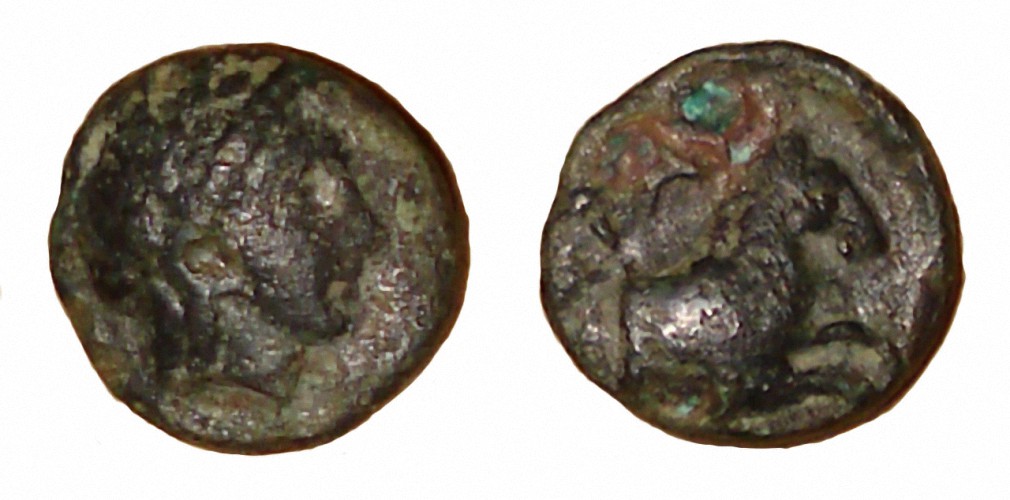 Atarneos - Mysia. 400-350 BC Obverse: Laureate head of Apollo right. Reverse: Horse forepart right. Reverse Inscription: ATAP. Bronze. Diameter: 10 mm. Weight: 0.8 gr. Reference: BMC 5. Same type as Auctiones GmbH eAuction #3 Lot 49 (19 Feb 2012). |
|
Pillar of the Community
 Spain
2752 Posts |
Another nice pick up Jim  .....Certainly seems to be quite an uncommon coin... And again thanks for giving me another city I hadn't heard of...Great links with Aristotle.. It's also a very old coin....How does that green area look at 11 o'clock? |
|
Pillar of the Community
United Kingdom
1168 Posts |
I keep coming across cities I hadn't heard of all the time Paul. It's part of the fascination of these coins.
The colouration of the coin is pretty true to life, and the green patch almost put me off buying it. However, I probably wouldn't see another, so decided to go for it. If it is the dreaded BD, have you any advice on how to deal with it?
Jim
|
|
Pillar of the Community
Spain
2752 Posts |
Hi Jim..... Quote:
If it is the dreaded BD, have you any advice on how to deal with it? I've been really lucky and never had to treat a coin with BD...There are lots of threads here on the forum with good advice and collectors experiences so maybe do a search?...One thing I do know is stick a mask on it and put in quarantine away from all your other coins until you can ascertain if it is in fact BD and whether it's still active. Here's one link I found that seems to have a good overall breakdown.. http://www.crescentcitycoinclub.org...0Disease.pdfGood luck and let us know how it goes.....Paul |
|
Pillar of the Community
United Kingdom
1168 Posts |
Thank you for the link Paul. It is an excellent article and very easy to follow. Quote:
Can you "scrape off" the green part with a stiff toothbrush, a toothpick or fingernail? I did have an attempt to scrape off some of the green stuff with a toothpick, but not even a speck of dust came off. The area appears to be solid and nothing came away. I'm hoping that it means that the coin is OK. Jim |
|
Pillar of the Community
Spain
2752 Posts |
That's a good start Jim ...Sounds like the Bd was maybe treated before and stabalised... Hopefully some of the experts here who have had hands on experience with Bronze Disease will chime in and give you a few tips....Paul |
|
Pillar of the Community
United Kingdom
1168 Posts |
Quote:
Sounds like the Bd was maybe treated before and stabilised. On close inspection it does look that way Paul. BTW is the regal looking gentleman in your new avatar Antoninus Pius? Another horse and rider reverse from Elaia - Aeolis, but it was the Corinthian helmeted Athena that first caught my eye. To my mind, the crested Corinthian helmet is one of the most elegant of the time. Elaea was an ancient city of Aeolis, Asia, the port of Pergamum. According to the Barrington Atlas of the Greek and Roman World, it was located near the modern town of Zeytinda#287;, #304;zmir Province, Turkey. The ruins of the silted port's breakwater can be seen on satellite maps at 38°56'35.54"N 27°2'16.34"E. The newly surveyed remnants of ancient harbour of Elaia reveal that it covers 2 x 1 Km. 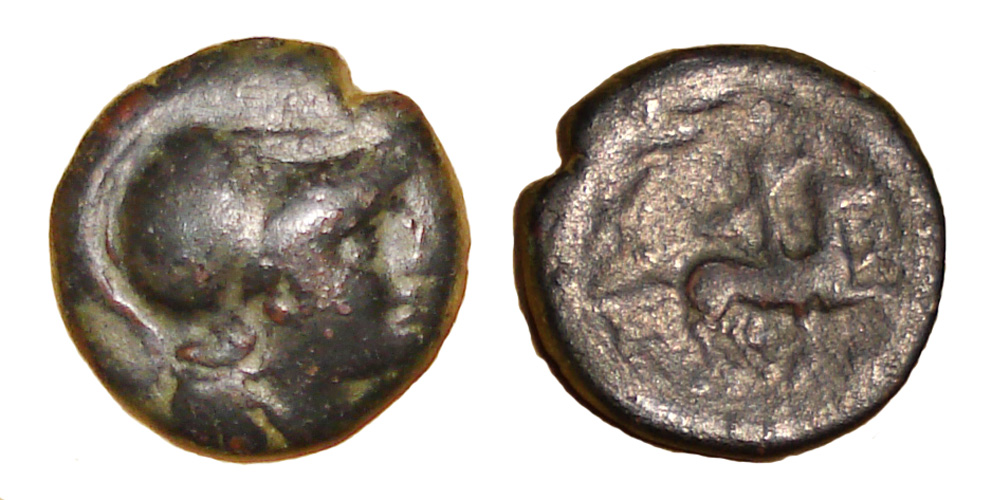 Elaia - Aeolis. 340-300 BC. Obverse: Head of Athena right, wearing crested Corinthian helmet. Reverse: Rider with raised arm on horse striding right, within wreath. Reverse Inscription: EΛAI. Bronze. Diameter 15 mm. Weight: 2.5 gr. Reference: BMC 15. Edited by Novicius
06/18/2020 7:41 pm
|
|
Pillar of the Community
United States
7067 Posts |
Nice coin, Jim. Looks thick. Interesting stick figure approach to the rider, considering it's 4th century BC Asia Minor.
|
|
Pillar of the Community
United Kingdom
1168 Posts |
It is pretty thick for it's size Bob, and is just a shade under 3 mm.
|
|
Pillar of the Community
United Kingdom
1168 Posts |
I didn't have an owl in the menagerie, as virtually all the coins I'd seen with owls were silver. I found his one to be attractive as it is bronze, it has an owl reverse, and it is Seleucid. 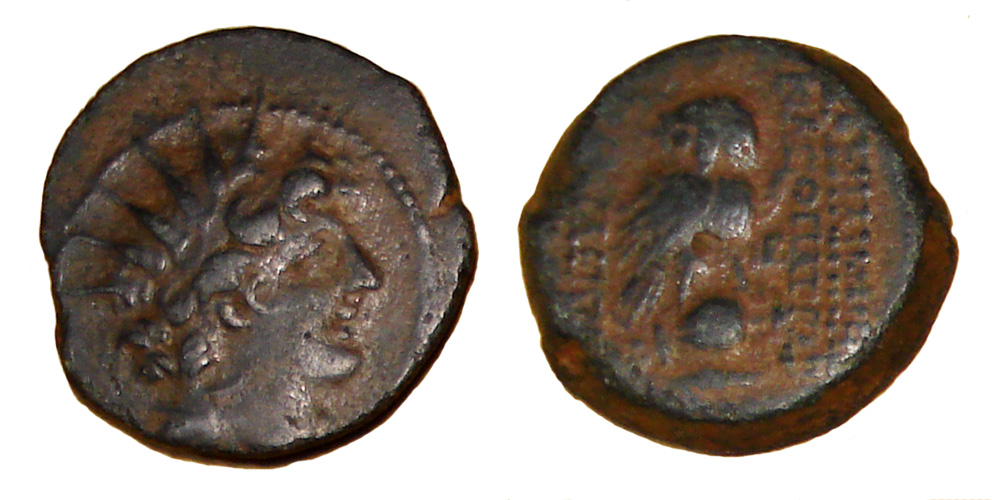 Cleopatra & Antiochos VIII. 125 - 121 BC. Obverse: Radiate head of Antiochos right. Reverse: Owl standing right, head facing, on prostrate amphora. BAΣIΛIΣΣHΣ KΛEOΠATΡA ΘEAΣ KAI BAΣIΛEΩΣ ANTIOXOY. Bronze. Diameter: 17 mm. Weight: 6.25 gr. Sear 7139. |
|
Pillar of the Community
United States
7067 Posts |
|
|
Pillar of the Community
Spain
2752 Posts |
Another nice coin Jim .... That reverse!....An engravers nightmare...."How many letters!?".."Can't I just engrave OWL!?"......... Nice addition........Paul |
|
Pillar of the Community
United Kingdom
1168 Posts |
Quote:
A very nice Seleucid bronze there. Thanks Bob, I was really pleased with this one. The images don't do justice to the coin, as it looks so much better in the hand. Thank you also for the links to the Celator articles. I enjoyed reading about the Seleucid coin symbols very much, and my interest in these coins is much increased now. I remember reading the second article when you posted the link back in January. I kept the link so I could refer to it again at a later date. The other articles in "The Celator" magazine make very interesting reading too. Thanks again. Quote:
"How many letters!?".."Can't I just engrave OWL!? Yes, I can just imagine the engraver's dismay, when faced with that Paul. A nightmare indeed. |
|
Pillar of the Community
United Kingdom
1168 Posts |
Like buses, you can wait for ages for a bronze with an owl reverse, then two come along together. This one is from Pergamon, one of the most importat cities in Mysia, a region in the northwest of ancient Asia Minor. It was bounded by Bithynia in the east, Phrygia in the south east, Lydia in the south, Aeolis in the south west, Troas in the west, and by the Propontis in the north. In ancient times it was inhabited by the Mysians, Phrygians, Aeolian Greeks and other groups. 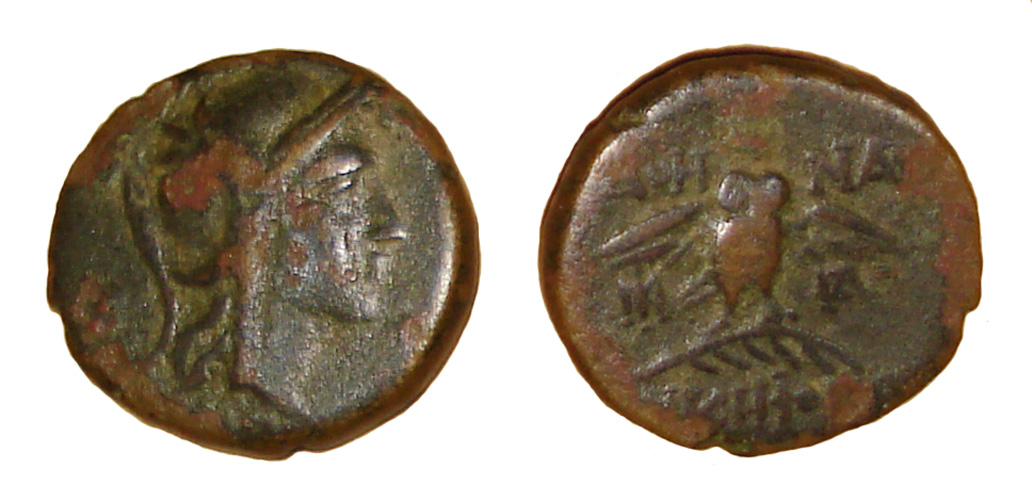 Pergamon - Mysia. 2nd century BC. Obverse: Helmeted head of Athena right, star on helmet. Reverse: Owl facing, wings spread, standing on palm branch. Reverse Inscription: AΘHNAΣ NIKHΦOΡOY. Diameter: 16 mm. Weight: 2.5 gr. Sear #: 3962. |
|
Pillar of the Community
Spain
2752 Posts |
Starting a 'parliament' of owls Jim? . Looking at the state of the majority of governments nowadays I'd vote for the 'Hooters'! This was one of the 1st types I looked at for my Olympian set and really like the reverse design.... Nice addition to your collection.....Paul |
| |
Replies: 638 / Views: 59,825 |







 First Page
 Previous Page


 Posted 06/06/2020 4:06 pm


