| Author |
 Replies: 1,060 / Views: 77,936 Replies: 1,060 / Views: 77,936 |
|
|
|
Pillar of the Community
 United Kingdom
983 Posts |
Some colourful serienscheine now, depicting former German colonies: 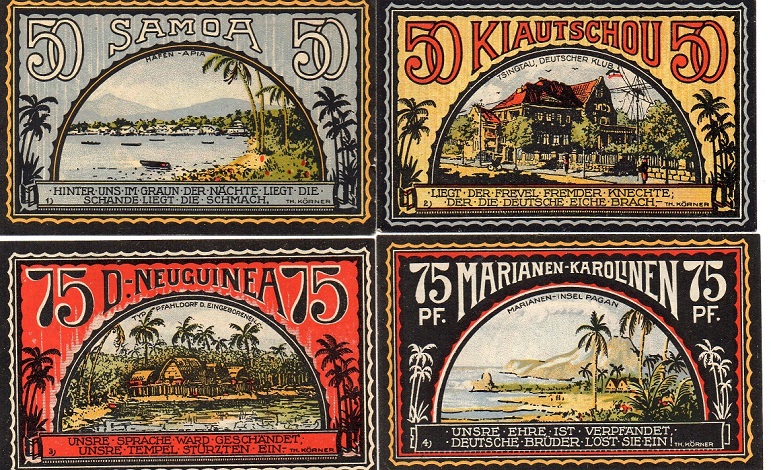 The pieces are numbered 1-4, which makes things nice and easy for collectors! This set was issued in Neustadt and pieces date from 1921......with a 'valid until' date of April 1922. |
|
Pillar of the Community
United Kingdom
983 Posts |
Again, issued in Neustadt, some more 'German Colonies' pieces..... 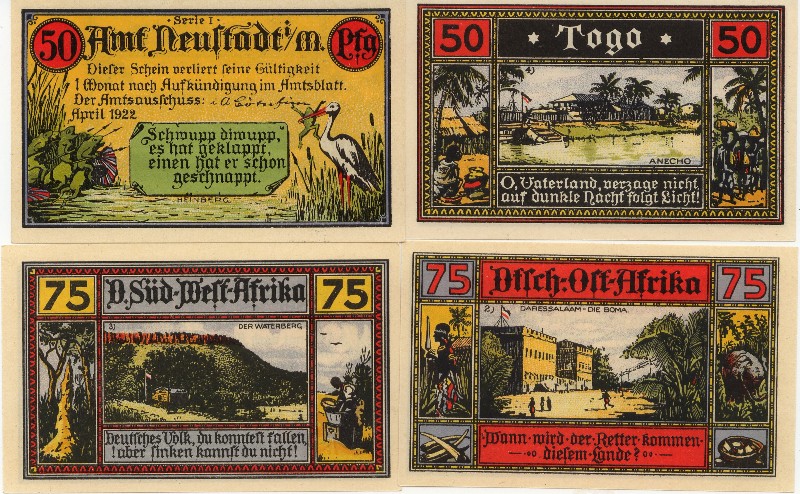 The story behind the frogs holding the spears is a very interesting one that I have written about in one of my notgeld website articles. |
|
Pillar of the Community
Canada
5285 Posts |
Can you link to your article or give us a summary here?
|
|
Pillar of the Community
United Kingdom
983 Posts |
@Oriole - I can give a summary of course:
The imagery of the frogs throwing spears at the bird, who is eating one of them, is a very interesting one - surely it has a 'hidden meaning'......as many of the notgeld graphics do. If one now states that the bird is an African Stork, then maybe the picture is about the war fought by the British against the Germans, 3-4 years previously in the German African colonies......
|
|
Pillar of the Community
United Kingdom
983 Posts |
Here is a 'well-known' notgeld piece with a 'hidden meaning'. Not sure if I can actualy post what this is all about here, as the topic or subject matter depicted here is a very toxic one.... 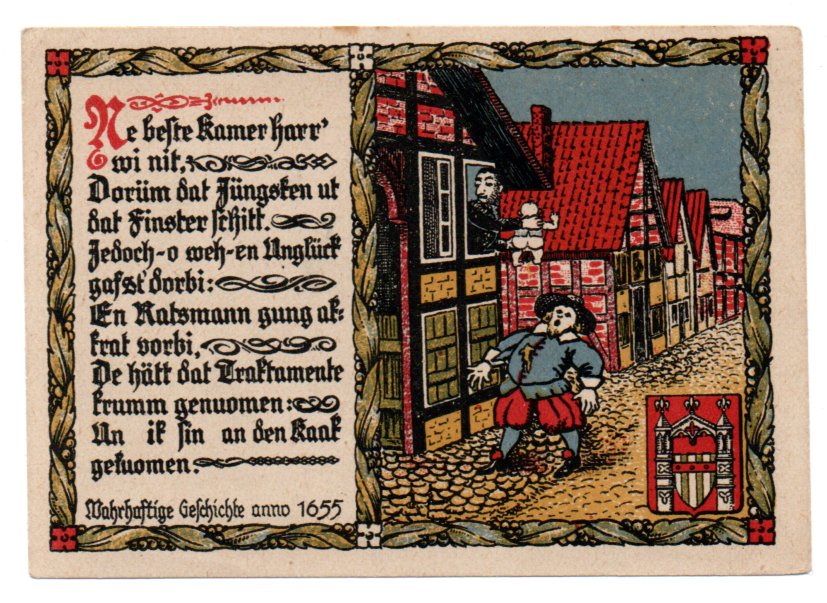 Email me from here if you are interested and I will return your email..... |
|
Moderator
 United States
192555 Posts |
Nice examples!  Quote:
Not sure if I can actualy post what this is all about here, as the topic or subject matter depicted here is a very toxic one.... Good call.  |
|
Pillar of the Community
United Kingdom
983 Posts |
@jbuck - better to be safe than sorry. All part of history, which these small historical documents record and personally, I believe, help collectors understand better the path history took.
|
|
Moderator
United States
192555 Posts |
Quote:
All part of history, which these small historical documents record and personally, I believe, help collectors understand better the path history took. Agreed. It is why I have been enjoying these posts. |
|
Pillar of the Community
United Kingdom
983 Posts |
At the end of WWI, several elections were held by certain areas, to resolve the question of who a town wanted to be governed by. Did the inhabitants want their land to be part of Germany or not? Town councils had definite views of their own, which they were able to depict on the notgeld they were issuing. This was basically due to the drawing up of a new European map, by the Allies. Elections/referenda were held in the following 3 regions on the dates stated: Upper Silesia plebiscite - Mar. 20th 1921 Germany/Poland (Ober-Schlesien) East Prussian plebiscite - Jul. 11th 1920 Germany/Poland Schleswig-Holstein plebiscite - Feb. 10th 1920 Germany/Denmark (Slesvig) Many collectors will have come across notgeld depicting plebiscite related scenes. These are some that spring to mind and are the Flensburg 'tug-of-war' notes (both sides trying to win the vote) 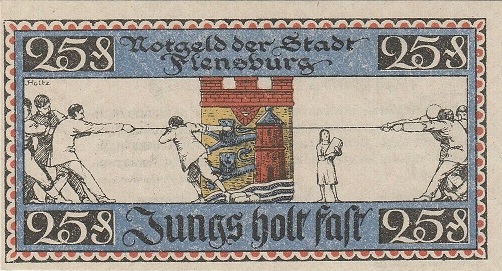 |
|
Pillar of the Community
United Kingdom
983 Posts |
Villages and towns held their plebiscites on slightly different dates from those stated above. The Flensburg one, for example was held on 14 March 1920, as can be seen here: (it depended on which zone a place was located) 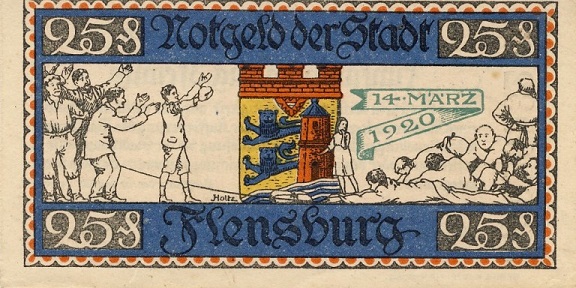 The town inhabitants voted to remain .....as part of Germany. |
|
Pillar of the Community
United Kingdom
983 Posts |
Here, another 2 variants (1 with the date of the plebiscite and the other without) show the people walking to the 'Germany' side! 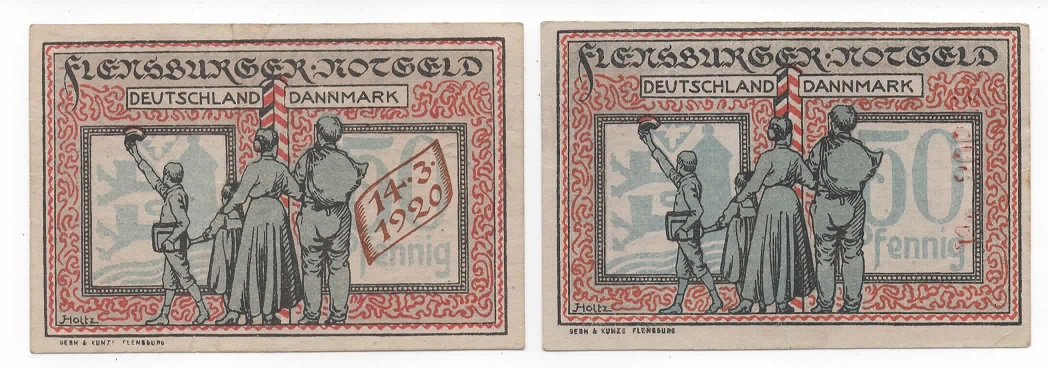 |
|
Pillar of the Community
United Kingdom
983 Posts |
Even when times were hard and the German People were suffering from the aftermaths of the First World War and its repairations, they tried to be upbeat. Some of the notgeld issues portray this, with 'comical' graphics and designs. A super example is the 'farting coppersmith' note from Oelde; 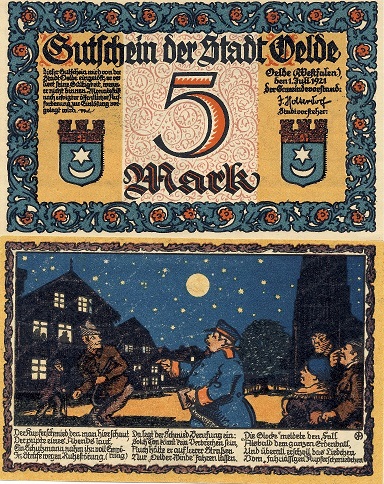 (notice one of the characters on the right, holding his nose)! |
|
Pillar of the Community
United Kingdom
983 Posts |
Here is a set of 6 paper pieces from Bielefeld: 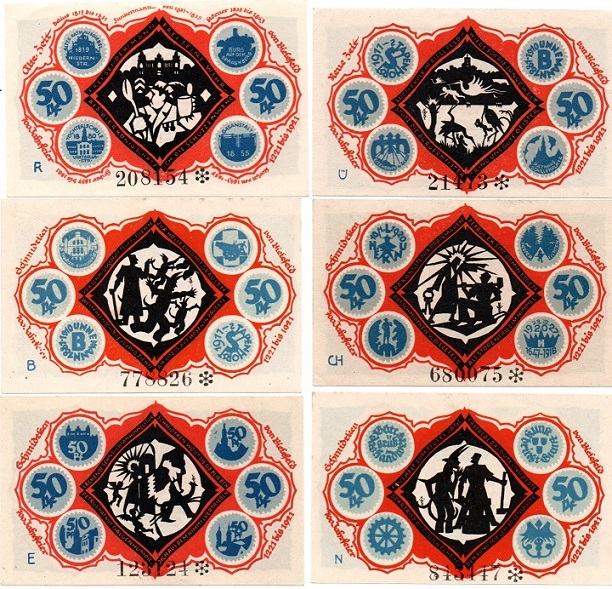 R U B CH E N - spelt out on the notes, I believe refers to the Turnips that were grown in this area after the First World War to try and help with the problem of starvation and shortage of food. |
|
Pillar of the Community
United Kingdom
983 Posts |
The note with letter 'B' depicts devil-like figures and a 'master' devil character, who has a small tail - in German - ' Teufel mit schwanz'. (devil with tail). For collectors, there is a piece where the devil has no tail - in German - ' Teufel ohne schwanz'. The 'common' piece is the bottom one of the two, shown below. I've circled it for clarity. These small variants make notgeld collecting so interesting! 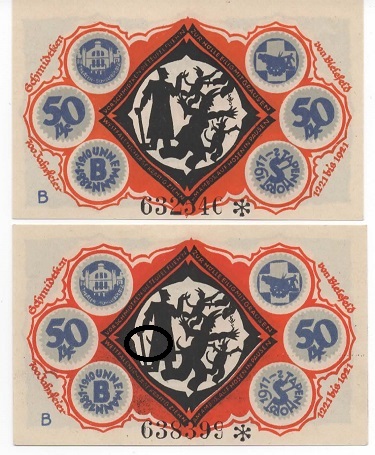 The piece with no tail catalogues at 15 euros, rather than the 'normal' piece which catalogues at 1 euro. A good 'find' that collectors can always stumble upon if they have their wits about them  |
|
Moderator
United States
192555 Posts |
Fascinating pieces of history. Imagine something like this being used today, during Brexit for example. Would be more fun to collect than spam e-mail I suppose.  |
| |
Replies: 1,060 / Views: 77,936 |








 First Page
 Previous Page


 Posted 02/19/2020 09:45 am


