| Author |
 Replies: 638 / Views: 128,034 Replies: 638 / Views: 128,034 |
|
|
|
Valued Member
 Netherlands
53 Posts |
I have not yet sent the photo of the coin holder to Heritage, but I did send it to an expert. For the further story, everything now depends on the XRF results. If it turns out to be modern silver, then the story ends. If it turns out to be American Colonial silver then I am one step further and the search continues. Nerve racking!  |
|
Valued Member
United States
215 Posts |
Im open to give you more sources if needed. I dont think this is going to end with one opinion. Goodluck!
|
|
Pillar of the Community
United States
1390 Posts |
The bottom of the holder appears to have "B. Ma." There are some prominent people with the last name of Quincy living in the B.oston Ma.ssachusetts area around or rather New England at that time.....even a soon to be President.
Edited by DoctorBurnzy
04/07/2020 9:34 pm
|
|
Pillar of the Community
United States
4932 Posts |
Holy crud! That's incredible. I feel like the 1798 holder just backs up potential authenticity...I honestly have no doubt in my mind it's probably authentic.
|
|
Pillar of the Community
United States
4233 Posts |
The "old forgery" idea floated by Heritage raises questions for me. Was there collector value prior to 1798? Of course, HA was unaware of the holder when expressing that opinion, but how far back do we go to the point where faking one of these was worth it? If it's fake but not prior to 1798, is the holder then also fake? Are these types of coin holders known from pre-1800? Or was the provenance known but added to a holder later? If someone went to all that trouble, why is it anonymously sitting in a "batch of old coins"? Granted, forgers of Dead Sea scrolls went to great lengths to obtain contemporary blank paper, etc, but for it to then appear in someone's old collection with just an unknown token attribution seems implausible. If it's fake, it must be the best I've ever seen on the internet. The cracks around the rim, the subtle corrosion around the E, the patina, and that subtle lamination under NE... who could fake such details? All the trade with "New Amsterdam" during the era when it was made seems to support such a piece ending up in the Netherlands, but then why is it attributed to the Quincy family in Boston? John Quincy Adams was appointed ambassador to the Netherlands in 1794. Authentic or elaborate subterfuge? So many questions. Fascinating.
|
|
Valued Member
Netherlands
53 Posts |
I just received the results of the XRF analysis. The composition of the metal is similar to that of American Colonial silver ! I place the results here, I have had the sides of the coin tested for the sake of certainty, because apparently due to corrosion there may be slight deviations on the surface of the coin. As you can see, there is a small percentage of gold (au) and lead (pb) in the silver. Another step in the right direction, I am happy!  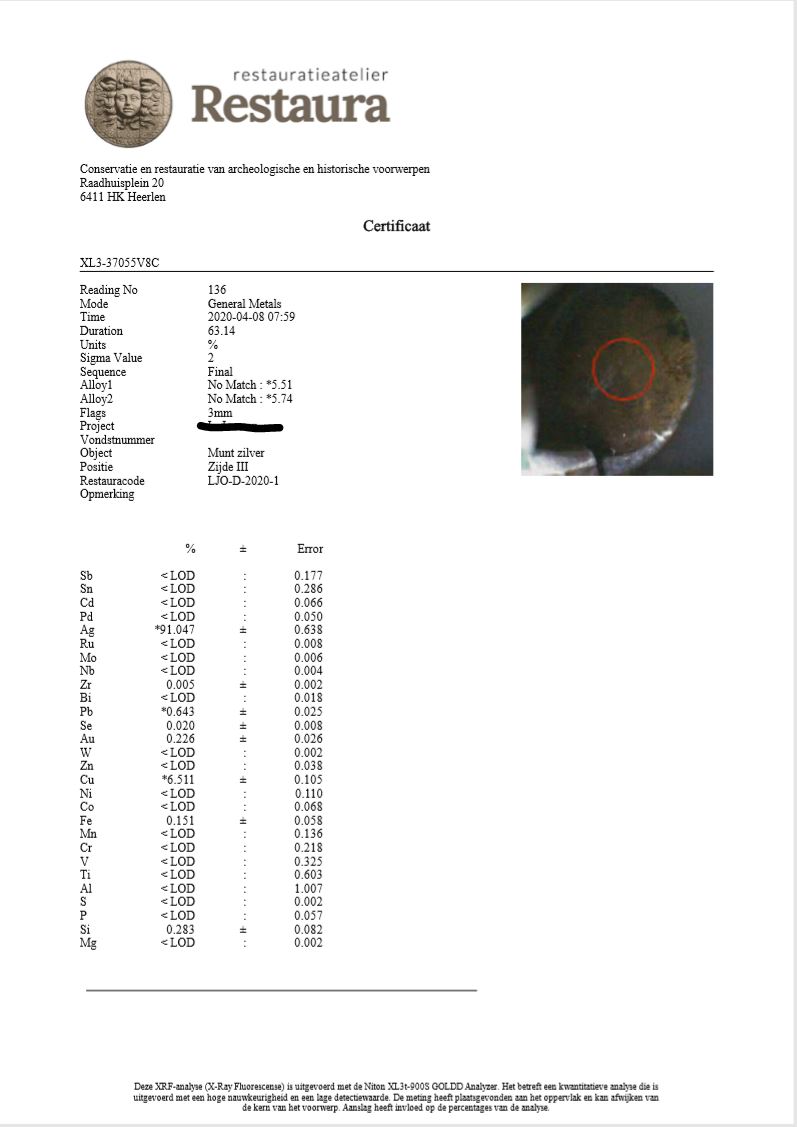 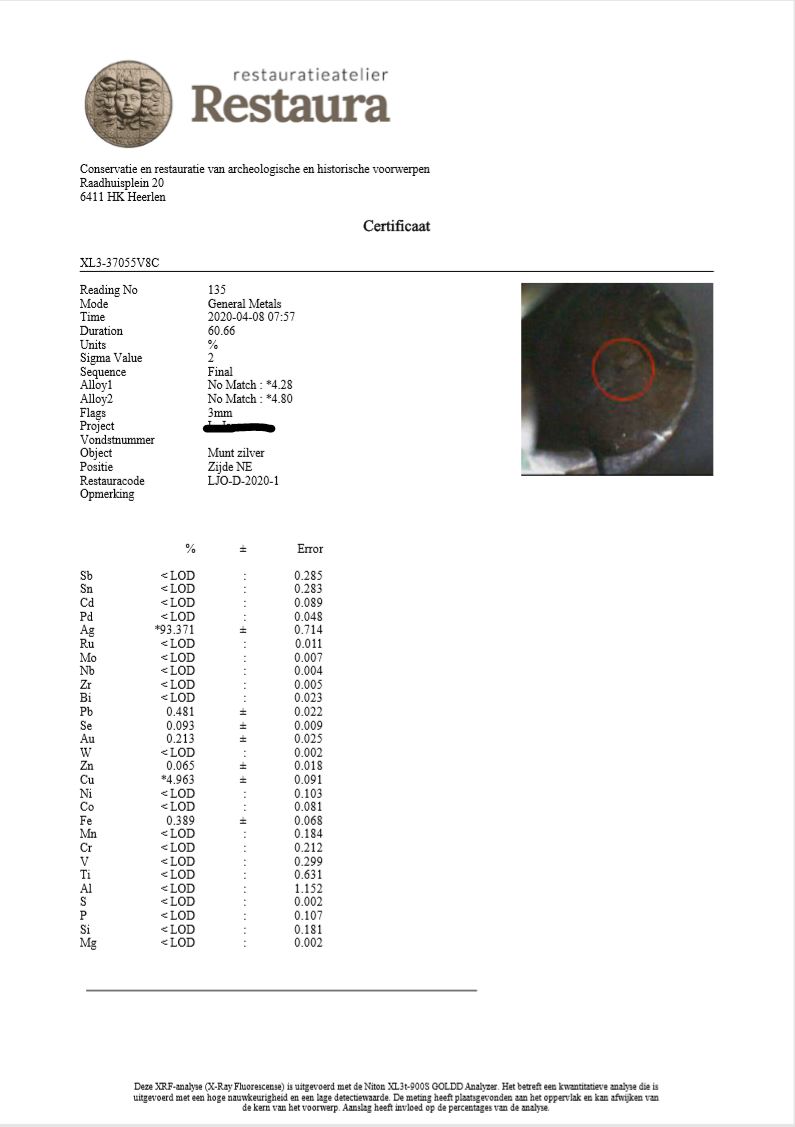 |
|
Moderator
 United States
34553 Posts |
@larsjan, every few days we will see someone post in this subforum a fake with a convincing story. Yours appears, so far, to be headed along a different pathway. Thank you for continuing to update this thread. How cool would it be for you to have actually found the real deal?
"If you climb a good tree, you get a push."
-----Ghanaian proverb
"The danger we all now face is distinguishing between what is authentic and what is performed."
-----King Adz
|
|
Pillar of the Community
Germany
1856 Posts |
Amazing! and I hope real.
First, a 'Continental Dollar' turns in exceptional (MS) condition in a flea market in Paris last year, bought for a few dollars or even less.
Last year also, the 12th best known William Pitt farthing was found in the UK (a comparatively modest but still significant find I made).
Now, this! fingers crossed for the finder.
Edited by GERMANICVS
04/08/2020 05:29 am
|
|
Pillar of the Community
United States
1390 Posts |
@kbbpll wow John Quincy Adams has a Netherland connection around the time frame of this holder. It's time to get perhaps some of the ink tested on the holder. The script could've been written years later, but if it were written 30 years after the fact...who was faking these in the 1820s? How many collectors were out there to make fakes to sell to at that time? This is getting more and more interesting. Good Luck!
|
|
Bedrock of the Community
United States
17884 Posts |
John Quincy Adams also had a coin collection. Things are looking very good so far for this coin.
|
|
Pillar of the Community
United States
1390 Posts |
Well done, Condor. I'd say inquire with the Massachusetts Historical Society if any of these coin holders were passed onto them for the coins when they received parts of the collection; however, it is also feasible to believe that the coin holders weren't there when they acquired these coins from his descendants...but if they have at least one maybe the handwriting is identical; testing the ink I believe for known properties of ink at the time is the next step.... B. Ma. = Boston Massachusetts perhaps....with the famous Quincy family from the area....with the Netherlands connection 1794 to John Quincy Adams.....and the fact that he had a coin collection...it's very intriguing now. https://www.forumancientcoins.com/c...sp?vpar=1847 and https://www.coinbooks.org/esylum_v15n21a24.htmlEdited by DoctorBurnzy
04/08/2020 11:21 am
|
|
Valued Member
Netherlands
53 Posts |
Thank you all for your good thinking and research, all very well found !!
I still believe in this coin, I still haven't heard back from the expert, I don't know why.
Heritage says to send the coin to NGC or PCGS before they can do something with it.
First I want to gather more evidence because I am almost certain that if I send in the coin now the experts still don't like it.
I think it is a very good idea to have the ink on the coin holder examined, I will look where it is possible here in the Netherlands and whether it is a bit affordable.
I will also see if I can still contact the people from whom I bought the coins at the time to see if they have any more information.
I also found out that John Hull, the one who minted these coins, was married to Judith Quincy. That will probably be a coincidence because I cannot imagine that the coin will end up in a collection as 'unknown'.
|
|
Pillar of the Community
United States
1390 Posts |
John Quincy Adams was a member of the same Quincy family https://en.wikipedia.org/wiki/Quinc...tical_family . In 1796 he was appointed ambassador to Portugal and a year later appointed ambassador by his father, the President John Adams, to ambassador of Prussia and moved to Berlin. He and his family were on the move in Europe. Maybe, he had to move quick and things were left behind and forgotten....just a theory..In 1797 the Netherlands were attacked by France....When people attack that's when things go missing...But, who knows for certain? All guesses. I would definitely test the ink if affordable. Good Luck! I can easily see this just passing down as an heirloom within the family and becoming lost to time. There weren't really many coin collectors then to take note of it and I can't believe the history books at the time were really complete and easy to come by. If I ask anyone today...What did your great grandfather or great-great grandfather do? I probably would not get a quick answer. Edited by DoctorBurnzy
04/09/2020 05:25 am
|
|
Valued Member
United States
277 Posts |
I'm amazed at what I'm reading! I really hope the coin is real.
I would recommend getting multiple tests done to verify the composition of the metal as well as authenticate the holder. With the potential value this coin may have, you need multiple tests done testing positive for the same result on the metal composition. Every test is subject to error, and any expert is going to look for a million reasons why the coin is not authentic. Multiple tests coming back positive for the metal composition you are looking for will only boost reassurance and confidence the coin is real.
|
|
Valued Member
United States
215 Posts |
I wouldnt rely on the xrf too much. Common practice of making copy coins and counterfeit coins is starting with a genuine coin base . Massachusetts silver was often made from the melting of spanish coins of the time. Thats probably the easiest test for a counterfeiter to pass as these coins can be purchased for a few dollars. You need a group of experts to study the lines of the die stamp. And maybe someone who can analyze age of patina or any dirt in the crevices if possible
|
| |
Replies: 638 / Views: 128,034 |







 First Page
 Previous Page


 Posted 04/07/2020 6:43 pm





