In the nearly 40-year history of the modern series of US commemorative coins (not including the Bicentennial commemorative coins of 1976-76), the Mint has produced just a single commemorative coin that incorporated platinum - the gold-and-platinum bimetallic $10 coin issued in 2000 to mark the Library of Congress (LoC) Bicentennial.
The first time legislation was proposed for the LoC coins was in May 1997 - the bill differed from the one that was eventually authorized by Congress. This early version of the bill specified the striking of up to 100,000 $5.00 gold coins but also gave the Treasury/Mint the option of striking the same number of $5.00 platinum coins with specifications TBD by the Treasury/Mint.
A new version of the bill was introduced a year later - in May, 1998 - it changed its language regarding the platinum coin and provided the Mint with the unusual option of striking a $10 gold-and-platinum bimetallic coin rather than the typical commemorative $5 gold coin. The Mint hadn't been given such an option before and it proved too enticing to let pass - at the urging of the Library of Congress, the Secretary of the Treasury instructed the Mint to strike the $10 bimetallic coin vs. the $5 gold coin.
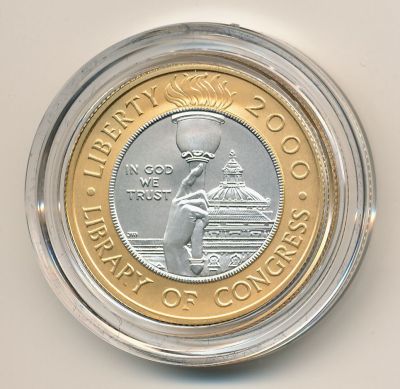
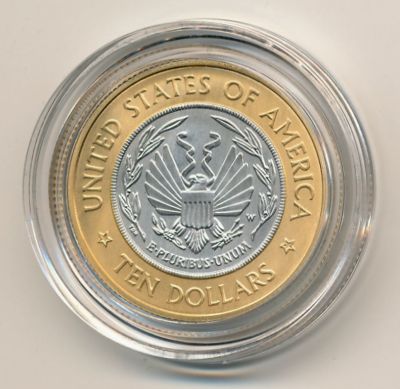
Unfortunately for the Mint, it experienced production problems that created a higher-than-normal rejection rate. Ultimately, 27,445 proof coins were sold along with 7,261 uncirculated coins. (You can read more about the program in my earlier post here:
Library of Congress CoinsThe Mint's one-time use of platinum for a US commemorative coin begs the question: "Were there other calls for the use of platinum in the US commemorative coin series?"
In a word, "Yes!"
The first call for a platinum commemorative coin predates the LoC coins and goes back to 1995; it was part of legislation to authorize coins in commemoration of the 150th anniversary of the Smithsonian Institution. The bill, as originally introduced in the House and Senate, did not include any language for platinum coins, but such language was soon added as an option vs. the $5.00 gold coins that were eventually struck. The platinum coin was specified to carry a $5.00 denomination and to be struck on fully platinum planchets (not bi-metallic ones).
The Public Law that ultimately authorized the 1996 Smithsonian coins was approved on January 10, 1996; it had the $5.00 platinum coin option language in it, but the Mint stuck with the traditional $5.00 gold coin (half eagle) for the program.
In 1999, multiple bills for commemorative coins for the US Capitol Visitor Center were introduced. Congress flipped the script a bit and specified the striking of a gold-and-platinum bimetallic $10 coin as its primary choice, but also gave the Mint the option of striking a standard $5 gold coin if it decided that striking the bimetallic coin would not be feasible. The Mint chose to strike the standard $5 gold coin rather than the bimetallic $10 piece for the 2001 program, likely due to the production issues it faced with the 2000 LoC coin.
In 2001, a bill calling for a commemorative coin program to honor Ronald Reagan was introduced in the Senate. It included the specification of a $5.00 gold coin, but also included a provision that would have allowed the Mint to strike a gold-and-platinum bimetallic $10 coin. The bill was referred to the Committee on Banking, Housing, and Urban Affairs but did not get reported out for a vote. Similar Reagan bills were introduced in following sessions of Congress (up through 2005), but none of the bills gained much traction and so no gold-and-platinum bimetallic coin was ever struck to celebrate Reagan's life.
More recently, in 2013 and again in 2015, bills were introduced calling for a commemorative coin program to recognize the 150th anniversary of the passing of the 13th amendment to the US Constitution. The 13th amendment officially abolished slavery in the United States. The proposal called for a $50 gold-and-platinum bimetallic coin, the exact composition was to be determined by the Treasury/US Mint; it also sought $20 gold coins and silver dollars to mark the anniversary. Each of the bills was referred to the House Committee on Financial Services, but neither was reported out.
The Mint has not been ignoring platinum, however. Since 1997, the US Mint has been striking platinum bullion coins, including proof versions for collectors. The call for the white metal's use in commemorative coins has not been top of mind for commemorative coin sponsors, however - CuNi, silver and gold appear to be working just fine as coinage metals for almost all proposed programs. Who knows what the future will hold?!








 Posted 07/14/2020 10:10 pm


 Now that the Mint has ventured into coloring, who knows what the future holds.


