A question that pops up here on CCF from time to time - and is often an issue on
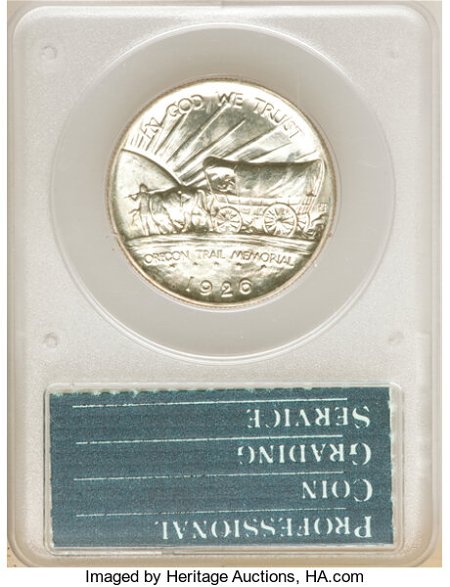
ebay and other online coin sites - is in regards to the 1926 Oregon Trail Memorial Half Dollar and whether it is the subject of a rotated reverse die error. I've responded here in the past that the 1926 Oregon coins struck in Philadelphia most often have a rotated reverse, while the San Francisco coins are found without rotation. Being a "numbers guy," however, I wanted to conduct a quick census to see if my anecdotal experience matched the cold hard facts.
So, I examined 100 recent auction lots of 1926 Oregon half dollars - 50 from Philadelphia, 50 from San Francisco - and counted the number of examples that featured either a "level" reverse or a rotated one; there was no cherry picking of examples to assess! I took them in order of appearance.
All of the coins I looked at had been encapsulated by either PCGS, NGC or ANACS. I looked specifically at encapsulated coins so that I would have a defined vertical reference (i.e., slab edges) which would rule out photographic correction of rotation (done by the auction houses to make the images easier to view).
I found that 50 out of 50 of the 1926-S coins I examined had a level reverse (i.e., no meaningful rotation). The outcome was very different for the 1926-(P) coins: just 7 out of 50 had a level reverse (14%), 43 of 50 had a rotated reverse (86%). Though the direction of the reverse rotation was always the same, down and to the left (i.e., counter-clockwise - CCW) from the viewer's perspective), the degree of rotation varied: I found coins with as little as two degrees of rotation (within the Mint's tolerance) and as much as 17 to 18 degrees (with stops in between at five to six degrees and eight degrees).
(Note: Though rotated coins such as the 1926-(P) Oregon are generally referred to as "Rotated Reverse" coins, it is not always a reverse die that is rotated, it could be (and very often is) a rotated obverse die. It's just easier to standardize the naming convention for all rotated die coins as "Rotated Reverse" since it is most often not definitively known by collectors which of the dies was actually rotated during striking.) In 1926, the Mint at Philadelphia struck 48,030 Oregon half dollars, and the San Francisco Branch Mint struck an additional 100,055. All of the Philadelphia coins were struck on September 14, 1926.
One way a rotated die error occurs is when a die is installed incorrectly in the press and thus not in the standard / expected orientation vs. the opposite die. Another way is for a die to become loose in the press and move / rotate during striking. As I considered the multiple degrees of rotation seen on the 1926-(P) Oregon half dollar, my thoughts tended toward a loose die vs. one that was improperly installed.
I consulted with Roger W. Burdette, the noted numismatic researcher / author and acknowledged expert on US Mint processes, to determine what he thought might have happened. In his opinion, a defective press mechanism used to secure one of the dies was the likely culprit, and the die came loose during striking as a result of some level of mechanical failure, possibly from lax maintenance, on a press that was past its prime; the loose die rotated in the press and produced the coins with which we are familiar. Mr. Burdette believes that it was most likely the obverse die that came loose as it encounters more mechanical stress during coining than does a reverse die which is generally in a fixed position.
So, I am comfortable in stating that the variable rotation seen on 1926-(P) Oregon Trail half dollars is very likely the result of a loose die (probably the obverse die) that rotated during coining and created the coins we regularly encounter.
In the end, the question is whether the 1926-(P) coins with rotation should be considered error coins and, if so, how much rotation is needed to meet the minimum "error coin" standards. Rotations of a minimum of 45 degrees are generally needed to get error collectors even a little excited; the real fun (interest) begins at 90 degrees. NGC requires a minimum of 15 degrees of rotation to have such identification on their insert; I haven't yet identified the minimum rotation required by PCGS but I haven't seen a "Rotated" indication on any PCGS insert unless the rotation was at least 30%. (I'm happy to hear of other, lesser measures, however!)
So, the rotation of less than 20 degrees on 1926-(P) Oregon Trail half dollars is not overly exciting, nor does it bring a premium price in the market. Are they errors? Technically, "Yes." Major errors? "No." Are they scarce? "No." Regardless, they are fun to look at!
My 1926 Oregon Half Dollar w/ Rotated Reverse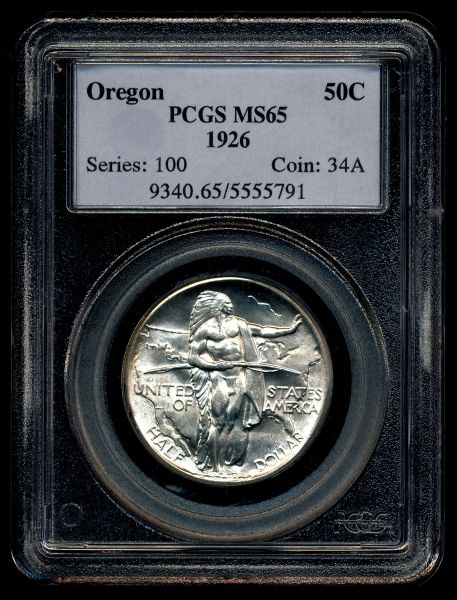
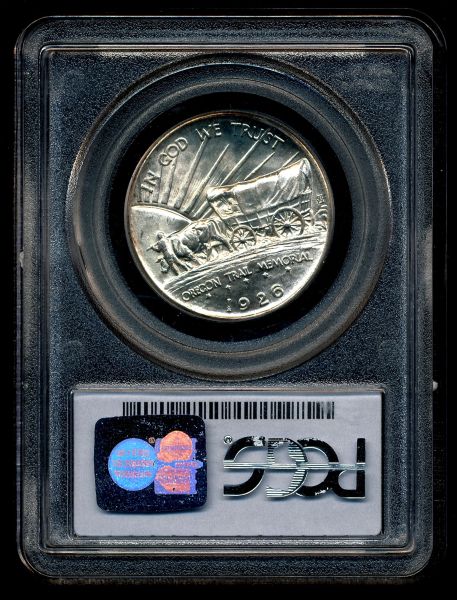 1926-S Oregon Half Dollar w/ Level Reverse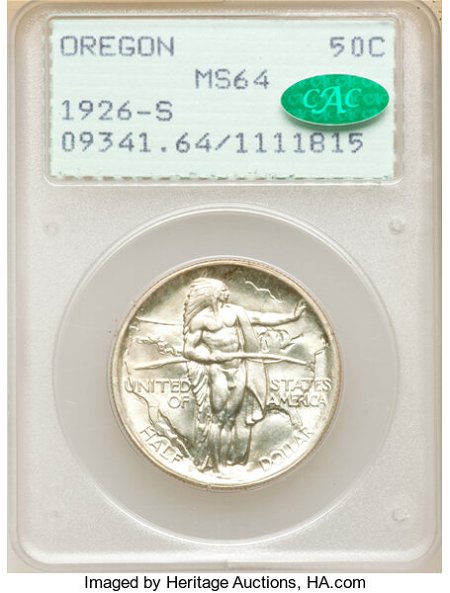
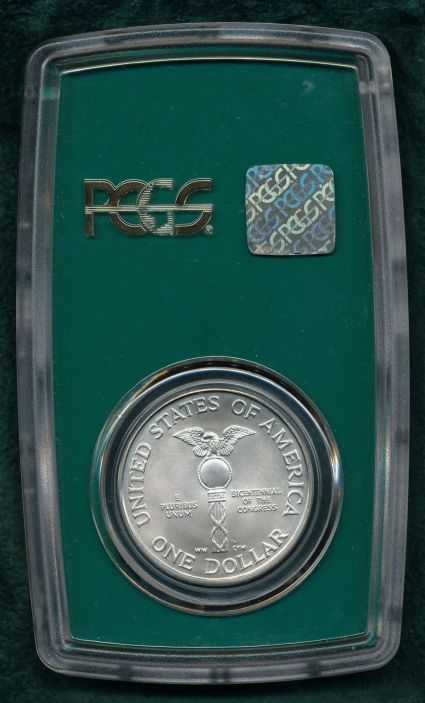
 My 1989-D Congress Bicentennial Half Dollar w/ Fully Rotated Reverse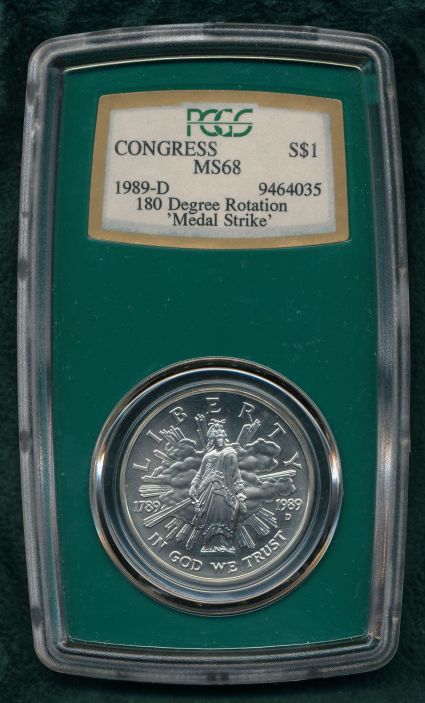
Read more about each of the coins presented here at:
Read More: Commems Collection









 Posted 02/01/2021 9:42 pm