| Author |
 Replies: 20 / Views: 3,964 Replies: 20 / Views: 3,964 |
|
Valued Member
United States
123 Posts |
Yes I did search, no I didn't find some topic that I could ask this. Sorry if I missed.  Continuing the question if you please, the 1944, 1945, and 1946 shell case pennies. Were a composition of 95% copper, 5% zinc. Is there any reasonable possibility of standard or variations or are all for all those years, going to be recycled shell casings? Would there potentially be some 1947 made using the old planchets or 1946 on the standard composition? I wouldn't expect any change over to be 100% everywhere at one time. Instead gradual as suppliers ran out. Any reasonable at home way, to tell the difference between the 1947-1982 composition and the 1944-1946 composition? |
|
|
|
Bedrock of the Community
United States
19552 Posts |
I would expect some crossover/transitional variations across the minting facilities after the war. I'm not aware of any do-it-yourself testing methods to make the distinction.
Of course, reading up on the matter of shell casings, it seems there is some controversy as to what sources were actually used (and to what degree they were used) in the production of planchets during that time.
|
|
Valued Member
 United States
123 Posts |
I'm actually thinking of getting a coin discriminator circuit, they are used in slot machines, not expensive and it compares the source to the test coin. I'm not sure about the electronics part of a discriminator/comparitor or if this is practical at all. I also don't have knowledge and have to do some reading on how sensitive one of these might be. For example, it would be easy to tell any other coin from a modern cent. But can it tell a pre-1982 cent from a modern cent. My original idea was make an automated way to sort through half dollars. Now there's an obvious one?  XRF isn't reasonable because of cost. So anyone with any ideas, and if one of those is a scale, I need a recommendation for one that's going to read down to .001 gm and not break the bank. (very small limited bank) As in, fixed income Senior. Edited by PPorro
03/03/2021 09:23 am
|
|
Pillar of the Community
United States
1667 Posts |
95% copper, 5% zinc = Brass
95% copper, 2.5% tin, 2.5% zinc = Bronze
"shell casing cents" are actually called "gilding metal"
The mint used gilding metal in 1944-1946, AND again from 1962-1982, the 1943 cent is zinc coated steel (galvanized)just as possilbe there to be 1944s in brass or 1945s or 1946's, or any of the ones from 1962-1982.
in either case the weight is 3.11 grams. There's a difference, but really, there's no difference. If you want to send a bunch of cents for materials testing to find out the metallurgical content for a laugh, I suppose you could, but it won't be cheap to do it.
|
|
Valued Member
United States
123 Posts |
Thanks Big-Kingdom if I understand right, weighing will not tell me if I have a brass or gilding metal cent. And no other way, without something complicated or expensive? But it's likely that any of those metals could have been used 1944-1946 and 1962-1982 and maybe who knows what variations from 1947 to 1961? Did I get that right? A big, no one knows for sure CARES! =  Edited for language and correction. Funny kind of aside. Every coupe of years, I take out the change bank that sits on the dresser. That's the one that I empty my pockets at night and all the change goes in there. I sort the coins and look at them all. I just got to the first sort which is cents and found two wheat cents. One 1942 and one 1944. Still finding wheat cents in circulation is a surprise to me as people started hoarding them in 1982 - when the cent changed to 97.5% zinc, 2.5% copper I also learned that Coin Brass and ammunition brass are not the same composition. Edited by PPorro
03/03/2021 3:41 pm
|
|
Pillar of the Community
United States
1667 Posts |
it's more like "no one knows, because no one really cares" kind of situation. it's literally the difference of 2.5% tin added to the composition or not. visually or weight wise, it's not significant enough, it's more of a "oh that's interesting, they used recycled shell casings for a bit". I suppose if you could conclusively identify the exact composition of the alloy, some grading company might want to attribute it as an "off metal" if it applies to that year. So far though it doesn't seem like anyone is interested in taking on this endeavor or the costs to find out. Honestly I'm not even sure it could be conclusively proven with a hardness test, the 2.5% variation of the alloy is so slight, and tin and zinc are close in hardness, but I don't know that for a fact. clad you enjoy the hunt, I like searching coins also, I just think this Shell casing cent thing is a good story for the hobby, and that's about it. proving the alloy would be much more complicated and require specialized equipment I'd think. Something else a bit interesting, I read in CoinWorld, this years silver proof set is going to have a twice plated proof cent. the clad proof set is announced by the mint and they don't mention it being a twice plated cent. But, I'd think, if they do it, this is going to change the composition of the S proof Lincoln Cent even slightly. you'd think if they were going to twice plate it, it would be a selling point they would be marketing, it would come at an additional cost, So I'm thinking the 2021 cent in the clad proof set is once plated, and maybe the silver proof set for 2021 will be twice plated. If the article from Coin World holds true. Article was here https://www.coinworld.com/news/us-c...art-in-aprilEdited by Big-Kingdom
03/03/2021 3:41 pm
|
|
Bedrock of the Community
United States
17884 Posts |
There is also the misconception that the Bronze composition of 95% copper 5% tin and zinc meant 2.5% tin and 2.5% zinc. Actually the percentage of each metal varied considerably but the combined amount of tin and zinc accounted for 5% of the total weight of the coin. Since the law did not specify set percentages, as long as there was a trace of tin in the alloy it complied with the law. Case in point after getting their allotment of metal from the War Production Board the San Francisco Mint had 50 pounds of Tin for their cent production. They struck 85,590,000 cents. That was 586,957 pounds of cents or a percentage composition of tin of .009% tin and 4.991% zinc.
From my understanding, after the shell case cent ended the amount of tin in the cents remained very low, well under 1%.
There is also the problem that both tin and zinc boil at temperatures below that of melted copper. That means that as long as the alloy is molten, tin and zinc are constantly vaporizing off which would make it very difficult to hit any specific composition or to hit it consistantly. So every melt would probably result in a slightly different composition.
|
|
Pillar of the Community
United States
787 Posts |
I saw 3 shell casing pennies listed at auction and did a quick web search on the topic. "Another forum" has members stating that spent casings were never actually used to mint coins during the war.
Can anyone confirm YES or NO? Curious...
|
|
Bedrock of the Community
United States
94367 Posts |
Learned a lot from this thread, thanks to all!
|
|
Pillar of the Community
 United States
4616 Posts |
I too have heard that shell casing was just a story.
I always thought that if they really had used spent shells from the firing ranges, somebody had to sort through and remove the occasional live round. Otherwise, you might find the melt being a little energetic.
I'm sure that would be the kind of task an enterprising Drill Instructor would use for minor malfeasance during training. Yet I never have seen a recollection from training camp of "I was caught smoking after lights out and the DI had me sort through two tons of shell casings to remove the live rounds".
-----Burton 50+ year / Life / Emeritus ANA member (joined 12/1/1973) Life member: Numismatics International, CONECA Member: TNA, FtWCC, NETCC, EveryCountry (online) coin club Owned by three cats and a wife of 40+ years (joined 1983) Author: 3rd Edition of the Sample Slabs book, https://www.sampleslabs.info/ |
|
Moderator
 United States
195203 Posts |
Quote:
I always thought that if they really had used spent shells from the firing ranges, somebody had to sort through and remove the occasional live round. Otherwise, you might find the melt being a little energetic.  Quote:
I'm sure that would be the kind of task an enterprising Drill Instructor would use for minor malfeasance during training.  |
|
Pillar of the Community
United States
787 Posts |
I did a search of the online Boston Globe newspaper archive via my library and not one mention of spent casings and pennies... that doesn't mean it didn't happen, it simply means it wasn't in the paper. I DID, though, see mention of a desire for Indian Head pennies to be put back into circulation...
|
|
Bedrock of the Community
United States
17884 Posts |
Quote:
Would there potentially be some 1947 made using the old planchets or 1946 on the standard composition? I wouldn't expect any change over to be 100% everywhere at one time. Instead gradual as suppliers ran out. Yes Quote:
Any reasonable at home way, to tell the difference between the 1947-1982 composition and the 1944-1946 composition? No. The only difference between the shell case cents and the post shell case cents was that the latter had some small amount of tin in them. Detecting that is going to take an XRF gun or something even more powerful. Or dissolve them in acid and do a qualitative chemical analysis for the tin. That last test requires the destruction of the coin. Quote:
I too have heard that shell casing was just a story. The "story" is true. In Roger Burdette's book on the experimental alloys used on the cents and five cent pieces during WWII he lists in the footnotes the location in the archives where the where the documents covering the operation may be found. Quote:
I always thought that if they really had used spent shells from the firing ranges, somebody had to sort through and remove the occasional live round. Otherwise, you might find the melt being a little energetic.
Part of the deal for using the shell casings was that the military would sort them to make sure there were no live rounds. |
|
Pillar of the Community
United States
787 Posts |
Quote:
The "story" is true. In Roger Burdette's book on the experimental alloys used on the cents and five cent pieces during WWII he lists in the footnotes the location in the archives where the where the documents covering the operation may be found. Nothing like a good footnote! :-) Did a little more searching and did indeed find the following: 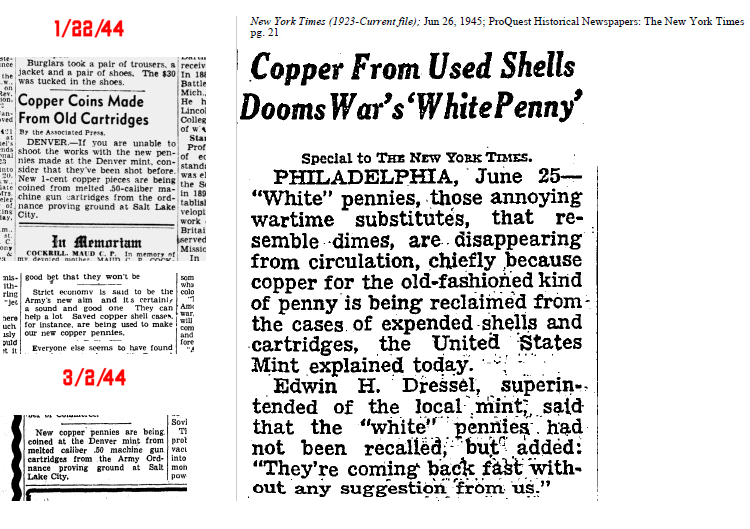 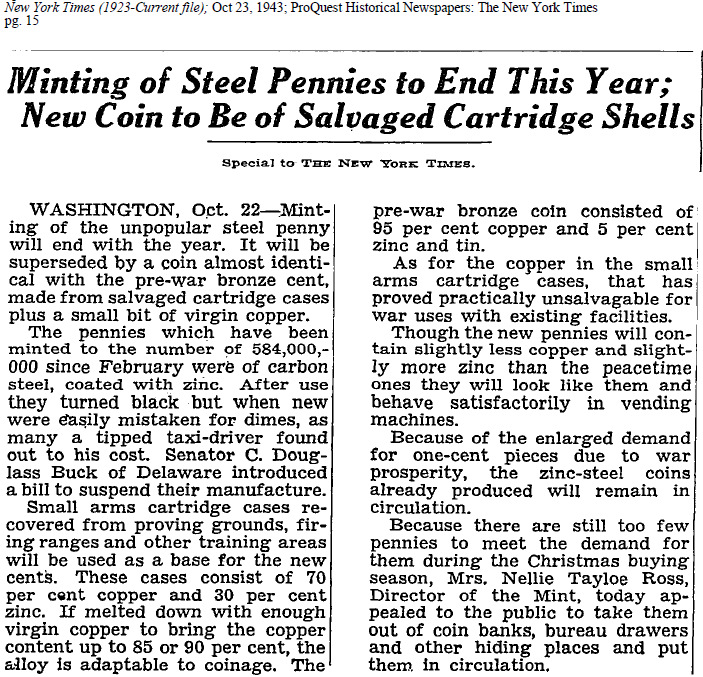 |
|
Moderator
United States
195203 Posts |
Fantastic sleuthing! |
|
Pillar of the Community
United States
4616 Posts |
Except it doesn't say it was actually done. It lays out the result, but that could be from a small experiment.
They also don't lay out the amount of "Virgin Copper" required to achieve 85-15. The math says it's as much again as the mass of the 70-30 shell casings used.
1944 - 1.435 billion cents
1944D - 0.431 billion cents
total 1,865,978,000 coins
A 30cal carbine cartridge weighs approx. 4.6g
It works out to a bit over 1/2 billion cartridges and 2.4 million kg of virgin copper.
-----Burton 50+ year / Life / Emeritus ANA member (joined 12/1/1973) Life member: Numismatics International, CONECA Member: TNA, FtWCC, NETCC, EveryCountry (online) coin club Owned by three cats and a wife of 40+ years (joined 1983) Author: 3rd Edition of the Sample Slabs book, https://www.sampleslabs.info/ |
| |
Replies: 20 / Views: 3,964 |
To participate in the forum you must log in or register.
 
- A Ridiculously Badly Written Computer Aided Book, Coin Collecting Bible, 2024
- Liberty Head 10/11 Stars Obverse With A Sick Looking Eagle On The Reverse Holed 0.59g 13.06mm
- The Tyrant Collector - PCGS Youtube Interview
- Counterfeit Detection: ANA Video - Introduction, With Brian Silliman And Jim Robinson Ep. 1
- Counterfeit Detection: ANA Video - Mistakes, Risk Factors, And Counterfeits & Alterations, Ep. 2
- Counterfeit Detection: ANA Video - Pimples And Pits, Looking At Cast Counterfeits, Ep. 4
- Counterfeit Detection: ANA Video - What Year Is That Cent? Key Date Coins, Ep. 5
- Counterfeit Detection: ANA Video - Diagnostics Of The 3, 5, And 10 Cent Coins, Ep. 6
- Counterfeit Detection: ANA Video, Counterfeit Quarter Dollar Diagnostics, Ep. 7
- Counterfeit Detection: ANA Video, Counterfeit Classic Commemorative Coins Diagnostics, Ep. 8
- Counterfeit Detection: ANA Video, Counterfeit Silver Dollar Diagnostics, Ep. 9
- Counterfeit Detectection: ANA Video, Classic US Gold Coin Diagnostics, Ep. 10
- Counterfeit Detection: ANA Video, Diagnostics Of Chinese Made Counterfeits Of US Coins, Ep. 11
- Counterfeit Detection: ANA Video - Wrap Up Recap With Brian Silliman And Jim Robinson Ep. 12
- 2026-P Jefferson Nickel Possible Die Chips, Die Cracks And Other Anomalies
- Commems Collection Modern: What If? 1993 Bill Of Rights Circulating Coinage - A 1990 Attempt
- Split Grading - An Idea That Would Drive Collectors Mad
- 1960 D Lincoln Memorial Cent (Small Date) BIE
- Is This 1888-S A VAM-10, 10A Or Something Else?
- 1994 Brazil 10 Centavo - With Die Clash
- Liberty Head 10/11 Stars Obverse With A Sick Looking Eagle On The Reverse Holed 0.59g 13.06mm
- 1980 D Lincoln Cent In Very Late Die State (Die Deterioration)
- A Ridiculously Badly Written Computer Aided Book, Coin Collecting Bible, 2024
- 2026-P Jefferson Nickel Possible Die Chips, Die Cracks And Other Anomalies
- Post A Trio Of Coins.
- 1878 S Trade Dollar. Found Doubling On Reverse
- Around The World With Banknotes - A Banknote Geography Game
- Post Your New Currency Acquisitions!
- Hokiefan's Collection Of Arkansas Obsoletes, Scrip And National Bank Notes
- Project 100k - Circulating Two Dollar Bills - Round 4!
- Counterfeit Detection: ANA Video, Counterfeit Classic Commemorative Coins Diagnostics, Ep. 8
- 20 Questions! (Forum Game) 11/04/24
- Commems Collection Modern: What If? 1993 Bill Of Rights Circulating Coinage - A 1990 Attempt
- Post Your Coins With A "five" Denomination
- 1893 World Columbian Exposition, Isabella Quarter PCGS MS-68+ (Cac Green) (Toned) (Schultz) On Gc.
- How Far Back Can We Go? Ninth Edition!
- The Tyrant Collector - PCGS Youtube Interview
- Counterfeit Detection: ANA Video - What Year Is That Cent? Key Date Coins, Ep. 5
- Post Your Coins With Coats Of Arms, Shields, Crests, Crowns, Etc.
- 1960 D Lincoln Memorial Cent (Small Date) BIE
Disclaimer: While a tremendous amount of effort goes into ensuring the accuracy of the information contained in this site, Coin Community assumes no liability for errors. Copyright 2005 - 2026 Coin Community Family- all rights reserved worldwide. Use of any images or content on this website without prior written permission of Coin Community or the original lender is strictly prohibited.
Contact Us | Advertise Here | Privacy Policy / Terms of Use
|
| Coin Community Forum |
© 2005 - 2026 Coin Community Forums |
| It took 0.44 seconds to rattle this change. |
 |
|










 Posted 03/03/2021 09:22 am


