A bill calling for 50-cent pieces "in commemoration of the one hundred and fiftieth anniversary of the meeting of the Continental Congress at York, Pennsylvania, September 30, 1777" was introduced in the House of Representatives by Representative Franklin Menges (R-PA).
The bill requested 300,000 half dollars of standard specifications. The bill did not name a specific sponsor of the measure, but it was revealed during the bill's Hearing held by the House Committee on Coinage, Weights, and Measures that the 150th Anniversary Committee of the City of York within The York County Historical Society was behind the proposal.
York, Pennsylvania was host to the Second Continental Congress from September 30, 1777 through June 27, 1778. Members of Congress fled Philadelphia, PA after the British victory at the Battle of Brandywine in an effort to stay ahead of advancing British troops. They spent a day at Lancaster, PA, but decided to move to the opposite side of the Susquehannah River and relocate in York for better security. It was in York that the Congress established a temporary capital for the still-very-young United States. Congress returned to Philadelphia following the British evacuation of the city; it held its first session there, without a quorum, on July 2, 1778.
Several notable events took place during the Congress' stay at York:

The Articles of Confederation were adopted on Nov. 15, 1777 and sent to the individual colonies for ratification;
The Treaty of Amity and Commerce with France was signed on February 6, 1778 by Benjamin Franklin and reported to the Congress - the Treaty formally recognized the US as an independent nation and encouraged trade between the two countries;
The Treaty of Alliance with France was also signed on February 6, 1778 and announced after receiving Franklin's report - the Treaty allied France with the US against Great Britain in the American Revolution, thus giving the US a powerful foreign ally in its battle;
The efforts of the Conway Cabal (a group of senior Continental Army officers headed by Brigadier General Thomas Conway) which sought to replace George Washington as Commander-in-Chief of the Army and elevate General Horatio Gates to take his place were squashed, in large part due to General Lafayette's staunch support of Washington as expressed to Gates by Lafayette while both were in York.
During the Hearing. Representative Menges discussed how the profits generated from sale of the coin were to be used to reconstruct the courthouse that served as the meeting place for the Second Continental Congress; it had been torn down and removed in 1841. The Courthouse was originally constructed in 1754.
He also stated to the Committee that the Historical Society was not in favor of a Congressionally-approved medal in lieu of a coin. The Committee made it very clear, however, that they would not go against the Treasury Department's objections to new commemorative coins and would not report out a bill requesting one. They would, however, have no objection to a bill requesting a medal; the Treasury would have supported such a bill as well.
Representative Menges amended his coin bill to request 50,000 commemorative medals. The amended bill was presented to the full House on February 28, 1927 for consideration and passed with only minor discussion. The bill was referred to the Senate, but was not considered before Congress adjourned on March 4, 1927. With the adjournment, the thought of having the US Mint strike an official medal for the Historical Society ended.
The Society decided to move forward with a privately-struck medal for its commemoration. The medal (shown below) was struck in bronze and features the Old Courthouse on its obverse and a front-facing, three-quarter portrait of James Smith on its reverse. The commemorative date "1777" and "1927" flank Smith's portrait. Beneath the "1927" is found a facsimile of Smith's signature, though it is faint and in low relief.
The piece was designed by J. Russell Price, a school-age resident of York; it was struck by Whitehead & Hoag of Newark, NJ. All of the medals I have seen - and in sync contemporary descriptions - have a loop at the top to facilitate use as a watch fob or part of a hanging medal. Those I have seen without the loop have had it removed vs. being struck without it. As struck, non-loop medals are certainly possible, however.
James Smith was an Irish immigrant who settled in York County, PA before moving to York itself. In 1774, he organized a local Committee of Correspondence (an underground network by which leaders in the colonies exchanged information and political messaging via written letters) and raised a local militia; Smith served as the militia's captain. In 1776, Smith was a signer of the
Declaration of Independence. He ultimately became a local hero stemming from his leadership in the fight for American independence from Great Britain and his support for Pennsylvania's western counties.
The privately-struck medal apparently did not raise enough funds to reconstruct the original courthouse; the Courthouse was finally reconstructed in time for the US Bicentennial and continues to welcome tourists/visitors to the present day.
Note: Representative Menges also introduced a House Joint Resolution that called for a Congressional Committee to be formed to attend the Continental Congress celebrations in York and serve as official representatives of the US Government. Though reduced in size from 14 members to 8 via amendment, the Resolution was passed by both chambers of the Congress and its members did attend the anniversary celebrations in York.1927 Continental Congress - York, PA Commemorative Medal - Obverse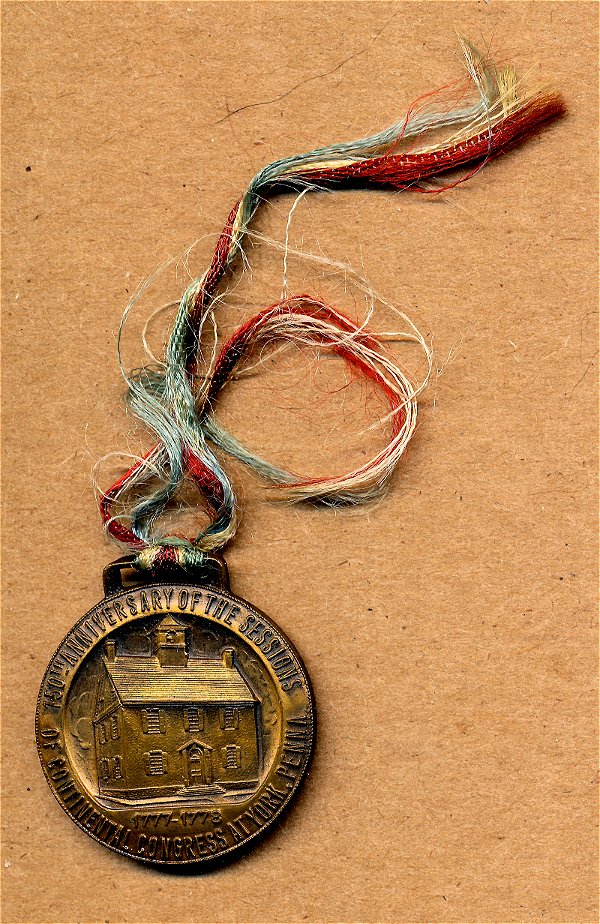 1927 Continental Congress - York, PA Commemorative Medal - Reverse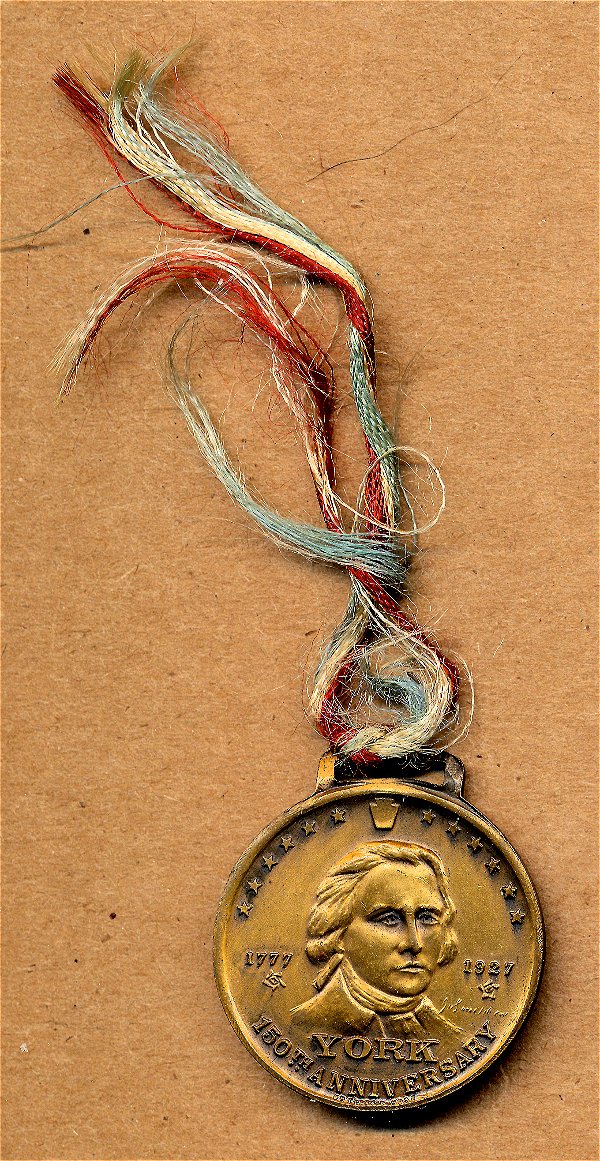
For other What If? posts about US commemorative coins and medals, check out:
Read More: Commems Collection.









 Posted 06/08/2021 3:31 pm


