Coin Community Family of Web Sites Join Thousands of Coin, Bullion, & Money Collectors
Specializing in Modern Numismatics Coin, Banknote and Medal Collectors's Online Mall 300,000 items to help build your collection! Shop for APMEX Bullion on eBay!Vancouvers #1 Coin and Paper Money Dealer Royal Canadian Mint products, Canadian, Polish, American, and world coins and banknotes. Join Thousands of Coin, Bullion, & Money Collectors


Username:
Password:
Save Password
Forgot your Password?


This page may contain links that result in small commissions to keep this free site up and running.

Welcome Guest! Registering and/or logging in will remove the anchor (bottom) ads. It's Free!

Testing US Coins For Silver Content, Part 2

To participate in the forum you must log in or register.
Author Previous TopicReplies: 23 / Views: 8,363Next Topic
Page: of 2
Bedrock of the Community
BH1964's Avatar
United States
10982 Posts
 Posted 01/14/2009  11:53 pm  Show Profile   Check BH1964's eBay Listings Bookmark this reply Add BH1964 to your friends list Get a Link to this Reply
Thank you for the part two Kurt. Work's been crazy lately and I haven't had the chance to give this much thought but I'd love to see some data on pre-1933 U.S. gold.

Silver and copper are relatively close in SP while gold and copper are drastically different. When you get a hold of an Eagle or Double Eagle, please let us know what you find out.
ANA #R3154474
Pillar of the Community
KurtS's Avatar
United States
5318 Posts
 Posted 01/15/2009  12:20 pm  Show Profile   Bookmark this reply Add KurtS to your friends list Get a Link to this Reply
I'm not a gold collector, but I wouldn't mind having some.
This was an interesting project, but also a somewhat trivial pursuit.
I'll test more coins as I get them.
Pillar of the Community
KurtS's Avatar
United States
5318 Posts
 Posted 01/16/2009  8:55 pm  Show Profile   Bookmark this reply Add KurtS to your friends list Get a Link to this Reply
Just a minor update to this test: I spoke with a friend who sends a lot of melt silver to a smelter, and their assay typically doesn't reveal a difference greater than .895/900 Despite some apparently accurate readings using a good scale, I'll be the first to admit this throws my results into question. It was all in fun anyway, and I hope you found it interesting all the same.
Valued Member
Brannenworks's Avatar
United States
106 Posts
 Posted 09/13/2009  10:03 pm  Show Profile   Bookmark this reply Add Brannenworks to your friends list Get a Link to this Reply
The coins minted by the US have always had very accurate composition. The problem is that to get an accuracy of 0.005 (i.e. 0.5%) in the silver content, you will have to measure the specific gravity to an accuracy of around 0.005 * 0.17 = 0.00085 or 0.085%, as the difference in specific gravities of copper and silver is only about 17%.

And then, because of the way you're measuring the coin weights in and out of water, to measure the specific gravity to an accuracy of 0.085% you will have to measure the weights to an accuracy of around 0.00085 x 0.10 = 0.000085 (since the weight in and out of the water differs by about 10%).

So to measure the silver composition as accurately as your smelter buddy, you're going to have to weigh them in and out of water with an accuracy of around 0.01%, i.e., you need to be measuring with 5 significant digits. In short, to get results that don't bounce all around you're going to have to invest in quite the scale.

Here's a table for silver / copper (gold/copper would be a lot easier):

5 digits: 0.5%
4 digits: 5%
3 digits: 50%

The above are worst case and are my back of the envelope guesses. You should be able to do better, depending on how lucky you are. (For example, if you have 3 digits accuracy you might measure 11.3 or 95.7. Then 0.1 is around 0.1% of 95.7 but closer to 1% of 11.3.)

As it turns out, this problem is one I've faced in my primary hobby, physics. This is why you need to give "error bars" on every measurement you make. And then, when you do the computations, you have to include the error bars with them.

I can type up an example showing how to do error bar calculations if you're interested. Doing calculations with error bars is a pain, so when I had to do this for hundreds of data items in one of my papers (on 100+ hadron masses), I wrote a java applet to take the data and do the calculations automatically for me.

Bedrock of the Community
DVCollector's Avatar
United States
10045 Posts
 Posted 09/13/2009  10:45 pm  Show Profile   Bookmark this reply Add DVCollector to your friends list Get a Link to this Reply
Interesting...what you describe no doubt accounts for the discrepancy, even with the average of 3 tests per coin. Error bars could be useful, if the margin of error were known better. This is very good to know if one wants to use SG as a confirmation of authenticity. Since I don't have a fancy lab to do this, I better learn to tell by coin details.
Valued Member
Brannenworks's Avatar
United States
106 Posts
 Posted 09/22/2009  12:33 am  Show Profile   Bookmark this reply Add Brannenworks to your friends list Get a Link to this Reply
I've been thinking more about the challenge of measuring specific gravity accurately, with inexpensive scales. I think there might be a way.

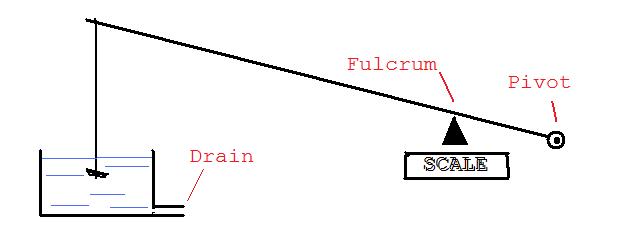
Part of the problem is that cheap scales tend to be for weighing things a lot heavier than a coin. A way to get around that problem is to use leverage.

Another problem I've observed with scale is that their measurements tend to depend on just how the item is being weighed, i.e. which part of the scale, etc. So a way to improve accuracy is to make the measurements of weight in and out of water using the exact same setup. This can be done by first measuring the weight while the coin is in water, and then letting the water drain out.

The mass of the halter that is underwater should be negligible. I'd ignore that part of the calculation completely. If you want to get more exact, you can always measure how much copper (I suppose) wire you use, and then calculate its mass from tables showing weight of copper wire as a function of gauge. But I'd use 30 gauge kynar wire wrap wire (without insulation) and I doubt you could possibly weigh it. For example, if you used copper and you had 2.23 grams of wire, then when you computed the difference in weight between in and out of water, you'd subtract 2.23 g / 8.94 since the specific gravity of copper is 8.94 (and therefore, the copper displaced 2.23/8.94 cubic centimeters of water).

To show how this works, an illustration might assist. So here's one:

Testing-US-Coins-For-Silver-Content,-Part-2

The fulcrum is just some single point where the fishing pole rests on the scale. The objective is to not have it move around (which would change the weight). The pivot is just a place where the fishing pole can pivot around; use your imagination but don't prevent the rod from free movement.

A more convenient way to drain the water might be to set up a siphon. Fill the siphon before making the "in water" measurement so you won't have to disturb it.
Valued Member
Brannenworks's Avatar
United States
106 Posts
 Posted 09/22/2009  12:35 am  Show Profile   Bookmark this reply Add Brannenworks to your friends list Get a Link to this Reply
Ooooops. Now that I think of it, it would be better to start with the dry measurement and then add water. Otherwise you'd have a wet coin and you'd have to dry it.
Rest in Peace
Parklane64's Avatar
United States
2668 Posts
 Posted 09/22/2009  5:14 pm  Show Profile   Bookmark this reply Add Parklane64 to your friends list Get a Link to this Reply
Wow.

And I think Jaobler should flesh out his response and enter it in Wheezydog's contest.
  Previous TopicReplies: 23 / Views: 8,363Next Topic
Page: of 2

To participate in the forum you must log in or register.


Disclaimer: While a tremendous amount of effort goes into ensuring the accuracy of the information contained in this site, Coin Community assumes no liability for errors. Copyright 2005 - 2026 Coin Community Family- all rights reserved worldwide. Use of any images or content on this website without prior written permission of Coin Community or the original lender is strictly prohibited.
Contact Us  |  Advertise Here  |  Privacy Policy / Terms of Use

Coin Community Forum © 2005 - 2026 Coin Community Forums
It took 0.28 seconds to rattle this change. Forums