Here's a reasonably scarce commemorative medal struck by the US Mint - an 1875 Battle of Lexington Centennial in bronze.
The medal was struck by the Mint (in Philadelphia) in bronze, silver and gold with mintage figures of 200, 100 and 4, respectively. White metal examples of the piece were privately-struck outside the Mint; these are often encountered holed for suspension. The bronze medals sold for $1.00, the silver medals for $3.00 and the gold medals for $30.00; the white metal pieces sold for $0.50 each. All versions of the medal tend to go for a bit more today!

The medal's obverse depicts a standing, right-facing Minute Man circa 1775 in the foreground of a shield encircled by a quote attributed to Samuel Adams: "What a glorious morning for America." Directly behind the Minute Man is seen a farmer working his fields - a nod to the fact that many of the citizen-soldiers that were Minute Men were full-time farmers. Further into the background is seen a colonial Lexington scene with a rising sun depicted in the distance - the start of the "glorious morning."
The quote presented on the medal is the common misquote of Adams' actual exclamation. In the address that he delivered at the commemoration ceremony at Lexington on April 20, 1835, Edward Everett, who had just completed ten years as the US Representative from Massachusetts and was the soon-to-be Governor of Massachusetts (and future US Senator), relayed the following about Samuel Adams, "Upon hearing the vollies of firearms from this spot [Lexington] announced to him and his companion, in the neighboring field, that the great battle of liberty had begun, he threw up his arms and exclaimed, in a burst of patriotic rapture, "Oh, what a glorious; morning is this!" "Yes! fellow citizens, such was the exclamation of Samuel Adams, when a thousand British troops were in possession of your village, and seven of your citizens were struggling in the agonies of death." The Adams quote morphed into a more obviously patriotic "What a glorious morning
for America," and has been quoted as often - if not more so - as Adams' actual statement at the time.
Two inscriptions flank the center shield. "1642 / CAMB. FARMS" is seen to the left (viewer's perspective) with "1713 / LEXINGTON" flanking on the right. Cambridge Farms was the name given to the area north of Cambridge, MA (of which it was legally a part) that eventually developed into the separate town of Lexington; the town was officially founded in 1713. The "1642" date refers to the first year for which documented proof exists for a house having been built in Cambridge Farms.
The medal's simple reverse features only commemorative inscriptions.
The design was the work of Rev. Edward Griffin Porter of Lexington, with the dies produced by Henry Mitchell of Boston.
The medal was struck by the Mint under its own authority (per the Coinage Act of 1873) vs. being mandated to do so by a distinct Act of Congress. I've read in some references that the 43rd Congress authorized these medals. I do know that the 43rd Congress authorized the Government to send 10 condemned brass cannons to Lexington, MA for "monumental purposes in commemoration of the Battle of Lexington" but I have never found any Act passed regarding the striking of a commemorative medal. I think this might be a case of an early reference confusing/misstating the facts and other references/internet sites running with the story without the proper fact checking. (If someone knows of an Act that I have missed, please let me know!)
The example shown here is a nice uncirculated example with rich chocolate brown coloring and clean surfaces.
1875 Battle of Lexington Centennial Commemorative Medal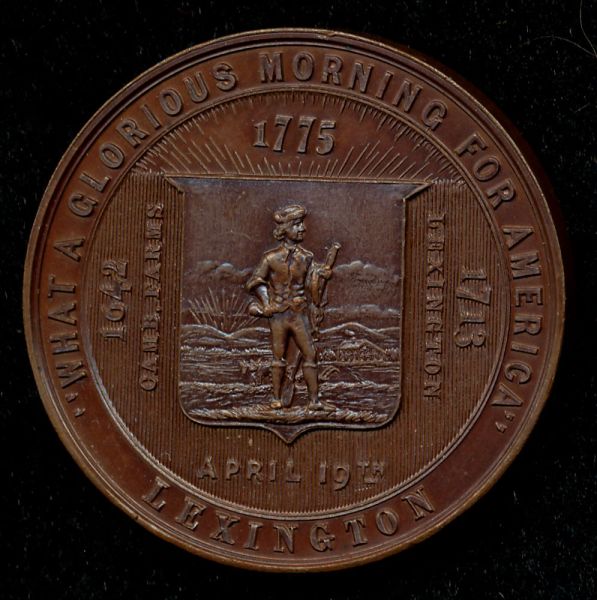
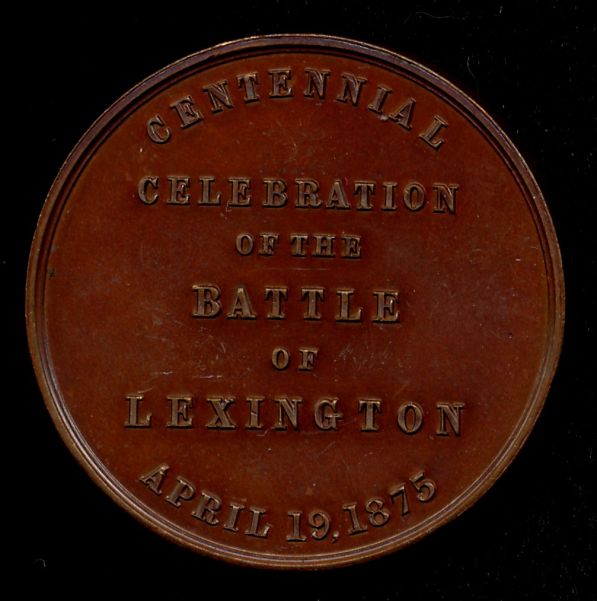
I also have one of the silver medals, and will post as soon as I can. (No gold example, however!)
For other of my posts about commemorative coins and medals, check out:
Commems Collection.










 Posted 10/04/2021 08:41 am


