I thought I'd share a few interesting tidbits about the Daniel Boone Birth Bicentennial half dollars that were struck "in commemoration of the two-hundredth anniversary of the birth of Daniel Boone." (Public Law 73-258)

C. Frank Dunn's connection to the Boone Bicentennial coins is well-known among collectors - he served as the contact for mail orders and handled distribution of the coins. His handling of the Boone half dollars was met with strong criticism at the time, and was often used as an example by those arguing that the US commemorative coin program was abusing and exploiting collectors. That said, many don't realize that he was the Secretary of the Daniel Boone Bicentennial Commission, and acted as the Commission's official coin distributor (vs. being an "independent" coin dealer looking to simply profit from the coins).
C. Frank Dunn filled orders for the coins out of an office in the Phoenix Hotel in Lexington, KY. The hotel provided the office free of charge to the Bicentennial Commission. Dunn also had a personal office in the same hotel, and apparently used the office to arrange personal coin deals.
In his role as distributor of the Boone Bicentennial coins, C. Frank Dunn engineered the infamous "shortage" of the Denver ("D") and San Francisco ("S") strikes of the 1935, Small 1934 half dollars. In fairness, the coins were fairly limited, with just 2,000 coins available from each Branch Mint facility. After receiving a large number of orders at the advertised price of $3.70 per pair, Dunn cancelled most orders and announced a "sell out." The notice created a frenzy among collectors and drove market prices for the D and S coins to over $100 for the pair. The sell-out/shortage was totally artificial, being created by Dunn. Based on his "behind the scenes" dealings, it was soon claimed that Dunn had held back hundreds of the "rare" sets for personal gain. Such claims seem at least plausible in light of the fact that Dunn suddenly had sets available after the higher market prices became established, claiming he had purchased the sets in the open market and/or from original purchasers.
Advertisement for 1935/34 Boone Birth Bicentennial Half Dollars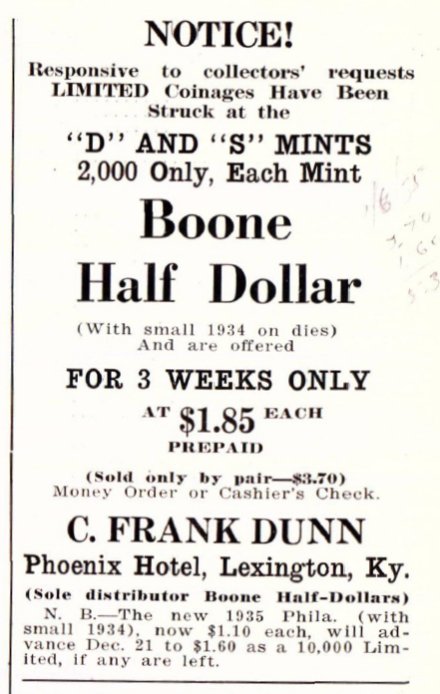 (image Credit: American Numismatic Association, The Numismatist, December 1935. Fair use.)
Early in the coin sponsorship process, C. Frank Dunn stated to the Daniel Boone Bicentennial Commission that the dies used to strike the 1921 Missouri Statehood Centennial half dollars could also be used for the Daniel Boone coins, because "these dies could be adjusted to fit the present celebration." This make me wonder if Dunn understood that the dies he was referring to were paid for by a private organization (vs. the US Government) and couldn't just be commandeered for use and modification by the Boone Commission without gaining permission from the Missouri group? (Also relevant is the fact that the Missouri Centennial Commission, the sponsor of the Missouri commemorative half dollar, had long been disbanded.)
This thinking likely played a role in the similarity of designs between the two coins.
In July 1934, the Commission informed Augutus Lukeman, the designer-sculptor of the coin, that its desire was to have "a profile head of Boone on one side and a corner of Fort Boonesboro on the other, with appropriate legend."
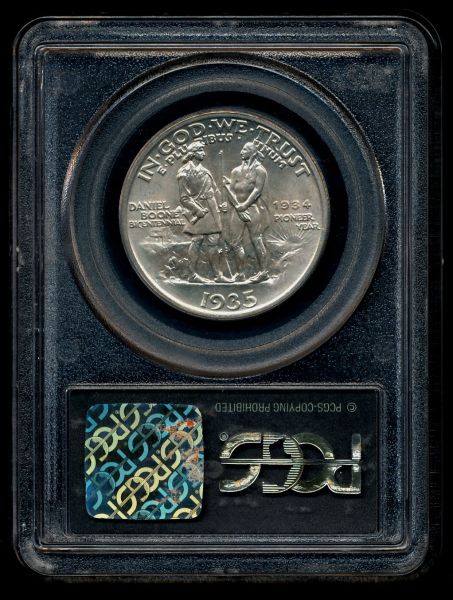
The Commission was not pleased with the first models developed by Lukeman, and labelled them "inappropriate to the occasion." In a letter to Lukeman, the Commission stated that Boone's "hair is too long, the nose too prominent and the chin too effiminate." [sic] The model does not liik [sic] like any Boone heads cited to the sculptor." In term's of the reverse, the Commission stated "take out the dog and the section of fort at left, entirely. Take off the Indian helmet and substitute shaved head, with scalp-look and feathers sticking through it. Add 1734 over "Daniel" in legend at left, and add 1934 over "Pioneer Year" at right. Remove fort scene at right (this is not a pioneer fort) and substitute prominently a block-house corner of a pioneer fort, with the proper palisades, or palings, adjoining it. Take out peace-pipe and substitute tomahawk."
Such criticisms call into question the reference sources Lukeman had used to create the coin's models; the historical inaccuracy of Lukeman's designs appears to have been immediately apparent to those knowledgeable about history.
The bill calling for the Boone half dollar was originally passed by Congress, and presented to the President, without language stipulating that the Government would not bear the costs associated with the coin. When the omission was realized, the bill was recalled from the President so that it could be amended to include the phrase "but the United States shall not be subject to the expense of making the models or master dies or other preparations
for this coinage." After being approved in Congress, the amended bill was presented to the President for signature and final approval.
1935, Small 1934 Half Dollar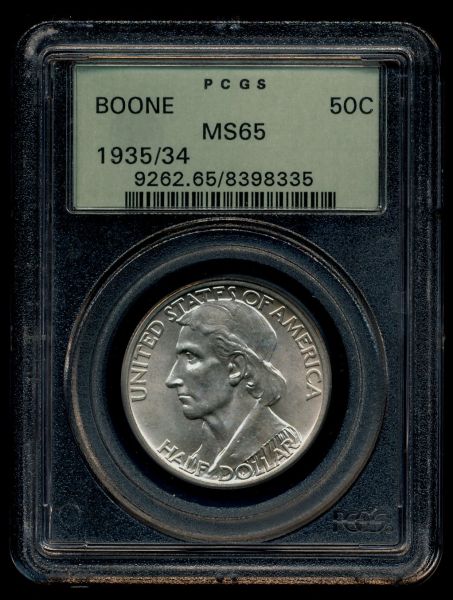
For other of my posts about the Daniel Boone Birth Bicentennial coins, see:
Commems Collection for links.







 Posted 01/09/2022 09:36 am





