I have a few medals commemorating the 1867 Alaska Purchase in my collection about which I plan on posting. I thought I'd start off with one of the less common pieces - a historical art medal struck by the Paris Mint that commemorate the Purchase, if not the actual centennial year.
The medal has a decidedly Paris Mint appearance - "it ain't from around here!" as locals sometimes still say here in the US South (most often in a joking manner). It was struck and issued during a time when the traditionally friendly relationship between the US and France was strong and the Paris Mint often produced medals with an American history theme (I will soon be posting others!). I like much of the Monnaie de Paris' medallic output, though I have to admit that many of its abstract/highly-stylized modern designs do not catch my eye.
The medal shown was struck in 1975. It was one of a group of medals struck by the Paris Mint as a tribute to US history during the US Bicentennial era.
The obverse of the medal features "head shots" of US Secretary of State, Frederick William Seward and Eduard de Stoeckl, the
charge d'affaires of the Russian embassy in Washington, DC; a
charge d'affaires is in charge of a nation's diplomatic embassy when its ambassador is not present. The pair were the primary negotiators of the Treaty that enabled the US' purchase of Alaska from Russia for $7.2 million (USD) in 1867 following agreement and ratification of the Treaty of Washington; the Treaty was signed by US President Andrew Johnson on May 28, 1867.
Signing the Alaska Treaty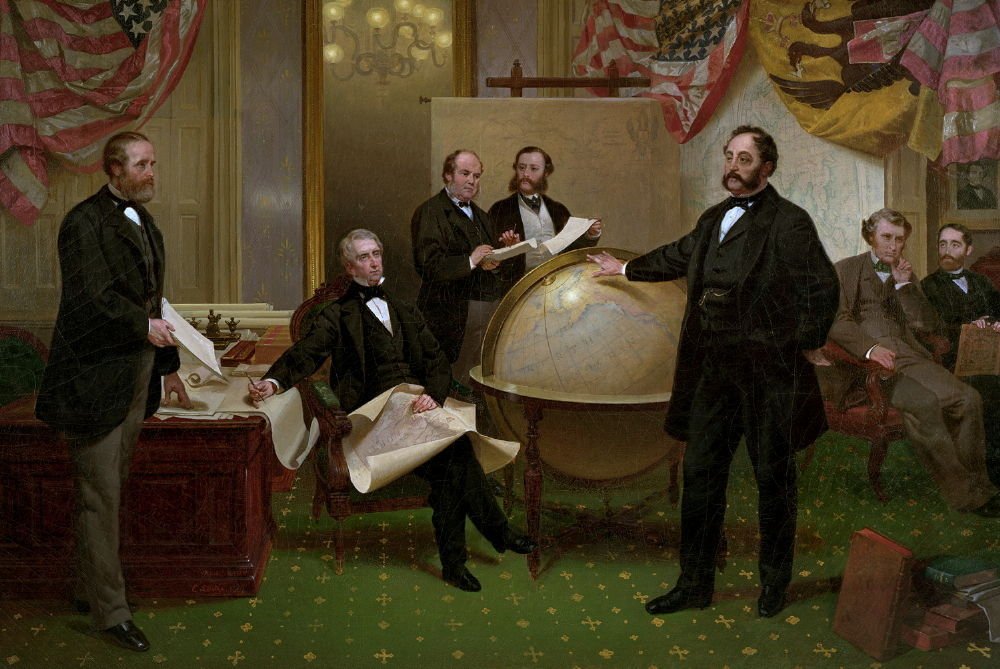 (Image Credit: Public Domain.)
The original painting was created by Emanuel Leutze in 1867. Depicted in the painting, from left to right: Robert Smith Chew (US Diplomat), William Henry Seward (US Secretary of State, seated holding a map), William Hunter (US Diplomat), Waldemar de Bodisco (Secretary of Russian Mission), Baron de Stoeckl (Russian Ambassador, standing with hand on globe), Charles Sumner (US Senator), Frederick William Seward (Assistant US Secretary of State).
The medal's two portraits are superimposed over a globe view of earth (including longitude and latitude lines), looking directly down upon the North Pole, with Russia and Alaska being primary geographic features; parts of Europe and North America are also visible.
Note: If you look closely at the medal's obverse (below), you will notice that Seward's portrait is labelled "Fred. W. Seward" rather than "William H. Seward." This is an error on the medal. Frederick William Seward was the son of William, and served as the Assistant Secretary of State under Presidents Abraham Lincoln and Andrew Johnson (and later Rutherford B. Hayes); he was not, however, the lead negotiator for the Alaska Purchase/Washington Treaty - such role was filled by his father. The portrait image depicts the correct Seward, however.The inscriptions are all in French, and read (from top to bottom) - with English translation:
Mer de Bering = Bering Sea
Russie d'Asie = Asian Russia
Pole Nord = North Pole
Les Etats Unis Acouierent L Alaska = the United States Accepts Alaska
Fred. W. Seward / Secretaire d'etat pour L'Amerique = Fred. W. Seward / Secretary of State for the Americas
Signent = Sign
Le Traite de Washington 1867 = the Treaty of Washington 1867
Edw. de Stoeckl / Ministre du Tzar Alexandre II = Edw. de Stoeckl / Minister of Czar Alexander II
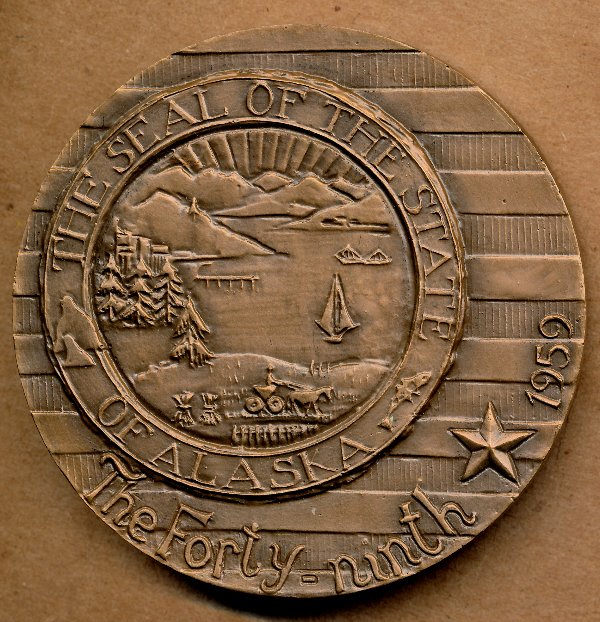
The medal's reverse presents a reasonably-accurate rendition of the Seal of the State of Alaska superimposed over alternating stripes that suggest the US Flag; the number of stripes (15) depicted is incorrect for either 1867 or 1959, however, hence my use of "suggest." The commemorative inscriptions (in English) read "The Forty-ninth" and "1959", alluding to Alaska's admission to the US Union as the 49th State in 1959 (January 3).
Regarding the design of the Seal, the web site of Alaska's Office of Lt. Governor (
https://ltgov.alaska.gov/informatio...state-seal/) states:
"The rays above the mountains represent the famous Alaskan northern lights, also known as aurora borealis. The smelter symbolizes mining, the train stands for Alaska's rail transportation, and ships denote marine transportation. The trees symbolize Alaska's wealth of timber and other forest products, and the farmer, his horse, and the three shocks of wheat portray Alaska's agriculture. The fish and seals signify the importance of seafood to Alaska's economy." (Try as I might, I can't find a train on the medal!)
Alaska Purchase Commemorative Medal - Paris Mint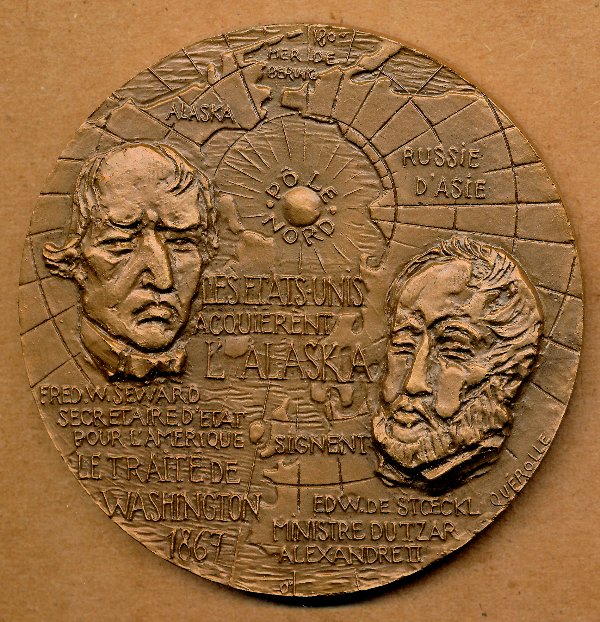
For other of my posts about commemorative coins and medals, check out:
Commems Collection. 






 Posted 02/19/2022 6:39 pm





