Companion bills calling for a half dollar "in commemoration of the three hundredth anniversary of he settling of New Netherland, the Middle States, in 1624, by Walloons, French and Belgian Huguenots, under the Dutch East India Company" were introduced in January 1923 (in the House) and February 1923 (Senate).
The bills called for up to 300.000 silver 50-cent pieces of standard specifications. As was the norm at the time, the language of the bills allowed for coins to be struck at all of the operating US Mint facilities, did not specify a date to be placed on the coins and did not include an expiration date for coining authority. The bills also did not name a sponsor/financial guarantor or any guidelines/restrictions regarding placing orders for the coins. The only related provision it included was that the "United State shall not be subject to the expense of making the necessary dies and other preparations for this coinage."
Upon introduction each of the bills was referred to its repective coinage Committee. The House Committee on Coinage, Weights, and Measures moved on the bill quickly, holding a Hearing the first week of February.
During the Hearing, Representative (and Committee Chairman) Albert Henry Vestal (R-IN) stated "I would not be in favor of the bill before us - I would not be in favor of reporting it favorably." Vestal's issue centered on the lack of a named party who could accept delivery of the coins and pay the Mint for them. Representative Fred Benjamin Gernerd (R-PA) (the House Representative who introduced the bill) responded that he was open to amending the bill and that the Fifth National Bank of New York City had already agreed to be the "responsible depository" for the coins.
Reverend John Baer Stoudt, the Secretary of the Huguenot-Walloon New Netherland Commission, the coin's sponsor, was next to speak at the Hearing. He provided a history of the Walloons and their settlement efforts in the "Middle States." Reverend Stoudt also described the Federal Council of the Churches of Christ in America, the group behind the Commission, and the various Societies that were going to be involved in the tercentenary celebrations. He made no effort to "hide" the coin's religious underpinnings in his comments - this religious connection was a sore point for many of the time who believed it violated the "separation of church and state" provisions of the First Amendment to the US Constitution.
Near the conclusion of his comments, Stoudt stated: "I might add that we would like to have this coin granted as a memorial to this tercentenary even if we are not allowed to sell it at a premium. We believe these 300,000 coins would be of patriotic and educational value to the people of America." Certainly an unusual statement from a coin sponsor!
In responding to a question about the planned designs for the coin, Dr. Stoudt stated, "we would have the arrival of the
New Netherland on one side and the purchase of Manhattan by Governor Minuit on the other." Of course, the Governor Minuit design was ultimately replaced by the conjoined portraits of Admiral Gaspard de Coligny and William the Silent.
The Committee issued its favorable report following the Hearing, and recommended the it pass with the following amendment:
Sec. 2. That the coins herein authorized shall be issued only upon the request of the Fifth National Bank of New York and upon payment of the par value of such coins by such bank to the United States Treasury.Simultaneous to the House actions, the Senate was moving its version of the bill through its process. It passed its version and sent it to the House for concurrence. The House substituted the Senate bill for its own, but amended it with the recommendation made by the Committee on Coinage, Weights, and Measures.
The Senate received the amended bill and concurred with the changes made by the House. At that point, the bill was examined and signed in each chamber and sent to the President for approval. US President Warren G. Harding signed the bill into law on February 26, 1923.
(Side Note: Harding died in office on August 2, 1923.)1924 Huguenot-Walloon Tercentenary Half Dollar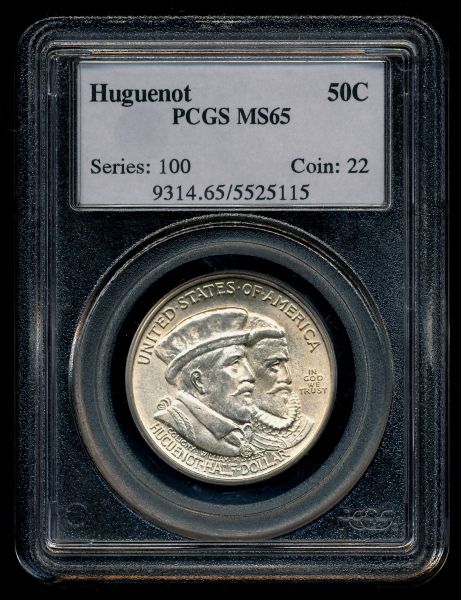
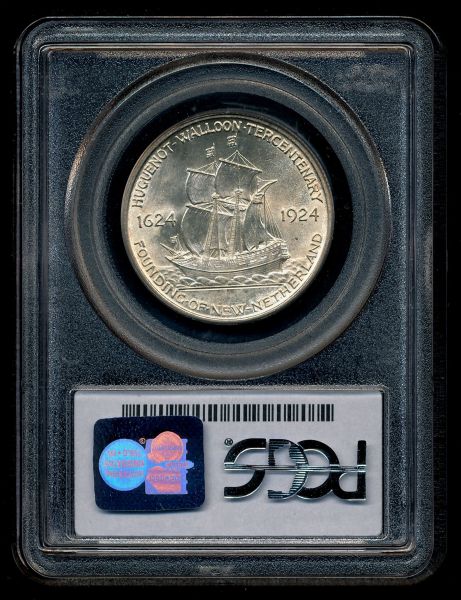
For more on the Huguenot-Walloon coin, see:
-
1924 Huguenot-Walloon Tercentenary-
1924 Huguenot-Walloon Tercentenary - Revisited-
1924 Huguenot-Walloon Tercentenary - Design Changes-
1924 Huguenot-Walloon Tercentenary - Coin #1For other of my posts about commemorative coins and medals, check out:
Commems Collection. 








 Posted 02/25/2022 06:16 am


