Today, collectors of US commemorative coins tend to consider the 1925 California Statehood Diamond Jubilee half dollar to be among the stronger designs of the series. When the original sketches/designs were put before the Commission on Fine Arts (CFA), however, a much different opinion was rendered.
Upon reviewing the initial design sketches for the coin,
James Earle Fraser, the sculptor member of the CFA and the well-known artist behind the acclaimed Indian Head/"Buffalo" five-cent coin, opined "I must say that I am not impressed with the composition, or any of the indications contained in the drawing. It strikes me that the artist has not had proper experience to do a successful coin. The bear is entirely too short, and the whole thing inexperienced and amateurish." He also stated (regarding the design element choices), "...there might be something which would be far more interesting and with a bigger sense of what California really is."
(Letter from Fraser to CFA Chairman Charles Moore, CFA Records, National Archives.)Fraser did, at least, make a few suggestions on how the design could be improved when he provided his thoughts to the Chairman of the CRF.
The artist in question was Joseph "Jo" Mora, the California-based artist/sculptor commissioned by the San Francisco Citizens Committee to create the coin's designs; Mora was living in Carmel, CA at the time.
Fraser recommended the task be reassigned to either Robert Aitken (designer of 1915 Panama-Pacific International Exposition Quintuple Eagle ($50) gold coins and 1921 Missouri Statehood Centennial half dollar) or Chester Beach (artist/designer behind the 1923 Monroe Doctrine Centennial and 1925 Lexington-Concord half dollars). The Citizens Committee contacted Aiken about the project; he responded with a quote of $2,500 (~$52,500 in 2022). The Committee was not planning for such an expense in its budget, as Mora had offered to create the designs for a "nominal" fee.
The Citizens Committee communicated this economic reality to the Mint while also stating its support for Mora and noting his many sculptural works in the San Francisco area that were considered "distinctly Californian" by local art critics and the public. It also informed the Mint that updated sketches would be provided which incorporated the revisions suggested by the CFA after its initial review; the design revisions were to be handled by Mora.
(Note: Aitken and Beach went on to design later US commemorative coins in addition to the 1925-or-before issues listed.)The Committee also stated that if the revisions were not accepted, it would be faced with the difficult task of either dropping its pursuit of the half dollar or grudgingly engaging Aitken (which would create timing/delivery issues).
Though Mora's revisions were not all the CFA had hoped for, his designs were ultimately accepted (the Citizens Committee held their ground!) and his sculpts were used by the Mint to create dies and strike the half dollars; all 150,000 authorized coins were struck at San Francisco in August 1925. Sometimes the more economical choice is the best one!
1925 California Statehood Diamond Jubilee Half Dollar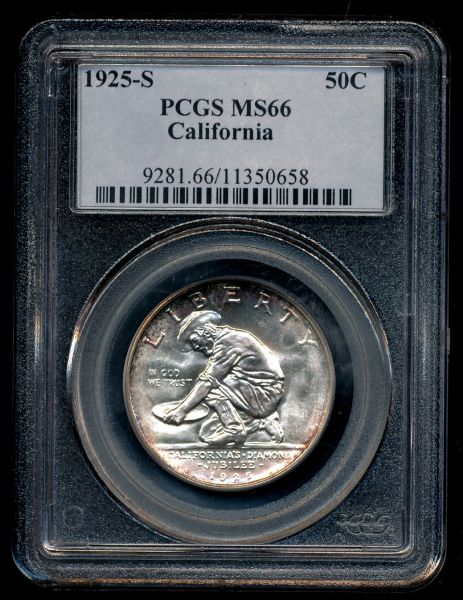
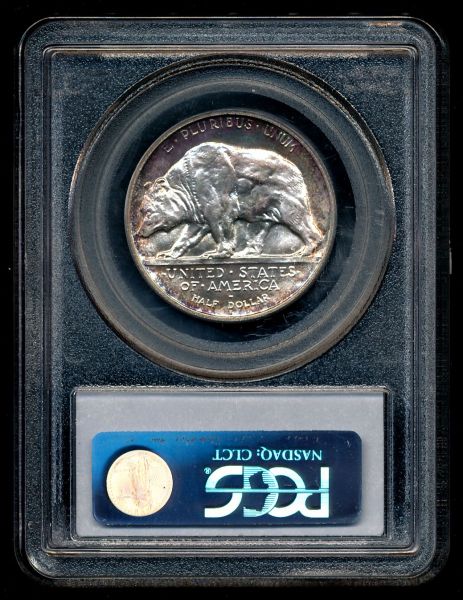
For more on the history of the 1925 California half dollar, see:
-
1925 California Statehood Diamond Jubilee-
1925 California Statehood Diamond Jubilee - Revisited-
1925 California Statehood Diamond Jubilee - Origin Story-
1925 California Statehood Diamond Jubilee - The Celebration-
It Should Have Been GoldFor other of my posts about commemorative coins and medals, see:
Commems Collection.






 Posted 04/21/2022 11:24 am





