I recall learning in elementary school of several famous rallying cries in American History: "Remember the Alamo!" "Remember the Maine!" and "Remember Pearl Harbor!" (There may have been others, but those are the ones "I remember!")

"Remember the Maine!" is one that was elevated in the public's mind as a result of journalists who got out ahead of the facts and placed the blame for the ship's destruction with the Spanish before such claims could be substantiated. More on this below...
The
Maine was a United States Second-class Battleship (originally designated an Armored Cruiser) that was commissioned in 1895 and patrolled the east coast of the US from 1895 until it was sent to Cuba in January 1898 to support US interests. The ship had a displacement of 6,682 tons, with a length of 319', a beam of 57' and a draft of 21'6". Her armament consisted of four 10-inch guns, six 6-inch guns, seven 6-pounders (~2.2-inch), eight 1-pounders (~1-inch), four Gatling guns and four 14-inch torpedo tubes. The ship had a crew complement of ~370; and a cruising speed of ~17 knots.
USS Maine at Sea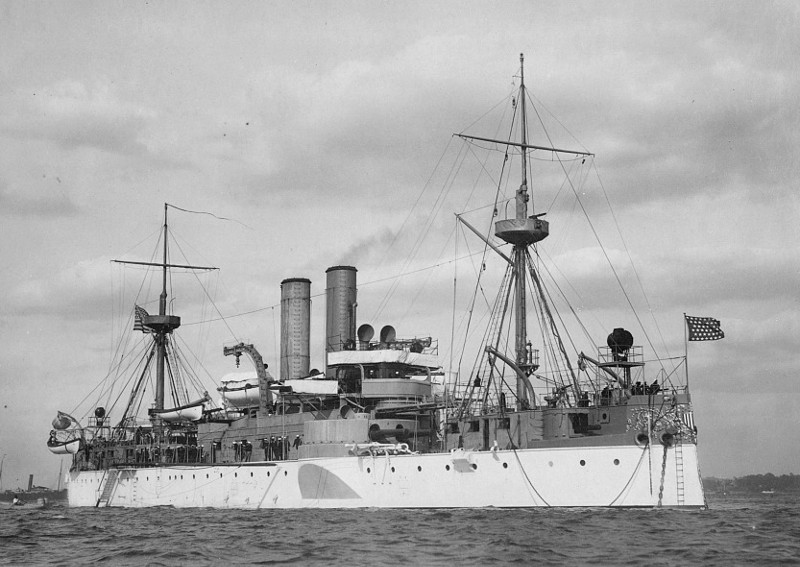 (Image Credit: Library of Congress, Prints and Photographs Division. Public Domain.)
On the night of February 15, 1898, the
Maine, anchored in Havana Harbor, was suddenly rocked by an explosion. The explosion was large enough to destroy a good part of the ship and cause it to sink on the spot - the ship was not otherwise under active attack. US newspaper journalists (especially those working for William Randolph Hearst in New York) soon blamed the explosion on sabotage by the Spanish, and gave birth to the "Remember the Maine!" rally cry. Approximately 260 crew and officers died as a result of the huge explosion.
USS Maine after Explosion - Sunk in Havana Harbor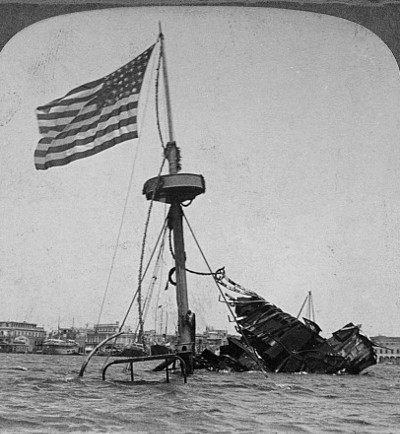 (Image Credit: Library of Congress, Prints and Photographs Division. Public Domain.)
Though a US Court of Inquiry investigating the explosion could not find evidence that connected it to any person(s) or country, US public opinion had been whipped into a state of frenzy against Spain and led US President William McKinley to request permission from the US Congress to use force against Spain; Congress subsequently issued a Declaration of War against Spain on April 21, 1898.
The US emerged victorious over Spain rather quickly, and acquired the Philippine Islands (for $20 million), and had Guam and Puerto Rico ceded to it as a result. In addition, Spain agreed to grant independence to Cuba.
In May 1947, Bertrand Wesley Gearhart (R-CA) sought to ensure that the memory of the explosion that felled the USS
Maine in the harbor of Havana, Cuba in 1898 would be aided by the striking of a half dollar "to commemorate the fiftieth anniversary of the destruction of the battleship United States Ship Maine, on February 15, 1898." Gearhart envisioned a major remembrance, calling for the production of up to two million coins - the coins were to be circulating commemorative coins.
Though the bill did not place a limit on which Mint facility or facilities could be used to strike the coins, it did include language that outlined several specifications for them:
1. The coin was to feature "a special appropriate design carrying a replica of the battleship United States ship Maine."
2. The coin was to be "issued at par, between February 15, 1948, the fiftieth anniversary of the destruction of the Maine and August 13, 1948, the fiftieth anniversary of the surrender of Manila, Spanish Capital of the Philippines, to the victorious armed forces of the United States."
Upon its introduction, the bill was referred to the House Committee on Banking and Currency; it was never reported out or considered by the Whole House.
Time and the accompanying improvements in forensic techniques/technological capabilities have seriously called into question sabotage/involvement by the Spanish regarding the explosion/destruction of the USS
Maine,
If the Spanish-American War is an interest of yours, check out:
What If? 1948 Termination Of The War With SpainFor more of my topics on commemorative coins and medals, including other What If? stories, see:
Commems Collection.






 Posted 11/10/2022 10:08 am





