Here's yet another commemorative half dollar proposal from 1937...In March 1937, Representative Melvin Joseph Maas (R-MN) intoduced a bill in the House that called for the striking of half dollars "in commemoration of the one-hundredth anniversary of the original establishment and founding of the city of Saint Paul, Minnesota, as a settlement, following treaties with the Sioux Indians." The bill was immediately referred to the House Committee on Coinage, Weights, and Measures.
St. Paul was established before either the Minnesota Territory (1849) or State of Minnesota (1858). in 1838, a Frenchman - a former fur trapper, and then-current liquor distiller / bootlegger / bar owner - by the name of Pierre Parrant operated his business very near Fort Snelling (built by the US on former Sioux land). In time, the Fort's command decided the soldiers of the Fort were indulging too heavily in what Parrant offered (i.e., they were getting drunk far too often!) and strongly "encouraged" Parrant to move his business elsewhere.
Parrant built a small house and tavern from which to operate his liquor business a few miles south of the Fort - it was on land occupied by present-day St. Paul. The growing settlement around Parrant's home and business was called "Pig's Eye Landing" for several years in reference to Parrant who was blind in one eye and was given the nickname "Pig's Eye" - his blind eye had a white ring around the pupil which added to its distinction.
The settlement was renamed in 1841 by Father Lucien Galtier, a French priest, as St. Paul. Galtier built a small church in the area and named it after Paul the Apostle. Though "Pig's Eye" continued to be used by locals for a time, St. Paul eventually won out as the growing community's name and remains in use to the present.
St. Paul, Minnesota - Circa 1853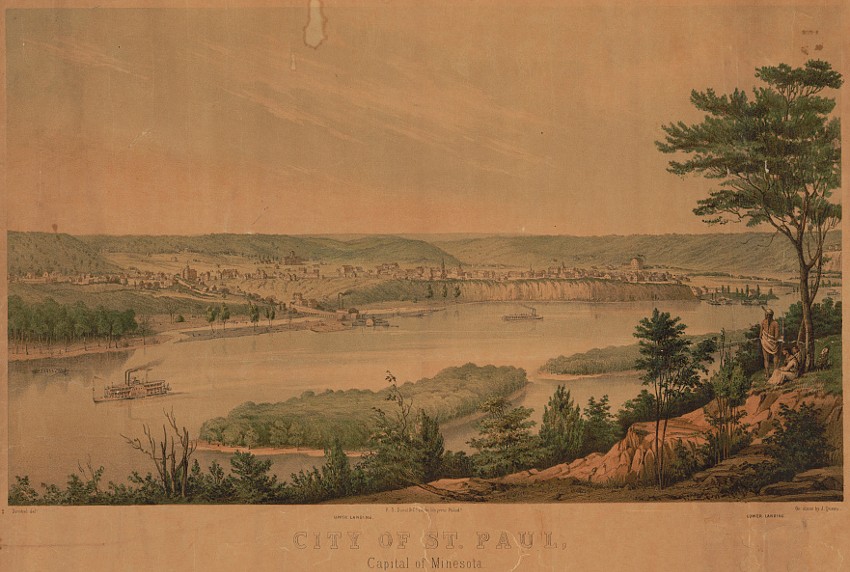 (Image Credit: Library of Congress, Prints and Photographs Division. Public Domain.)
When the Minnesota Territory was created on March 3, 1849 (after its area was split from the Iowa and Wisconsin Territories) St. Paul was established as its capital. When the present-day State of Minnesota was split from the Territory to become the 32nd State on May 11, 1858, St. Paul continued as the capital (though municipal competitors emerged).
Maas' bill called for the minting of up to 20,000 half dollars of standard specification for the benefit of the Saint Paul Commemorative Coin and Celebration Committee (affiliated with the Saint Paul Junior Association of Commerce) to aid "in defraying the expenses incidental and appropriate to the commemoration of such event and in keeping with the public purposes of said corporation expressed in its articles." The striking of the coins was not limited in terms of which Mint facility or facilities could be used (i.e., P/D/S sets would have been possible). All coins struck were to be dated 1937. The minimum order size was 5,000 coins and the coin's issuing authority was set to expire one year after enactment of the bill.
The bill did not gain the needed support and was never reported out of Committee. The bill died for lack of action when the 75th Congress adjourned in June 1938.
In an interesting twist, Representative Maas tried again in January 1939 - at the opening of the 76th Congress - by introducing a duplicate of his 1937 bill. The bill continued to specify that the coins were to be dated 1937 "irrespective of the year in which they are minted or issued." A clear request for back-dating!
The fate of the 1939 bill was the same as the 1937 proposal - it was referred to the House Committtee on Coinage, Weights, and Measures but never reported out for further consideration. The bill died for lack of action when the 76th Congress adjourned in January 1941.
Historical Note: The bills made specific reference to treaties signed with the Sioux. It is true that treaties were signed with the Sioux and that they gave up very significant territory in and around present-day Minnesota as a result, but it is also true that the fairness / equitable terms of the treaties - as well as follow-up treatment of the Sioux - can be questioned. It is a story far too large for coverage here, but I encourage further study by all those with an interest.For my What If? 1949 Minnesota Territorial Centennial post, see:
-
What If? 1949 Minnesota Territory CentennialFor more of my topics on commemorative coins and medals, including many more What If? stories, see:
Commems Collection.







 Posted 01/05/2023 04:46 am





