PMG -
This month's edition shows how counterfeiters will do just about anything to alter a note, even if the profits are small.Last month, we discussed how certain Chinese notes can be worth much more to collectors if they have a replacement prefix, leading counterfeiters to find ways to alter serial numbers. This month, we will look at how similar alterations can be performed to the date of a note to make them appear more valuable.
The Chinese 50 Yüan note with Pick #888 is a popular piece that is available in two varieties: the a-variety, released in 1980, and the b-variety, released in 1990. They are each relatively common, and neither variety is usually worth a large amount of money.
The 1980 variety, however, does tend to command a higher price than the 1990, and at some point, counterfeiters discovered that it was not too difficult to change a "9" to an "8" and immediately have a note that was worth more than what they had paid for it.
 An altered date on a Chinese 50 Yüan note (Pick #888b)
One such note was recently submitted to PMG's US office. Though the date is credible at a distance, simply looking at it through a loupe or high magnification reveals many imperfections: the edges of the "8" appear uneven, and the underprint was damaged by whatever process was used to remove the "9" that was originally there. (A disturbance in the underprint is a common tell-tale sign of an alteration, as counterfeiters are less likely or able to properly maintain such minute details.) Alternative light sources can show that the ink on the "8" is completely different from the ink that was used on the other digits.
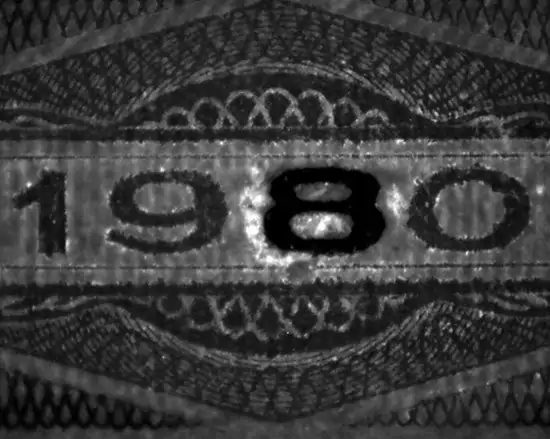 The underprint was damaged by whatever process was used to remove the "9" that was originally printed.
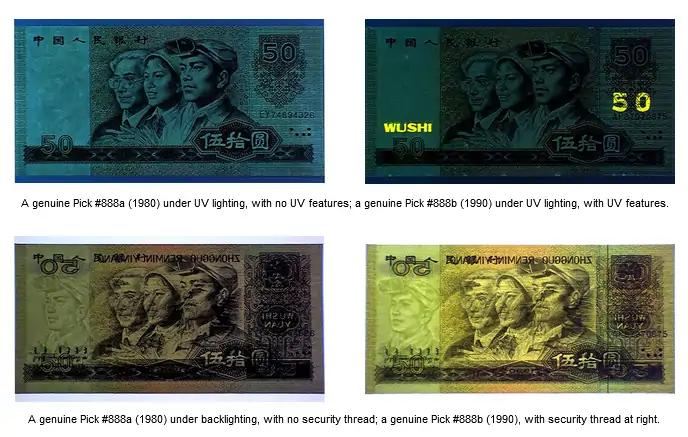
Luckily, even for the average collector, there are many ways to detect this particular alteration—in fact, Pick makes note of a few tips. When the b-variety of this note was released in 1990, certain security features were added, including UV-reactive ink and a security thread.
Therefore, if a Chinese #888a note (1980) has a security thread, or if a quick check with a UV light reveals a vivid yellow "WUSHI" and "50" on the face of the note, then it is a good idea to take a closer look at the date, as this note was likely altered. For a quick reference, the images below show what the genuine a- and b-varieties of this note should each look like under UV and backlighting.
The China 1980 2 Yuan Pick 885a* is very popular with collectors in the US, and even more popular in the Chinese market. Just as so-called "star notes" can carry large premiums on US currency, replacement notes issued with special prefixes are highly collectible in China.
Unfortunately for Chinese collectors, unscrupulous people will often alter a note's serial number prefix (or even the number itself) to make the note appear to be a replacement or a note with a fancy serial number. Such is the case with this note recently submitted to PMG's Shanghai office.
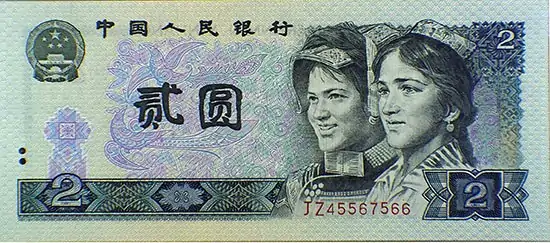 1980 China 2 Yuan (Pick 885a*) with altered serial number prefix.
As you can see from the photo above, nothing really seems amiss with this note. Even a closer inspection of the prefix would probably not be alarming to an average collector.
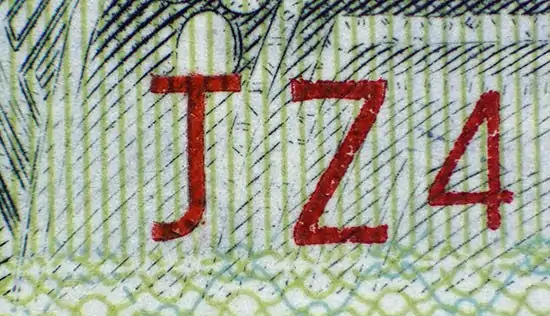 Close-up of JZ prefix on altered 1980 China 2 Yuan (Pick 885a*)
However, note how the green security lines appear much darker on the J than the Z and do not quite line up with those on the note. The lines don't connect because a forger has physically cut out a J from a more common note, removed the letter that was on the present note, and dropped the J in!
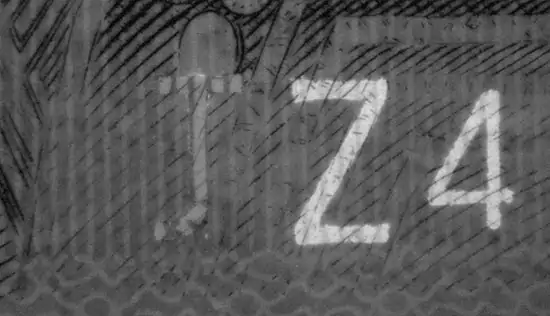 Close-up of JZ prefix using specialized lighting
When the counterfeiter transferred the letter, the process changed the fluorescence of the ink in the J. This is very clear in the photo above, as the J is much less fluorescent than the Z and the 4. When such a large difference is seen between two inks that appear the same under visible light, it's an alert that something has been done to the serial number.
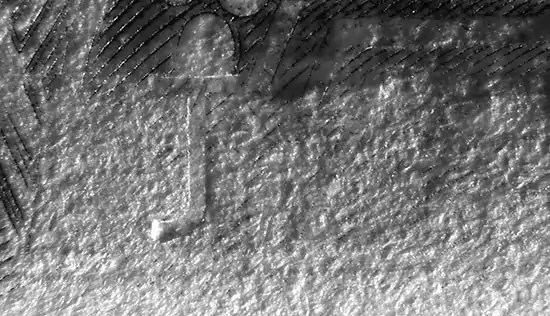 Additional close-up of JZ prefix using specialized lighting
The photo above is the tell-tale sign of alteration on this note. It is very clear that the J is simply sitting on top of the paper rather than being a part of it. This is in comparison to the Z, which is pressed into the paper as a digit should be.
As you can see from this analysis, it can be quite difficult to authenticate the serial number on a note without proper training and equipment.
Read More: Counterfeit Detection Series









 Posted 03/10/2024 07:52 am





