Here's a commemorative coin story that might surprise you...In May 1936 (74th Congress), Frank Crowther (R-NY) introduced a bill in the House of Representatives that called for half dollars to be struck "in commemoration of the memory of the late Doctor Charles P. Steinmetz." The bill was immediately referred to the House Committee on Coinage, Weights, and Measures.
If you are unfamiliar with Dr. Steinmetz, it may surprise you to learn that he was not a medical doctor and the bill was not commemorating a medical advancement. Charles Proteus Steinmetz was a German-born (1865) mathematician and electrical engineer whose groundbreaking work in the field of electricity enabled significant advancements in the technology of motors, generators and alternating current (AC) power systems (among other things electrical). Steinmetz's birth name was Karl August Rudolph Steinmetz, but he changed it upon emigrating to the United States in 1888 to appear "more American."
During his career, Steinmetz was a researcher and electrophysics professor at Union College in Schenectady, NY, a draftsman at Osterheld and Eickemeyer in Yonkers, NY where he worked on electric motors and generators and a chief engineer at General Electric in Lynn, MA and Schenectady, NY. In 1901-02, he was president of the American Institute of Electrical Engineers (AIEE).
Charles Steinmetz Portrait - Circa 1922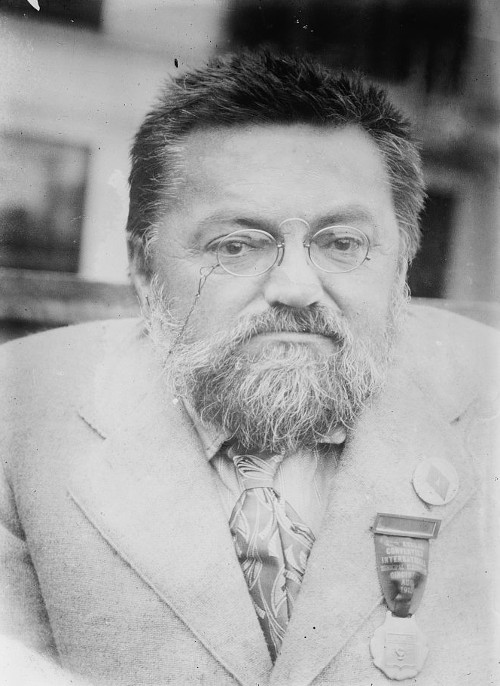 (Image Credit: Library of Congress, Prints and Photographs Division. Public Domain.)
Steinmetz's life, physical issues and academic and professional achievements make for a fascinating story - one that is beyond the scope of this failed coin story. I encourage those with an interest to check out the following link to a brief biography of the man:
-
Smithsonian Magazine: Charles Proteus Steinmetz, the Wizard of SchenectadyCharles Steinmetz with Inventor Guglielmo Marconi at General Electric Research Laboratory, NY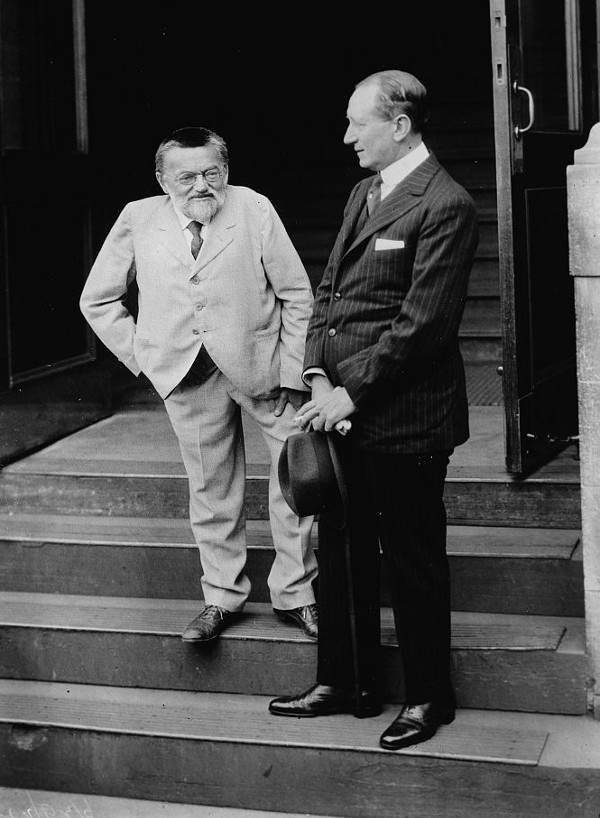 (Image Credit: Library of Congress, Prints and Photographs Division. Public Domain.)
Crowther's bill sought the striking of 25,000 half dollars of standard specifications at one or more US Mint facilities - a P/D/S set, therefore, would have been a possibility. No restrictions were placed on the date to be included on the coins or the year(s) in which they were to be struck. A limited mintage, multi-mint, multi-year program would have been possible.
The coins were to be struck for the benefit of the Steinmetz Memorial Committee of the Schenectady Junior Chamber of Commerce, with the Memorial Committee able to order coins "in such numbers and at such times" as it desired. Net proceeds from sales of the coins were to "be used in furtherance of the commemoration of the memory of the late Doctor Charles P. Steinmetz."
The bill was favorably reported out by the House Coinage Committee with a recommendation to pass; the Committee offered no amendments. The bill was considered in the House under the rules of Unanimous Consent, and was passed without objection or discussion. The bill was then sent to the Senate for its consideration.
Rather than a smooth continuation of its path to becoming law, however, the bill's journey came to an end in the Senate. Upon its receipt from the House, it was referred to the Committee on Banking and Currency but was never reported out. The Senate's lack of action on the bill signaled its demise.
In January 1937, upon the opening of the 75th Congress, Representative Crowther tried again by re-introducing his Steinmetz coin bill. This time, the House Coinage Committee did not report the bill and it died for lack of action when Congress adjourned in June 1938.
Steinmetz continues to be remembered/honored today via the Institute of Electrical and Electronics Engineers (IEEE) Charles Proteus Steinmetz Award. The annual award is given "for exceptional contributions to the development and/or advancement of standards in electrical and electronics engineering." (IEEE web site:
IEEE Steinmetz Award.)
For other of my topics on commemorative coins and medals, including many more What If? stories, see:
Commems Collection.









 Posted 02/03/2023 09:30 am


