Continuing the story...In the House of Representatives, Representative Multer stood to offer his support for the Senate bill, noting that it was identical to the one he had previously introduced. His comments included:
"Three hundred years ago this community was brought into being as a trading post on the North American continent.It soon became the provincial capital of the New Netherlands.
"It later served as the national capital of the United States of America and as the capital of the State of New York.
"When Peter Stuyvesant and his council in 1653 proclaimed a grant of municipal government, placing city affairs in charge of two burgomasters, or mayors; five schepens, or councilmen; and a schout, or prosecutor, western democracy was born in America, because this municipal council was the first democratic institution on this continent."
The House passed the bill without objection or debate and informed the Senate of its action. With the bill being passed by both chambers of Congress, it was examined and signed in each, then sent to President Dwight David Eisenhower for approval.
Its fate was the same as the Louisiana Purchase and Northampton, MA coin bills - the three were vetoed by President Eisenhower on the same day. As he did in his messages for the other two coin bills, he noted that he was not specifically opposed to a celebration of New York City's milestone, stating "I fully recognize the importance to the country of the event which this coin would commemorate."
In his message, Eisenhower included the "standard" language that was drafted by the Treasury Department:
"The principal objection to commemorative coins is that they detract from the fundamental function of the coinage as a medium of exchange. Multiplicity of designs on
United States coins would tend to create confusion among the public, and to facilitate counterfeiting. The Congress recognized the necessity for limiting the designs of coins by section 3510 of the Revised Statutes which provides that "no change in the design or die of any coin shall be made oftener than once in 25 years from and including the year of the first adoption of the design, model, die, or hub for the same coin."
Eisenhower also included a note regarding his support of a commemorative medal for the event, calling them "wholly appropriate" to commemorate such anniversaries. (The Committee did have a medal produced, but not by the US Mint.)
The Report of the Committee for New York City's Three Hundredth Anniversary Celebration was included in "Extended Remarks" in the
Congressional Record. In its section subtitled "Some Disappointments" was this about the failed coin proposal:
"The commemorative coin: Bills were introduced in Congress calling for the coinage of 50-cent pieces to commemorate the tercentennial. Congressman Multer was extremely active and spearheaded a drive for this coin which resulted in the bills being passed by the House and the Senate. The Under Secretary of the Treasury, however, stated he was opposed to the passage of all coinage bills. Efforts made at the White House and other high political quarters were fruitless and President Eisenhower vetoed the bill."
The Committee was successful in securing a US postage stamp for the anniversary, Its First Day of Issue (FDI) was on November 20, 1953. The day was marked by a re-enactment of George Washington's first inaugural on the steps of Federal Hall in New York City. The stamp presents a Dutch ship in the center foreground with the city's skyline in the background.
1953 New York City 300th Anniversary 3-Cent US Postage Stamp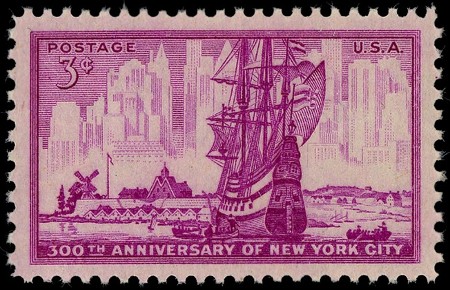 (Image Credit: Smithsonian National Postal Museum. Fair use, education.)
If any US city was significant enough to be singled out for celebration via a US legal tender coin during the classic era, I suggest that New York City was that city. It was the first US capital, it was the country's largest city and it was (and had been) the leading business/economic center of the nation. Unfortunately, far more minor cities such as Columbia, SC; Hudson, NY; Lynchburg, VA; New Rochelle, NY and Norfolk, VA were celebrated - largely due to the timing of their coin proposals - and New York City was denied.
For the first part of this topic, see:
What If? 1953 New York City 300th Anniversary - Part IFor more of my topics on commemorative coins and medals, including more What If? stories, see:
Commems Collection.










 Posted 03/15/2023 1:30 pm


