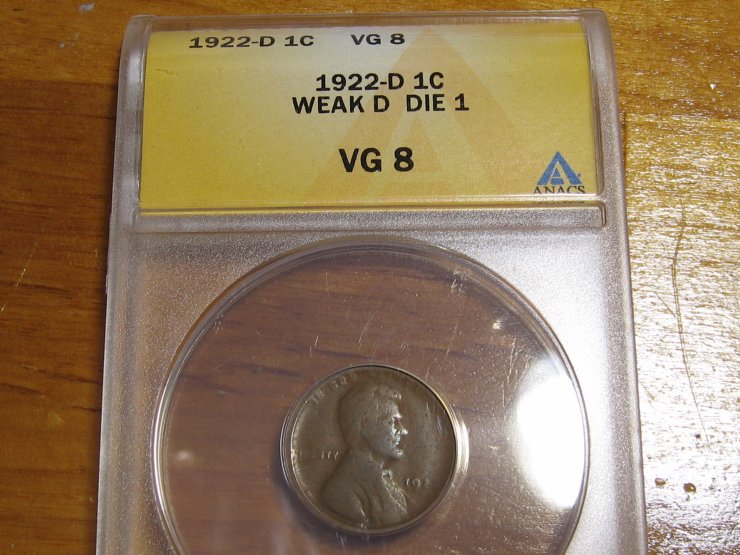
The 1922 "plain" or "no d" can be produced from four different die pairs. Die Pairs #1, #3 and #4 produce either
a "weak D" or a "No D". Die Pair #2, which is the most desirable of the four die pairs, always produces a "No D".
All 1922 weak D or No D coins fall into one of 7 categories:
1. Die Pair #1 Weak D (Weak Reverse)
2. Die Pair #1 No D (Weak Reverse)
3. Die Pair #2 No D (Strong Reverse) also called 1922 Plain
4. Die Pair #3 Weak D (Weak Reverse)
5. Die Pair #3 No D (Weak Reverse)
6. Die Pair #4 Weak D (Weak Reverse)
7. Die Pair #4 No D (Weak Reverse)
PCGS, NGC and some other grading services do not distinguish between the varieties. PCGS and
NGC authenticate Die Pairs #1, #3 and #4 as either "1922 weak D" or "1922 No D weak reverse". Die Pair #2 is
authenticated as "1922 No D strong reverse".
ANACS does things a little bit differently. Only Die Pair #2 is given a "No D" classification. Die Pairs #1, #3 and
#4 are all classified as "Weak D's" regardless of the strength of the mintmark.
Die Pairs #1, #3 and #4 were the result of "mint grease", which is a combination of dirt, metal, and oil, filling the area of the mintmark. Mint grease would fill the mintmark gradually, resulting in different levels of "weakness". It is believed that the mint grease would fall out, then refill creating a cycle of normal D's, broken D's, weak D's, and no D's. When looking at circulated examples of 1922 D's, keep in mind that the mintmark could have simply be worn from use. Die Pairs #1, #3 and #4 have "weak reverses" because they were struck with worn reverse dies.
Die Pair #2 is not believed to be the result of "mint grease".
Bookmark this; more info here if needed including how to classify the die pairs:
https://lincolncentresource.com/192...rieties.htmlThat was the only info I had on this.










 Posted 05/26/2023 11:57 am