The Lincoln Sesquicentennial Commission was established on September 2, 1957 via Public Law 85-262; the enabling legislation was introduced as House Joint Resolution 351.
Logo of Lincoln Sesquicentennial Commission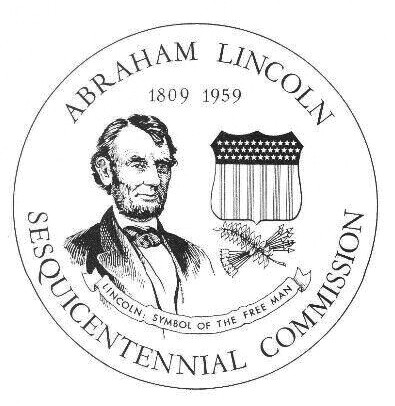 (Image Credit: Final Report of the Lincoln Sesquicentennial Commission. 1960.)
During an Executive Committee meeting in February 1958, the Commission decided to explore the possibility of securing a souvenir/commemorative coin and the US Mint was contacted to discuss the options:
"Discussions with Mr. F. Leland Howard, Assistant Director of the U.S. Mint, revealed that there were three possibilities along this line:
(1) the minting of a special commemorative coin, such as the Daniel Boone coin;
(2) the redesigning of one of the coins now in circulation; or
(3) the issuance of a medal which would have no value in currency, but which could be cast and sold by the Mint."
(Source:
Final Report of the Lincoln Sesquicentennial Commission. 1960. "The
Lincoln Penny.")
The Commission soon learned of the US Treasury Department's vigorous objections to special commemorative coins, but also learned the Treasury was open to the redesign of the
Lincoln Cent as the coin/denomination was already being struck by the US Mint as part of normal operations. Also, the design on the
Lincoln Cent had been in place since 1909, which meant it had already exceeded the minimum time requirement of 25 years for any coin design and was thus eligible for a redesign without Congress needing to pass new legislation.
The Commission did not avail itself of the Mint's offer to produce a high-volume souvenir medal for the general public, but it did engage the Mint for the production of a very limited number of Award Medals for those who contributed significantly to keeping the memory of Lincoln alive via their work in one of six categories: 1) Writing, 2) Collection, 3) Promoting, 4) Painting, 5) Sculpture or 6) Drama. Just 88 of the Award Medals, with accompanying Certificates, were given out.
Award Medal of Lincoln Sesquicentennial Commission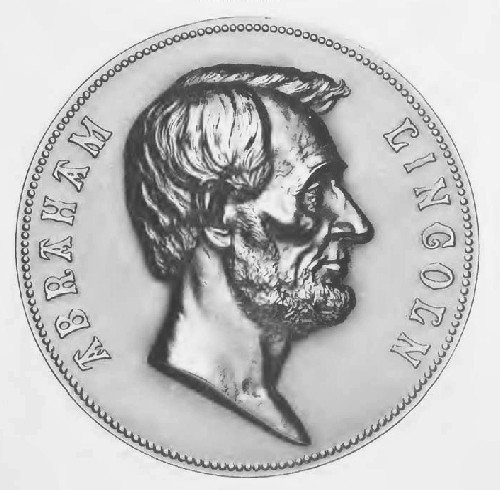
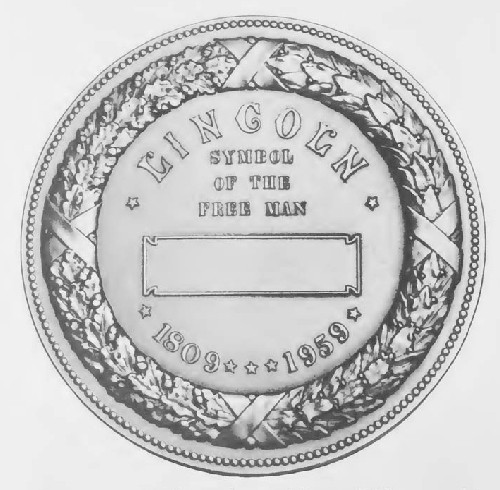 (Image Credit: Final Report of the Lincoln Sesquicentennial Commission. 1960.)
For the medal's obverse, the portrait of Lincoln used on the Presidential Series medal *first issued in 1909) was enlisted; it is the work of George T. Morgan.
The medal's reverse inscriptions were new for the Award, with a place for the recipient's name to be engraved added. Morgan's wreath was retained.
The Commission worked with the Mint on a new design for the
Lincoln Cent, deciding that only the reverse design would be updated.
Victor David Brenner's original right-facing portrait of Lincoln was to continue on the obverse of the new coin.
The Commission left the design development to the Mint, but asked for several options from which to select. Three Mint engravers submitted design sketches, with Assistant Engraver
Frank Gasparro's Lincoln Memorial design being selected. I haven't seen the other two engravers identified, but Chief Engraver Gilroy Roberts and Engraver Engelhardus von Hebel were accomplished Mint engravers at the time and could very well have been involved. (If anyone has definitive information, please post!)
On December 21, 1958, US President Dwight David Eisenhower approved the Treasury's recommendation for a sesquicentennial-inspired design change for the
Lincoln Cent. This brought about the end of production of the "Wheat Ears" design effective December 31, 1958 and the start of the "Lincoln Memorial" design in production beginning on January 2, 1959. The new coins were delivered to Federal Reserve Banks (and their branches) across the country during January and were placed into circulation on the 150th anniversary of Lincoln's birth - February 12, 1959.
1959 Lincoln Memorial Cent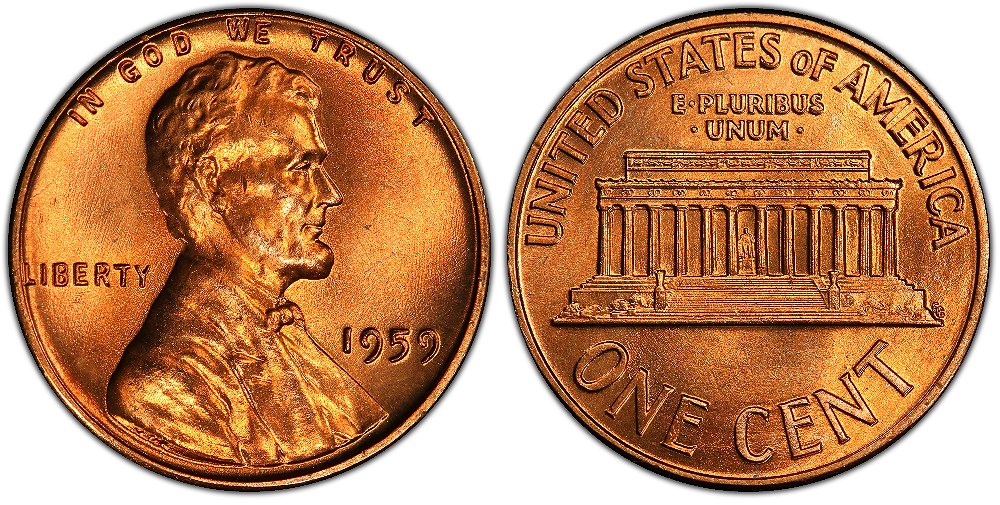 (Image Credit: PCGS CoinFacts. Fair use, education.)
For other of my posts about commemorative coins and medals,, see:
Commems Collection.






 Posted 05/29/2023 2:08 pm





