Hello!
As I was born in Mönchengladbach, I am perhaps predestined to tell you more about your note. :D
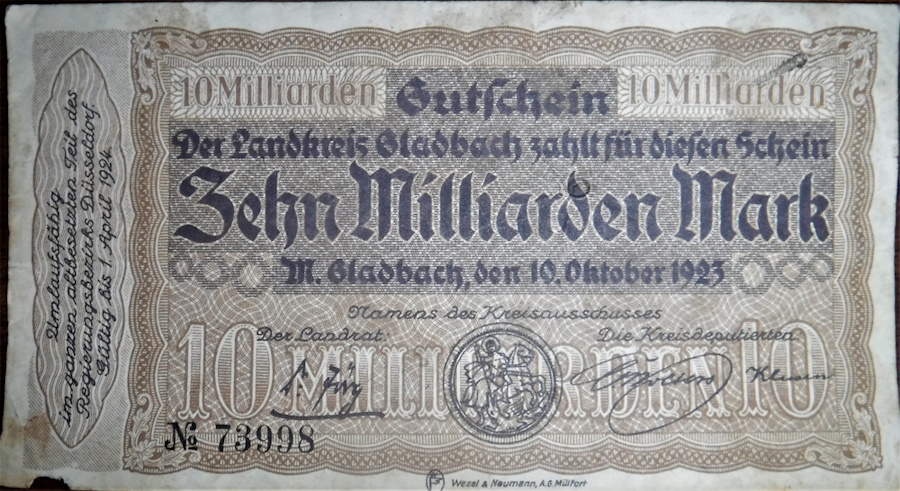
It's an emergency banknote from the height of inflation in Germany.
"M. Gladbach" ( = München-Gladbach) is the old spelling for today's Mönchengladbach. The Bavarian "München" has nothing to do with it. Mönchengladbach is a large city in the Rhineland. At that time it was divided into the city and the district of Mönchengladbach, both with their own administration.
The addition on the left-hand side is interesting: "Umlauffähig im ganzen altbesetzten Teil des Regierungsbezirks Düsseldorf" - you translated it correctly.
One must know that the Rhineland was occupied by French troops after the First World War from 1919 to 1930. However, the same currency was used there as in the rest of the German Reich, the mark - not the French franc.
However, this special banknote was only valid in the occupied part of the administrative district of Düsseldorf.
To illustrate the dramatic fall in prices: In mid-November 1923, a kilo of rye bread did cost 233 billion marks, a kilo of beef 4.8 trillion. Unfortunately only on payment, there is also an article on the subject: "Inflation in Mönchengladbach. When a bread roll cost 5 billion marks":
https://rp-online.de/nrw/staedte/mo...aid-73453941 br /
A detailed article on precisely this type of banknotes on "Geldscheine Online" (a German notaphilist online site) has unfortunately recently become available only against payment.
https://www.geldscheine-online.com/...ndkommission br /
A similar banknote is currently being offered on
ebayhttps://www.ebay.com/itm/304801721695Kind regards from Germany









 Posted 01/05/2024 1:24 pm


