| Author |
 Replies: 285 / Views: 11,725 Replies: 285 / Views: 11,725 |
|
|
|
Bedrock of the Community
United States
12057 Posts |
Yes, it's Bremen, late night "brain failure", I edited my post.
I have quite a few 17th c. and earlier coins that I have no way to determine silver content. Mostly German States, Austria, a couple from Poland, some Arabic and Indian too. Also, no idea how to determine silver content of things like Roman denarii, silvered antoniniani, etc.
Anyone know silver content on a "typical" Hohlpfennig, Prager groschen, Tirol kreuzer, Schwarzpfennig, or Schildgroschen? Or on hammered English coins (Edward I, Henry III, Henry VIII?)
Member ANA - EAC - TNA - SSDC - CCT #890 "Most of the things worth doing in the world had been declared impossible before they were done." -- Louis D. Brandeis Edited by paralyse
01/12/2024 12:42 pm
|
|
Pillar of the Community
Russian Federation
5186 Posts |
Quote:
I have quite a few 17th c. and earlier coins that I have no way to determine silver content. Mostly German States, Austria, a couple from Poland, some Arabic and Indian too. Also, no idea how to determine silver content of things like Roman denarii, silvered antoniniani, etc.
Anyone know silver content on a "typical" Hohlpfennig, Prager groschen, Tirol kreuzer, Schwarzpfennig, or Schildgroschen? Or on hammered English coins (Edward I, Henry III, Henry VIII?) Some of the Polish ones might be known - which ones they are? Maybe some of the others too. For the antoniniani there's an ongoing theory that the XXI (or, at some mints, KA) on the coins after Aurelian's reform is intended to represent a ratio of 20 parts copper to one part silver (which rounds to 0.048 silver fineness, or 5%). The measured silver content apparently roughly matches those numbers. Edited by january1may
01/12/2024 1:43 pm
|
|
Pillar of the Community
  United States
8056 Posts |
For the Prager groschen, Gumowski gives the following info in Table c, p.200:
Wenceslas II 1300-1305 - 0.9375 (15/16ths)
John 1310-1346 - 0.906 (14 1/2/16ths); Numista gives 0.875
Charles I 1346-1378 - 0.844 (13 1/2/16ths); Numista gives 0.795
Wenceslas IV 1378-1419 0.625 (10/16ths)
Not sure why the Numista values are different on a couple, but those were very long reigns.
If you provide date and type for your Polish coins I can probably help on some.
Edited by tdziemia
01/12/2024 2:14 pm
|
|
Pillar of the Community
Sweden
2124 Posts |
Quote:Quote:
I struggle to understand why they even included such a low percentage of silver in them. Erafjel can probably comment with more authority and eloquence on this, but I think it was because even their smallest denominations were still on a "silver standard" at that time: the value of each coin was linked to the mass of silver in the coin, so even the smallest denomination needed to contain some silver. The only way to accomplish this without making impossibly tiny coins was by using these low percentages. Not sure about the eloquence (but thanks for the compliment  ), but if we look at French coinage (the only one I can say something about with any trace of authority) towards the end of the pure silver-billon era, that confirms your proposition about coinage being on a silver standard. Charles IX (1560-1574) had deniers tournois (i.e., 1 d.t.) weighing 0.8 g and all the way via doubles, liards, douzains etc. up to testons with a value of 144 d.t. and weighing 9.6 g. The teston has 0.899 silver, the denier tournois 0.060. The silver content per d.t. of value is 0.060 g for the teston resp. 0.048 g for the denier, and it is pretty consistent around that figure for the whole denomination range. And as you say, to make the small denominations manageable and not become too tiny to handle, they had to have much lower silver fineness. Charles IX's successor, Henry III, changed the game plan by introducing pure copper for the lowest denominations (1 and 2 d.t.). It was not his idea, copper coins had been in use in the Low Countries for decades.The copper 1 d.t. weighed 1.57 g, about twice as much as the former billon 1 d.t., which I think was a way to instill some trust in it - no silver, but at least it was heavier than the old coins. The copper 2 d.t. weighed exactly twice as much as the 1 d.t. (With copper being worth roughly 1/100th of silver, the 1 d.t. coin should have weighed about 4.8 g to follow a "copper standard", but that was not the intention.) |
|
Pillar of the Community
Russian Federation
5186 Posts |
Quote:
Not sure why the Numista values are different on a couple, but those were very long reigns. For the (common) Wenceslas IV/III* there's also the extra confusion due to prolific posthumous issues (presumably of lower fineness). I've read somewhere that there's a detailed classification of issues in his name (including posthumous types) that assigns many subtypes to quite narrow chronological ranges, but I've never actually seen any catalog for it. Quote:
Charles IX's successor, Henry III, changed the game plan by introducing pure copper for the lowest denominations (1 and 2 d.t.). I have a Henry III liard (3 deniers) somewhere, but I'm not sure which type it is, and I'd be surprised if the fineness stayed the same through his reign. Numista says that one of the types is 0.125 fine, but it's not the one I most likely have. *) history knows him as Wenceslas IV but the coins said WENCEZLAVS TERCIVS [sic] - presumably because the year-long reign of Wenceslas III proper in 1305-06 wasn't counted at the time Edited by january1may
01/12/2024 3:13 pm
|
|
Pillar of the Community
Sweden
2124 Posts |
Quote:
I have a Henry III liard (3 deniers) somewhere, but I'm not sure which type it is, and I'd be surprised if the fineness stayed the same through his reign. Numista says that one of the types is 0.125 fine, but it's not the one I most likely have. For Henry III there are five types of liards, grouped into two emissions. 1st emission, 1576-1577, has fineness 0.135 and weighs 0.956 g. 2nd emission, 1578+, has fineness 0.125 and weighs 1.003 g. 1st emission thus contains 0.129 g silver, 2nd 0.125 g. Overall, silver content sank with time. The Charles IX coins I discussed contain on average ca 0.55 g silver/d.t. of value. Those of Louis XI, a century earlier, also show a consistent amount of silver/d.t. over the denomination range, but with 1.0 g silver/d.t. |
|
Bedrock of the Community
United States
12057 Posts |
Looking for info:
1534 - Ducal Prussia - Groschen (Grosz) - Polish rule
1560-1620 (n.d.) Vierer, Alsace/Strassbourg
(15)8Z = 1582 2 Kreuzer, Pfalz-Veldenz
1624 Schwarzpfennig, Bavaria
1623 Poltorak/Dreipolker - Sigismund III Vasa - Poland/Lithuania, I have 3 or 4 of these
1630 Dreipolker - Elbing
1643 Solidus - Christina - Livonia
1650 & 1663 - 3 Kreuzer - Tirol (Hall) - Further Austria
1634 HR - 3 Kreuzer - Silesia (Evangelical Estates) - Breslau
1669 - 3 Kreuzer - Austria (Olmutz/Olomouc)
1669 E - 1/96 Thaler (Sechsling) - Lübeck
1671 KB - 3 Kreuzer - Leopold I - Hungary
1686 BA - 6 Groschen - Brandenburg
1686 - 6 Mariengroschen - Brunswick-Lüneburg
1696 - Groschen - Bohemia (cf. KM 590)
1705 IAR - 2 Albus - Hesse-Darmstadt
1708 FN - 3 Kreuzer - Joseph I (Breslau)
I'll have to find the Prager groschen date when I get home
Member ANA - EAC - TNA - SSDC - CCT #890 "Most of the things worth doing in the world had been declared impossible before they were done." -- Louis D. Brandeis Edited by paralyse
01/12/2024 5:48 pm
|
|
Pillar of the Community
Russian Federation
5186 Posts |
Quote:
1623 Poltorak/Dreipolker - Sigismund III Vasa - Poland/Lithuania, I have 3 or 4 of these I think I have a bunch of those dreipolkers too (don't recall if specifically this date though), plus similar contemporary issues from Prussia and Sweden. Numista doesn't give silver contents for any of them (IIRC) and I got the impression that they varied a lot (though were generally low) so it's possible that there's actually no way to assign official fineness to those. I think I have a Prussian grosz from the 1530s as well, but I forgot if it was Ducal or not... and unlike the poltoraks I'm not confident that I have photos. I do have pics of some 18th and 19th century German States coins whose fineness I couldn't find on Numista, and maybe I'll try to list those. I'd be surprised if Christina's Livonian solidi could be assigned anything. It doesn't help that there's a bunch of contemporary counterfeits from Suceava, though AFAIK my coin (1645) had been declared to be probably from the original issue. EDIT: I don't suppose you'd know how little silver there actually was in the Bohemian 1/4 (kipper) kreuzer from 1621-22... Krause says "silver" but the examples online (as well as my coin) all just look like copper, which suggests to me that most likely it was some kind of very low grade billon, but I couldn't find a reference to the exact silver content. Edited by january1may
01/12/2024 6:08 pm
|
|
Bedrock of the Community
United States
12057 Posts |
I'm afraid I haven't the slightest idea.
If I had the means, I'd buy an XRF machine...
Member ANA - EAC - TNA - SSDC - CCT #890 "Most of the things worth doing in the world had been declared impossible before they were done." -- Louis D. Brandeis |
|
Pillar of the Community
United States
8056 Posts |
Quote:
1534 - Ducal Prussia - Groschen (Grosz) - Polish rule Gumowski has this at 0.375 (6/16ths) Quote:
1623 Poltorak/Dreipolker - Sigismund III Vasa - Poland/Lithuania, I have 3 or 4 of these
1630 Dreipolker - Elbing Gumowski has the dreipolkers late in Sigismund III's reign also at 0.375 starting from 1623. However, the Elbing coins are occupation issues under Gustav Adolf of Sweden, and it's not to hard to imagine reasons the composition might have deviated from the official one. That's all I can help with. Edited by tdziemia
01/12/2024 9:57 pm
|
|
Bedrock of the Community
United States
12057 Posts |
Better than nothing! Adding to update 1534 Groschen / Grosz - Ducal Prussia, 37.5% silver 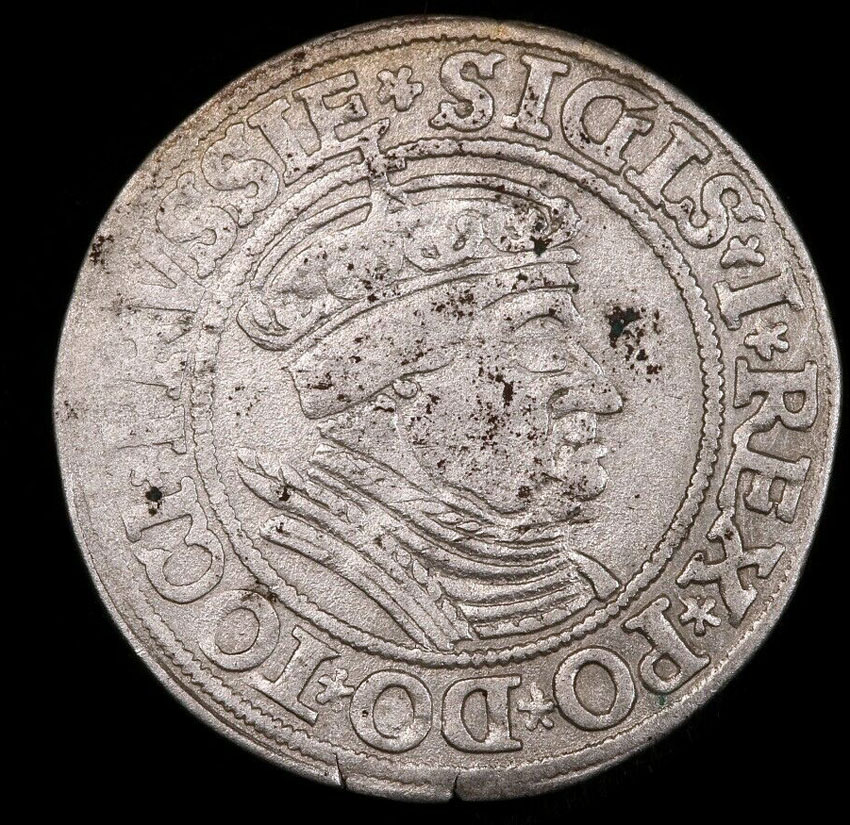 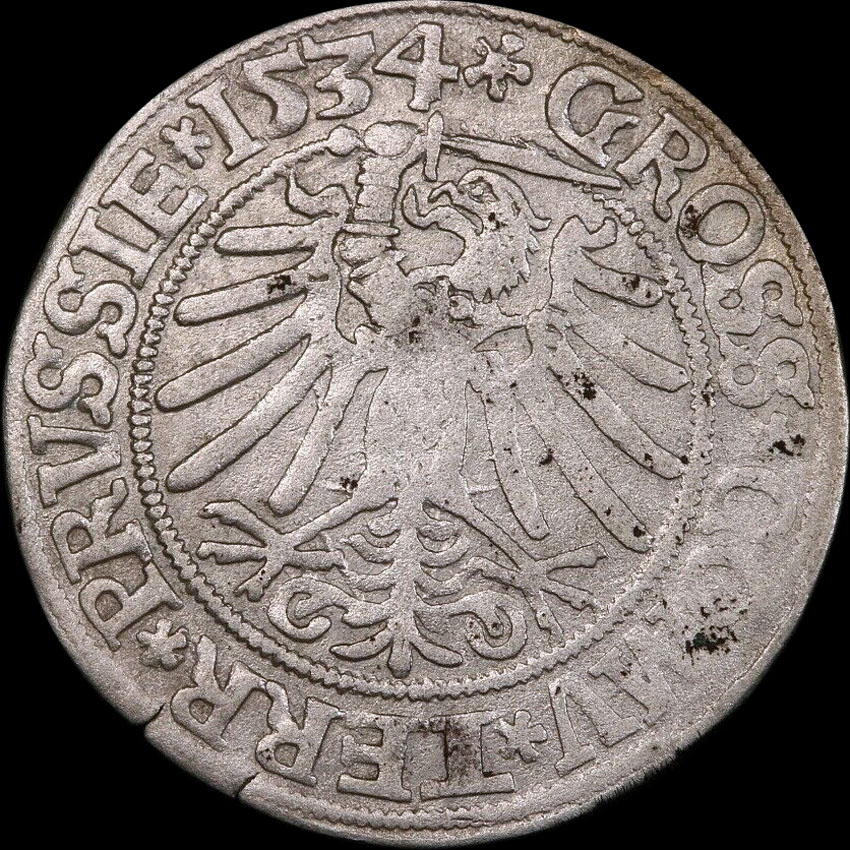 Diocletian BL Antoninianus, (theoretically) 5.0% silver (the nicest example I have) 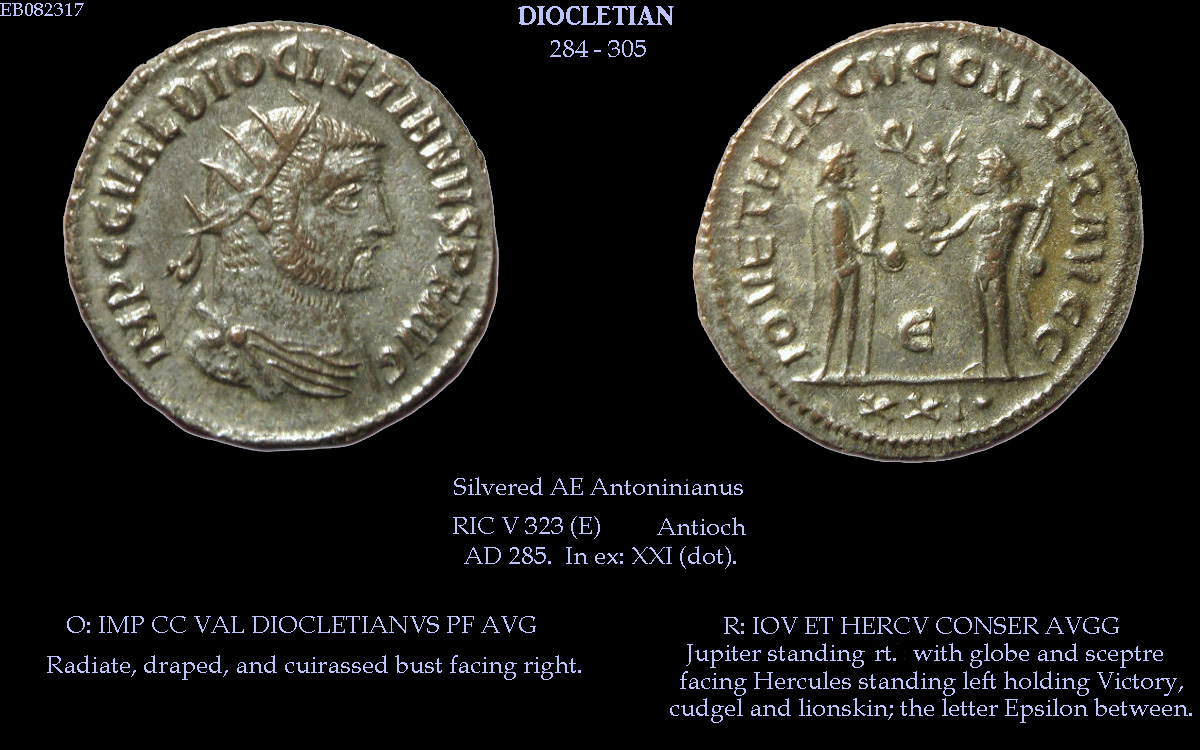 Member ANA - EAC - TNA - SSDC - CCT #890 "Most of the things worth doing in the world had been declared impossible before they were done." -- Louis D. Brandeis |
|
Pillar of the Community
United States
8056 Posts |
Quote:
Quote:
1623 Poltorak/Dreipolker - Sigismund III Vasa - Poland/Lithuania, I have 3 or 4 of these
I think I have a bunch of those dreipolkers too (don't recall if specifically this date though), plus similar contemporary issues from Prussia and Sweden. Numista doesn't give silver contents for any of them (IIRC) and I got the impression that they varied a lot (though were generally low) so it's possible that there's actually no way to assign official fineness to those. Here is what Gumowski has for the dreipolkers: Munzkommission 1614 - 0.469 (7 1/2 / 16ths) Munzkommission 1619 - 0.406 (6 1/2 / 16ths) Munzkommission 1623 - 0.375 (6/16ths) However, there is also this paper https://www.ncbi.nlm.nih.gov/pmc/ar.../PMC9654620/where the authors claim the actual silver contents are much higher, in the 60-90% range. They did not use XRF, but used other analytical techniques. I am a bit skeptical that these coins would have been struck at comparable or higher silver content than higher value coins. My lowest type for this thread is this 2% double mite from the Duchy of Brabant struck under Philip the Good, 1434-1467: 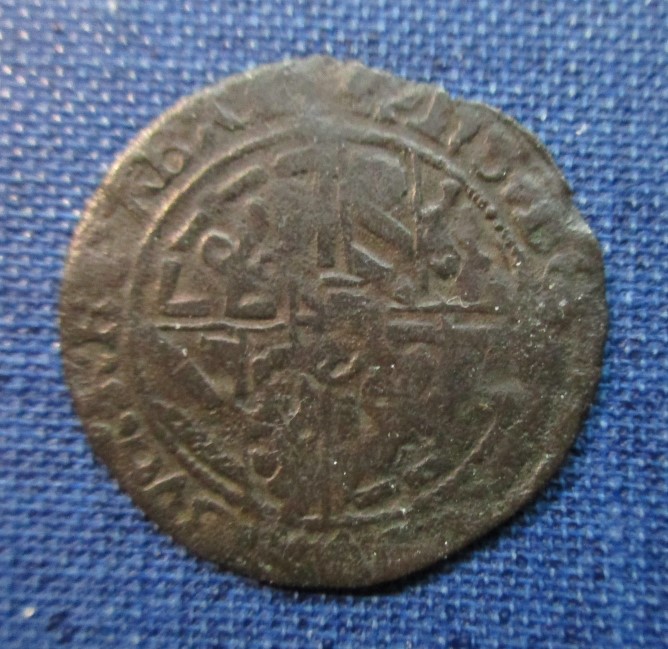 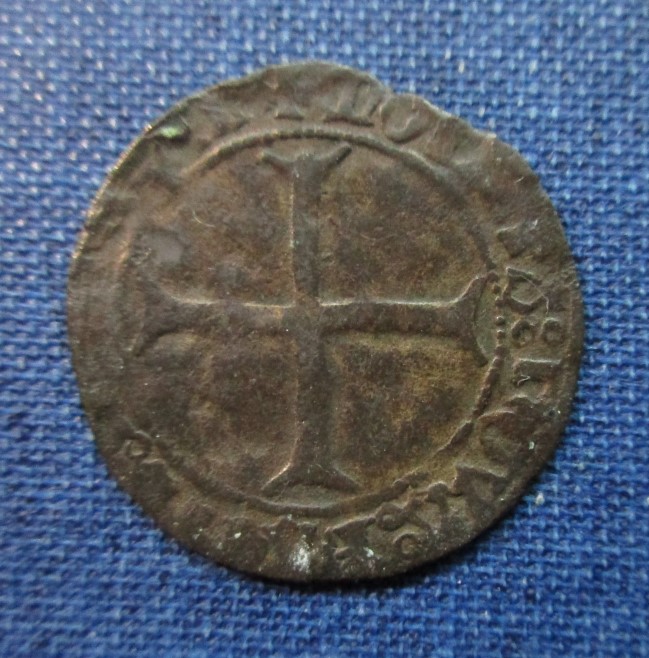 Despite the low value of the coin, the diemaker took just as much time engraving Philip's complex coat of arms and the long legends, as on the higher value types. Edited by tdziemia
01/13/2024 09:41 am
|
|
Pillar of the Community
United States
8056 Posts |
And a "probable" contribution for 6%, (which surprisingly is the only gap between 9% and 2%). A 1761 solidus/schilling struck in the Torun (Poland) mint. 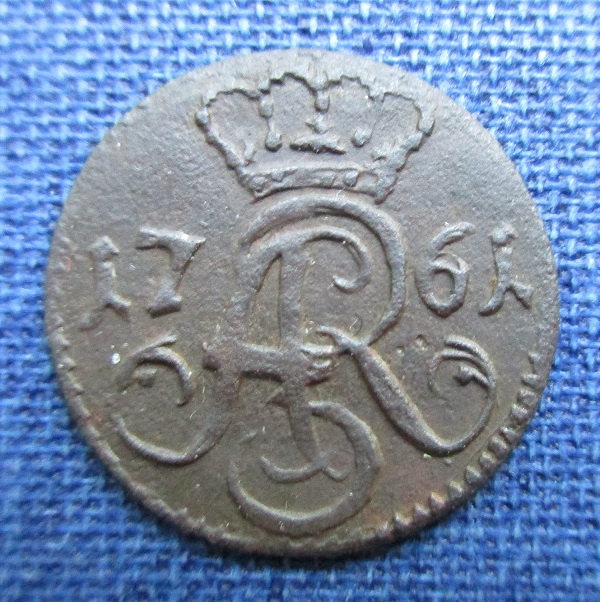 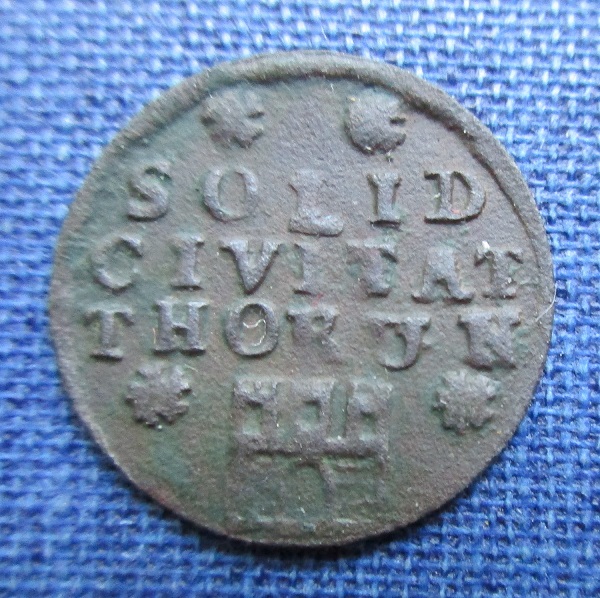 Gumowski has a list of the types struck at the Gdansk mint between 1760 and 1762 with their compositions (Table dd, p.217). The solidus/schilling is listed at 1/16th, or 0.0625 (6%). He does not have the analagous types from the Torun mint in that table, but on page 72, says "In 1760 the city of Torun decided to re-open their mint, striking coins that followed the example of Gdansk. They made billon schillings, 3 and 6 groschens with the monogram or bust of King August III." Throughout the monetary history of Poland from the 1520s, it was normal for the three former Prussian city mints (Gdansk, Elbing, Torun) to make coins with equivalent specifications, so it is likely that the Torun coins were of the same composition as Gdansk. Edited by tdziemia
01/13/2024 11:45 am
|
|
Pillar of the Community
United States
8056 Posts |
I think we have these contributions for the 9% and lower range:
9% Lithuania 2 denars KM#15 (tdziemia)
.......Poland Gdansk solidus/Schilling N#96806 (tdziemia)
8% Cyprus (Venetian) carzia N#127028 (january1may)
7% France Francois I denier tournois (#39083 (erafjel)
6% * Poland 1 solidus/schilling Torun N#182131 (tdziemia), probable not confirmed
5% France Louis XI obol tournois N#65414 (erafjel)
.......Romean Empire, Diocletian antonianus (paralyse)
4% France/Hainaut 2 deniers #95706 (tdziemia)
3% County of Flanders 2 mites N#126945 (tdziemia)
2% Duchy of Brabant 2 mites N#108934 (tdziemia)
|
|
Bedrock of the Community
United States
12057 Posts |
Is there a known 1% silver coin?
Member ANA - EAC - TNA - SSDC - CCT #890 "Most of the things worth doing in the world had been declared impossible before they were done." -- Louis D. Brandeis |
| |
Replies: 285 / Views: 11,725 |








 First Page
 Previous Page


 Posted 01/12/2024 1:43 pm


