More than a decade ago, in May 2013, I presented a What If? story about a proposed 50-cent piece to commemorate the 150th anniversary of the British surrender at Yorktown; the surrender effectively brought the American Revolution to an end. In that long ago post, I also referenced a commemorative medal proposal that moved forward in lieu of the half dollar. I've decided to revisit the medal and share more details about it.
You can read the original post here:
-
What If? 1931 Yorktown SurrenderBoth the coin and medal bills were introduced in the House of Representatives by Roy Fitzgerald (R-OH); the medal was introduced on December 3, 1930. Fitzgerald was a member of the US Yorktown Sesquicentennial Commission ("Commission"). Just over two weeks later, on December 19, 1930, a Hearing was held by the House Committee on Coinage, Weights, and Measures.
During the Hearing, Representative Fitzgerald presented a potential design for the medal to the Committee - it was originally prepared for the half dollar. The design was prepared by Virginia-artist FW Sievers of Richmond. Fitzgerald supported/desired the use of a local artist for creation of the design, believing it to be most appropriate considering Yorktown's location. The designs were described as having a bust of George Washington on the obverse, with an eagle on the reverse, accompanied by the inscriptions "United States of America", "Half-dollar medal" and "Surrender at Yorktown". Fitzgerald also acknowledged that the Commission on Fine Arts (CFA) had to review and approve any design before it could be used.
Representative Schuyler Otis Bland, also a member of the US Yorktown Sesquicentennial Commission, testified next and spent the bulk of his time reviewing the celebration plans for the anniversary. Bland emphasized the intents of the Commission for the celebration: "We would like to have representatives of our fleet there, and of the fleets of France and Great Britain, but it is our desire not to emphasize any feeling of triumph, or what would tend to promote discord. We want to make it an event that will tend to promote good will, international amity, and a real sense of patriotism in the hearts of all those who may attend. We want a celebration that will suit the scenes and the grounds on which the great event took place." The medal, via the proceeds from its sale, would be used to financially support the Commission's plans.
Mary O'Reilly, Assistant Director of the US Mint, also attended the session and was available to offer the opinion of the Treasury Department/US Mint, as requested. She also discussed the finances of medal production at the Mint. O'Reilly reviewed the pricing data presented by Secretary of the Treasury, Andrew Melon, namely: $200 for die production (from models provided by the Commission) and a unit cost of $0.25 per medal. The costs assumed a silver medal roughly the size of a US half dollar, an octagonal shape and a production run of 100,000 pieces.
O'Reilly also expressed the Treasury's/Mint's opinion that the medal bill should set a maximum mintage, but that it needn't specify the metal to be used (though silver was assumed for the majority of pieces struck).
The Committee reported Fitzgerald's bill out with an amendment setting the maximum mintage at 500,000. The amended bill was passed by the House and Senate, and signed into law by US President Herbert Clark Hoover on February 20, 1931.
The Mint never struck a medal for the Commission, however. Check out the link above for the background.
1931 Yorktown Surrender Sesquicentennial Badge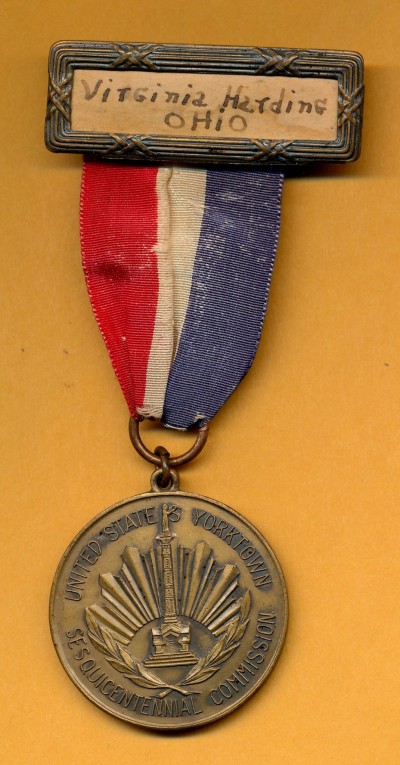
For more of my stories about commemorative coins and medals, including many more What If? stories, see:
Commems Collection.







 Posted 06/14/2024 1:07 pm





