It is a common belief among US modern commemorative coin collectors that the 1983-84 silver and gold coins for the Los Angeles Olympics were the United States' first foray into Olympic Games commemorative coinage. The LA Olympics program was the first to be approved and struck, but it was not the first to be proposed within Congress.
In June 1978, Joseph Patrick Addabbo (D-NY) introduced a bill in the House of Representatives that proposed 50-cent pieces "bearing a design emblematic of the 1980 winter Olympic games."
The 1980 Winter Olympics were held at Lake Placid, New York. The Games featured 38 events in 10 sports, with 37 countries participating. The medal leader of the Games was East Germany with 23; the Soviet Union (USSR) won the most gold medals - 10. The United States won a total of 12 medals (3rd most): 6 Gold, 4 Silver and 2 Bronze.
The Lake Placid Games bore witness to the now-famous (at least in the US) "Miracle on Ice" hockey game when the US team defeated the heavily-favored, and four-time defending gold medalist, USSR 4-3. The game was not for the Gold Medal - it was a semifinal game - but it enabled the US team to go on to the Gold Medal game where it faced, and defeated, Finland.
1980 Lake Placid Winter Olympic Games Logo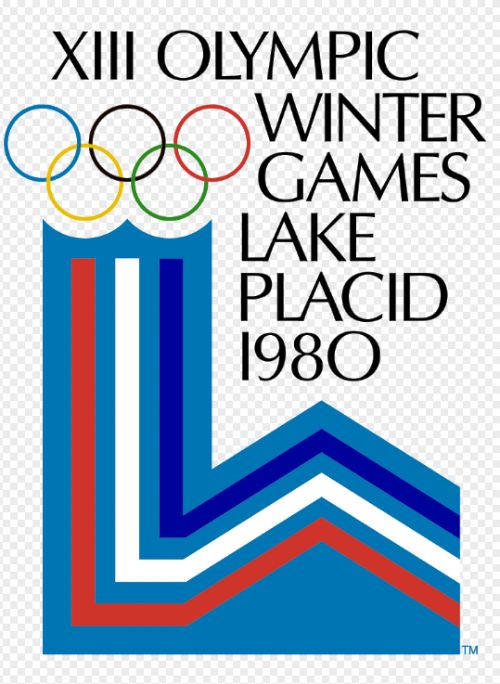 (Image Credit: Lake Placid Olympic Games, Inc. Fair Use, education.)
The bill had a number of unusual provisions.
1. It called for a Silver Clad half dollar vs. the Copper-Nickel (CuNi) Clad half dollar that was in circulation: "each piece shall be a clad coin (within the meaning of section 108 of the Coinage Act of 1965), with a cladding of an alloy of eight hundred parts of silver and two hundred parts of copper and with a core of an alloy of silver and copper, and shall be 40 per centum silver by weight." As a point of reference, the 1965-1970 Silver Clad half dollars of the US were 40% silver by weight, had an outer layer of 80% silver and 20% copper and an inner core of 79% copper and 21% silver. So, a return to a previous specification.
2. The coins were to use silver previously earmarked for the collector versions of the 1971-78
Eisenhower dollar: "Such pieces shall, to the extent practicable, be coined with silver reserved for production of silver-clad
Eisenhower dollars under section 101 of the Coinage Act of 1965." The US had plenty of silver in its stockpile at the time, so this provision was not an issue.
3. The coins were not going to require a symbol of Liberty or an eagle, US law not withstanding: "each such piece shall bear an impression emblematic of liberty or the figure or representation of an eagle, or both,
only if required by such design." (Emphasis added.) Potentially, a major side-step of existing law!
The bill left the coin's design selection to the Secretary of the Treasury, as long as it was "emblematic of the 1980 winter Olympic games." The Secretary was to consult with the Commission of Fine Arts (CFA) regarding potential designs. Such a provision was not unique to the Winter Olympics bill - previous coin bills had included such a specification, though it was most often a component of circulating commemorative proposals vs. collector coin bills.
The Secretary was also to set the mintage for the coin, and its issue price; the bill capped the price at $10 per coin. Net proceeds from the sale of the coin were to be paid into the US Treasury as "miscellaneous receipts." The US Mint did not have its own operating fund at the time - i.e., no equivalent to the present-day Public Enterprise Fund.
Upon its introduction, the bill was referred to the House Committee on Banking, Finance and Urban Affairs. It was not, however, reported out, and no further action was taken on the bill.
It's possible that the idea of a commemorative coin that would provide financial benefits was planted in the collective mind of the US Olympic Committee with the Lake Placid bill. Within the next few years, bills for Los Angeles Olympic Games Silver Dollars and Gold Eagles were introduced. After much debate, one was ultimately approved and a connection between US commemorative coins and the Olympics was forged. Collectors have been paying the price ever since!
For more of my stories about commemorative coins and medals, including more What If? stories about classic and modern US commemorative coins, see:
Commems Collection.










 Posted 07/18/2024 09:48 am


