I've written before about a proposal to authorize the striking of a two-cent copper coin with a portrait of Theodore "Teddy" Roosevelt. (You can read about it here:
-
1921 Theodore Roosevelt Two-Cent CoinThis time out, I'm presenting a brief review of a short-lived parallel proposal for a 2-1/2 cent Roosevelt coin.
In January 1920, during the Second Session of the 66th Congress, Albert Henry Vestal (R-IN), the then-current Chairman of the House Committee on Coinage, Weights, and Measures, introduced a bill that called for a circulating 2-1/2 cent copper coin featuring a portrait of Teddy Roosevelt. Accompanying the design's portrait were to be the years of Roosevelt's birth and death (1858-1919).
The coin was to have a composition of 95% copper, 5% tin and zinc - the standard alloy for circulating US copper coins at the time. Of course, the coin was to have a larger diameter and be heavier, with specifications in line with its denomination.
Upon its introduction, the House bill was referred to Vestal's Committee. It was never acted upon by the Committee, however, likely deferring to the Senate bill that proposed a more practical two-cent coin. The Senate bill was introduced two days prior to Vestal's House bill and was passed by the Senate in May 1920.
Why introduce two bills with the same objective - to honor the recently-deceased Theodore Roosevelt - but with different denominations? There doesn't appear to be an obvious practical reason. The Senate bill (2-cent coin) had some justification based on contemporary pricing models, but the House's 2-1/2 cent piece was next to impossible to justify as fractional pricing was not the norm at the time.
For example, the Post Office couldn't be cited as the reason for the unusual denomination (as it had been for the earlier three-cent coin) as a first class US postage stamp was
Two Cents in 1920 (and additional ounces were also
Two Cents). In addition, there weren't other common day-to-day business needs that required a fractional coin.
The 2-1/2 cent denomination choice seems too unusual to have simply been a mistake. It's more likely - at least to me - that the odd denomination was chosen more as a distinctive novelty vs. practical solution. The objective might have been to create a circulating commemorative piece - one that would be pulled from circulation in bulk - without calling it a commemorative in the hope that such would find more support in Congress.
What do you think?
1872 US Two-Cent Coin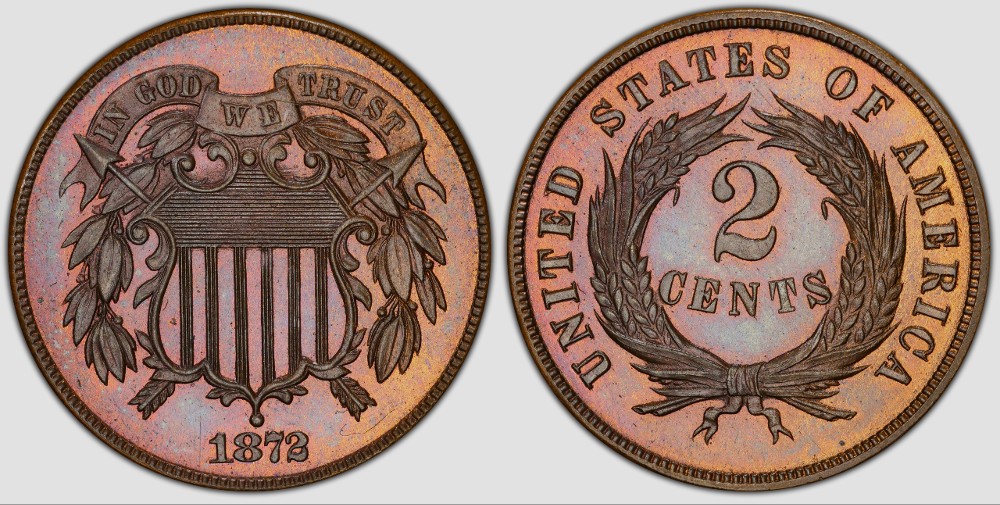 (Image Credit: PCGS CoinFacts.)
For more of my stories about commemorative coins and medals, including more What If? stories, see:
Commems Collection.










 Posted 07/19/2024 09:42 am


 Uncirculated American Silver Eagles


