The Act authorizing the Stone Mountain Memorial Half Dollar was signed into law by US President Calvin Coolidge on March 17, 1924. The coin was intended as a fundraiser to support the "carving on Stone Mountain, in the State of Georgia, a monument to the valor of the soldiers of the South, which was the inspiration of their sons and daughters and grandsons and granddaughters in the Spanish-American and World Wars, and in memory of Warren G. Harding, President of the United States of America, in whose administration the work was begun."
But enactment of the coin legislation was not the starting point for fundraising for the monument/memorial.
On Sunday, July 19, 1914, John Temple Graves wrote an article for the
Sunday American (a newspaper supplement for Sunday editions of newspapers - think the former
Parade magazine) that proposed the formation of an
"organization of Confederate veterans and Confederate veterans' sons and daughters to begin to get ready for the work [of monument creation]."Graves began his article with:
"To the veterans of the dead Confederacy, to the daughters and sons, and to all who revere the memories of that historic and immortal struggle, I bring to-day the suggestion of a great memorial, perfectly simple, perfectly feasible, and which if realized will give to the Confederate soldier and his memories the most majestic monument, set in the most magnificent frame in all the world."He later wrote:
"Stone Mountain is distinctly one of the wonders of the world. Its glories have never been fully appreciated or utilized by the people who see it every day. It is a mountain of solid granite one mile from its summit to its base. Much of Atlanta has been builded from it, and there is enough left to build ten more Atlantas without touching the lofty spot that is nearest to the sun."Graves envisioned a different monument (by a different artist-sculptor) than what was ultimately created:
"On the steep side of Stone Mountain, facing northward, there is a sheer declivity that rises or falls from 900 to 1,000 feet.
"Here, then, is Nature's matchless plan for a memorial. On this steep side let those who love the Southern dead combine to have the engineers cut a projection 30 feet wide and 100 feet deep. Into this projection and as high as it may be made let us ask Lorado Taft, the republic's greatest sculptor, to chisel a heroic statue, 70 feet high, of the Confederate soldier in the nearest possible resemblance to Robert E. Lee. Let him chisel also the insignia of the Confederate uniform, of which the gray stone is the natural base."Stone Mountain Monument Promotional Booklet - Front Cover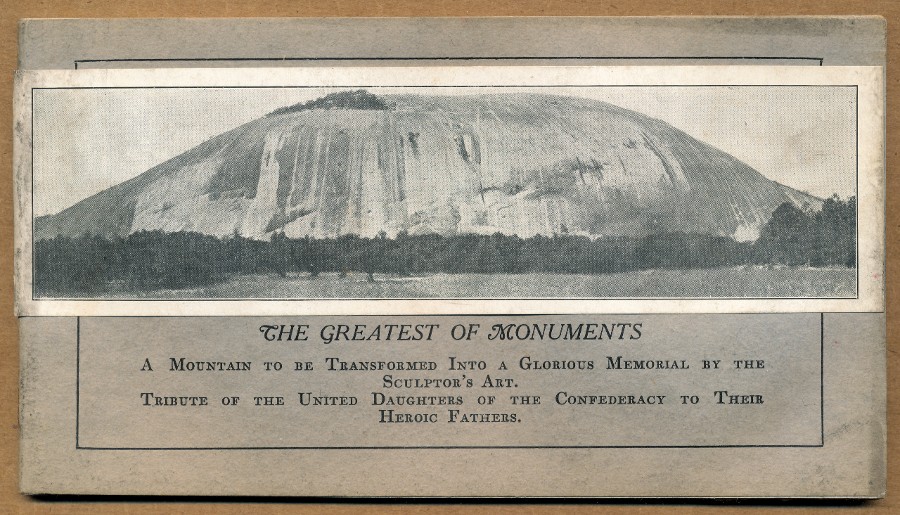
So, a depiction of Confederate General Robert E. Lee was part of the Memorial's design from its earliest conception. (Not much of a surprise considering Lee's position during the Civil War and the high regard in which he was held in the South following it.)
Graves concluded his piece with:
"I ask that General Andrew West and [others] form an organization of Confederate veterans and Confederate veterans' sons and daughters to begin to get ready for the work."Support for Graves' idea rose up immediately, with published responses within days.
From General Andrew J West, Commander, Confederate Veterans:
"A more unique, original, patriotic and appropriate suggestion never came from the pen of man than the remarkable production from Colonel Graves in Sunday's American urging a Confederate monument on Stone Mountain. From Joseph A. McCord, first governor of the Federal Reserve Bank of Atlanta:
"We could not select a better subject or a better place in which to perpetuate the memorial of a cause so dear to us all.
...
"I suggest that this matter take on tangible form; that a memorial association be established; that public subscriptions be taken to carry out the plan and purpose as outlined by Mr. Graves."From Mrs. William Lawson Peel, daughter of a Confederate veteran:
"...I thank you for your noble suggestion, which should be well under way before another day.
...
"Surely the whole Southland will rise up and adopt your suggestion."(All quotes as published in the Atlanta Georgian, July 23, 1914.)I'll discuss what happened next in
Part II.
For more of my stories about commemorative coins and medals, including other Stone Mountain half dollar stories, see:
Commems Collection.







 Posted 08/22/2024 2:12 pm





