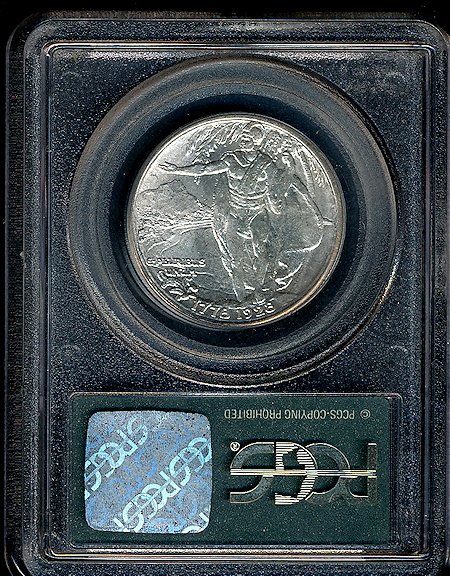
In 1928, one of the keys to the classic-era US commemorative coin series was issued - the Hawaiian (European) Discovery Sesquicentennial Half Dollar. The Act authorizing the coin specified that it was to commemorate "the one hundred and fiftieth anniversary of the discovery of the Hawaiian Islands by Captain James Cook."
1928 Sesquicentennial of European Discovery Half Dollar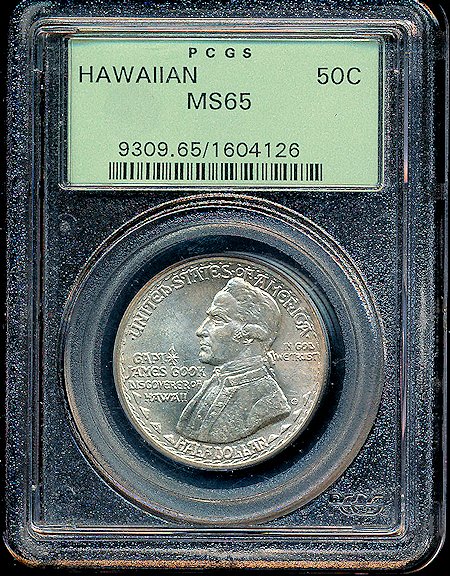
The European discovery of the Hawaiian Islands is almost universally attributed to Captain Cook. But was he the first European to "discover" the islands?
Some suggest that the Spaniard, Juan Gaetano, came upon the islands in 1555 (or 1542), more then 220 years before Cook! He is also sometimes credited with naming the islands the "Islas de Mesa" or "Table Islands." and causing their appearance on early maps (though not in the correct position).
A potential source of the Gaetano "legend" are the notes Gaetano kept during his 1542 voyage (not 1555) across the Pacific Ocean from Mexico to the Philippines; the voyage was under the command of Ruy López de Villalobos and included six sailing ships. Gaetano was not the capain nor the navigating pilot of any of the ships. In fact, from the available records, Gaetano was not in any position of authority within the expedition and his notes of the voyage were not considered an official account of the trip - such status was given to the reports of others who kept written records of the journey. It should be noted that no reference to Gaetano appears in the official reports - he definitely appears to have been a minor participant.
The Gaetano-Sandwich Islands link was promulgated by Jean François de Galaup, comte de Laperouse ("Laperouse"), who, in 1785, was commissioned by French King Louis XVI to lead a global voyage of discovery that originated in present-day Mexico (the voyage has also been described as a mission to colonize the Philippines). Laperouse carried with him a translated version of Gaetano's 1542 report and made an assumption regarding the validity of Gaetano's "discovery."
Henry B. Restarick, president of the Hawaiian Historical Society ("Society"), in his
The Discovery of Hawaii, published in 1930 by the the Society, made his viewpoint clear in the volume's subtitle -
Gaetano did not discover Hawaii, nor did the Spaniards know of the existence of the Hawaiian Islands before Captain James Cook discovered them in 1778. Restarick provided a lengthy account of the case against Gaetano - a case far too lengthy for my scope here - but suffice it to say that he provided compelling, factual evidence from the 16th and 17th centuries for his position. Among the more convincing arguments:
- there is no record in the Spanish archives connecting Gaetano with the Sandwich Islands (Cook's original name for the Hawaiian Islands, given in 1778) save a map created post-1778 that identifies the "Sandwich Islands" and includes an undocumented note listing Gaetano as their discoverer;
- there is no record of a Spanish voyage across the Pacific Ocean in 1555, never mind one that sailed in the vicinity of the present-day Hawaiian Islands; such voyages were not a regular occurrence at the time and there were typically years between them;
- Gaetano was not the captain, nor any primary officer, during the 1542 trip he was part of between Mexico and the Philippines - i.e., not in a position that would typically yield discoveries that would bear his name;
- in 1660, noted Spanish navigator and explorer Andreas de Urdaneta, working under Spanish King Philip IV's orders, prepared a navigational guide for Spanish captains to use when crossing the Pacific Ocean. Though the importance of locating certain islands to take on water, food and other supplies was stressed (largely to prevent scurvy among the crew) the Hawaiian Islands were never mentioned under any name by Urdaneta - a very odd occurrence if the Spanish were aware of the islands, especially considering their abundance!
So, though the "legend" of Gaetano's discovery persists to the present day, when I consider all of the evidence available, I feel comfortable in believing that Hawaii got its history correct and that Cook was the first European to "discover" the islands, doing so in 1778.
The potential for alternate histories compared to the subjects commemorated on
US coins is ever-present, however, and is interesting to explore! (At least IMO!)
For more of my stories about commemorative coins and medals, including more about the Hawaiian half dollar, see:
Commems Collection.







 Posted 10/08/2024 09:31 am





