|
This page may contain links that result in small commissions to keep this free site up and running.

Welcome Guest! Registering and/or logging in will remove the anchor (bottom) ads and the security checks. It's Free!
To participate in the forum you must log in or register. | Author |
 Replies: 12 / Views: 1,388 Replies: 12 / Views: 1,388 |
|
|
New Member
United States
5 Posts |
I am doing historical research, and apparently the 'official US Government gold price" ( https://nma.org/wp-content/uploads/...833_pres.pdf ). Is this correct? That would have been $20.67 in 1863-4. But the US Mint would not be paying out at $20.67/oz, I would think. There would be some sort of 'refining fee' and I can not find what it was for Mints. I have been looking at US MINT-San Fran- records from this time frame and see that gold dust (from Idaho 1863), for example, totaling 435.87 oz, melted down to 419.37 oz (for loss of average loss of 3.8%) resulted in a $7388.55 payment to the depositors in 1864. Can you direct me to information that shows the US Government (or even private business for 19th century) 'refining fees' at this time and over history? Does it make sense that the SF Mint would charge a 15% refining fee on the melted gold ($7388.55/419.37oz=$17.62per oz paid, versus using the $20.67/oz which gives only 85.2% pay out- 17.62/20.67 both $ per oz)? Did their 'refining fees' vary by gold source and/or year and/or Mint? Thank you so very much! |
|
|
|
Moderator
 United States
197800 Posts |
 to the Community! Your post was moved to the appropriate forum for the proper attention.  |
|
Bedrock of the Community
United States
94367 Posts |
 to the CCF! |
|
Moderator
United States
34570 Posts |
@mint, first welcome to CCF. Second, you pose an interesting question, one for which I have gone down a bit of a rabbit hole. My particular collecting interest generally falls to older (i.e. medieval) coins and so have stumbled across an interesting article that addresses your question in 13th and 14th Century Italy: https://muse.jhu.edu/chapter/2471371I'm hoping that others here can help you more that I have. "If you climb a good tree, you get a push."
-----Ghanaian proverb
"The danger we all now face is distinguishing between what is authentic and what is performed."
-----King Adz
|
|
New Member
 United States
5 Posts |
Thank you, Spence... that is a bit too early, as you know, and too pre-United States for me. But 40 % for sliver, wow! I suspect it was harder in the old days... Thnak you for kicking this off!
|
|
Pillar of the Community
United States
3368 Posts |
In modern times, without government involvement, 8% refining fee for gold dore under 20 oz. The fee drops to 5% over 20 oz. https://goldrefiningforum.com/threa...rgins.31217/Given SF's frontier location, a 15% assay/refining fee for small quantities of gold dust doesn't seem unreasonable. Consider that in 1851 eggs cost three dollars each and circulating coins were scarce. Gold dust was heavily discounted when used for money. Assay offices were scattered around the US. Here's the 1871 office in Boise ID. They purchased, assayed and refined significant amounts of gold and silver until 1933. 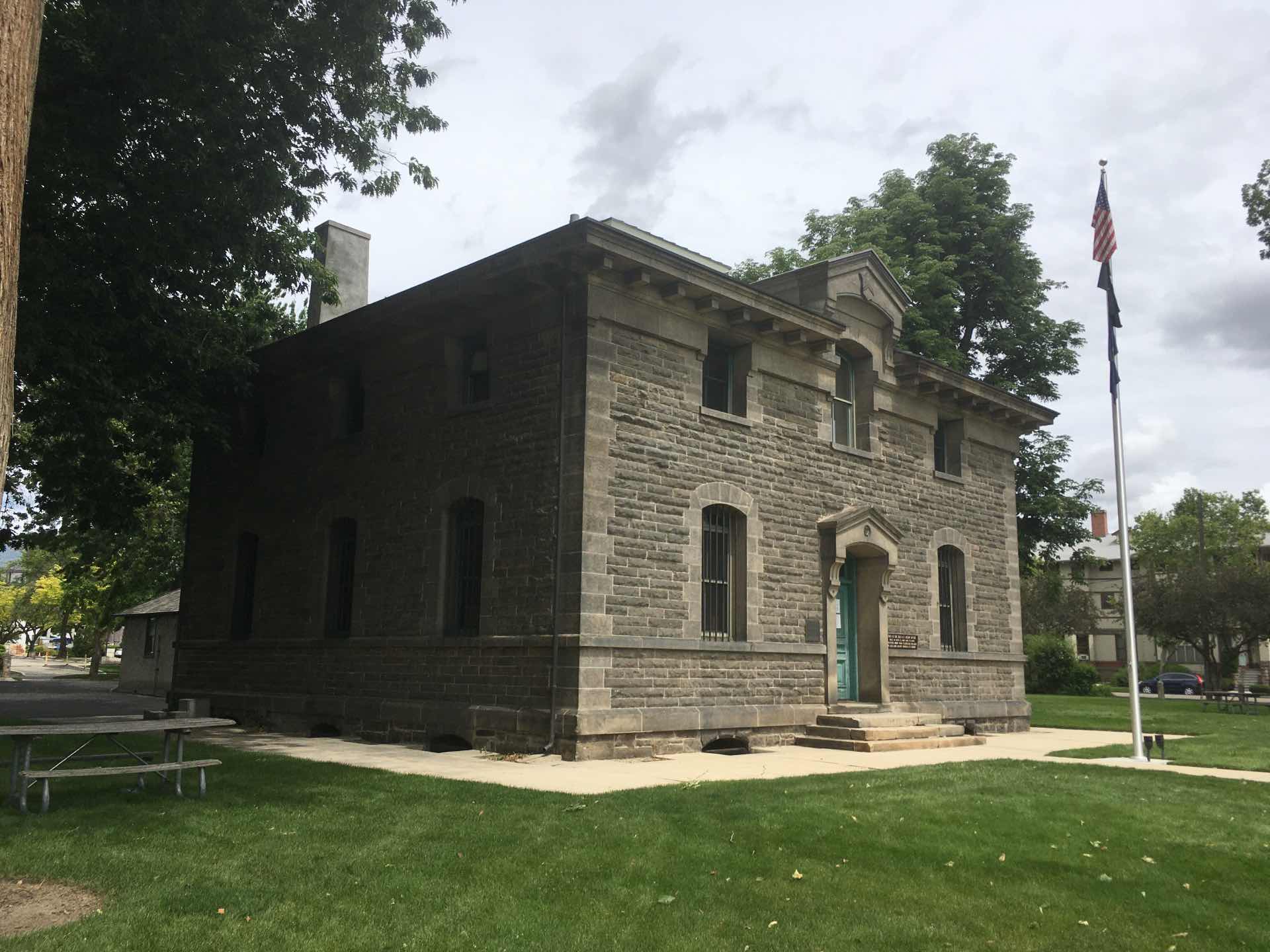 "Two minutes ago I would have sold my chances for a tired dime." Fred Astaire
Edited by thq
11/27/2024 09:23 am
|
|
Pillar of the Community
United States
1880 Posts |
I did not think that the mint charged any fee. I thought you could take your gold to a mint and have it turned into gold coins. My GUESS would be that the difference between the gold dust and the amount paid would be due to the purity.
|
|
New Member
United States
5 Posts |
Hi thq, Thank you! I had actually found that site but it only mentions private.. and that is what caused me to think the delta payment from $20.67 must be due to processing/refining. 15% doesn't seem unreasonable to me, either, but I can not find that documented anywhere! Not even in the laws and regulations posted by the US Mint. I have copies of the original records and nothing else is mentioned besides the 2 weights -- I think I got an example uploaded here: 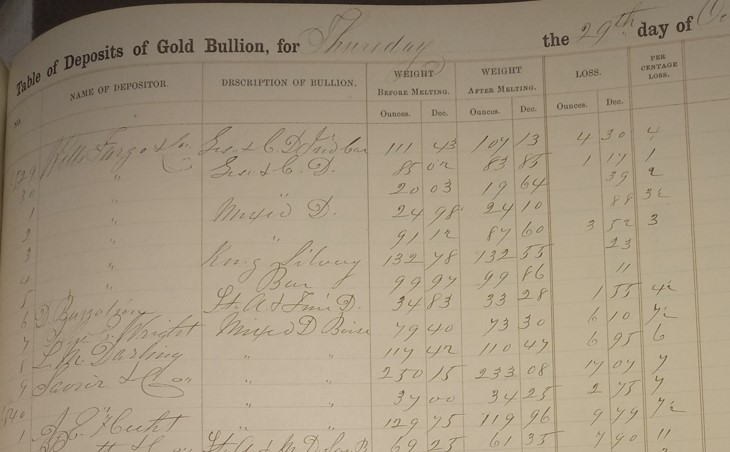 So it looks to me like they have already factored in the "loss", so I don't know how they would include purity, @psuman08. And also @psuman08 (Thank you!) plus I tried calling the US Mint and of course, they didn't know but she went off for a long time and first comment was that they didn't charge! But if that it is not processing/refining fee, then why the discrepancy in payment. Can anyone comment on the $20.67 being the "US Govern Gold Price"? |
|
Pillar of the Community
Canada
5299 Posts |
Well, gold dust was not pure gold, perhaps 18 or 20 karat as I recall. So at the very least the payment would need to be discounted based on an average purity. Buying from the public could easily give you material contaminated (accidentally or deliberately) with things other than gold. I would be interested to know how the mint checked the stuff coming in the door.
|
|
New Member
United States
5 Posts |
#Oriole- I think that is why the Mint weighed it and melted it and weighed it again. Presumably they used the melted weight for all their calculations? The melted weight would kinda cover the uncertainties....
|
|
Pillar of the Community
United States
3368 Posts |
Here are the Treasury mint reports for 1875-79. On page 6 there is a tabulation of 1875 earnings and costs for all the mints and assay offices. It's interesting to read, but I'm not sure it gets to what you're looking for. The mints and assay offices collected a lot of income from depositors, but not enough to cover their costs of operation. Especially Carson and San Francisco. The earnings from these two came mainly from parting and coining, while Philly earned money coining subsidiary silver and minor coins. Assay offices at Denver, Charlotte and Boise were very small in comparison to the mints. Other points of interest: 12-13% profit earned from silver seignorage (bars to coin). Philadelphia benefitted the most, though it was also profitable in SF and Carson. The US government actively encouraged and promoted PM mining in the West. In the 1876 report the mint director toured the Virginia City deep mines, collected samples and reported on their estimated reserves and ore quality. At that time it appears that California mining was hydraulicking, to a great extent. Fractional currency was depreciated in value and was being redeemed for silver. https://fraser.stlouisfed.org/files...875-1879.pdf"Two minutes ago I would have sold my chances for a tired dime." Fred Astaire
Edited by thq
11/28/2024 10:22 am
|
|
Pillar of the Community
 United States
4623 Posts |
You need to go back to the law, always... Section 18 is what you want. https://coinweek.com/coinweek-iq-co...uary-9-1837/Quote:
Section 14. And be it further enacted, That gold and silver bullion brought to the mint for coinage, shall be received and coined, by the proper officers, for the benefit of the depositor: Provided, That it shall be lawful to refuse, at the mint, any deposite of less value than one hundred dollars, and any bullion so base as to be unsuitable for the operations of the mint; And provided also, That when gold and silver are combined, if either of these metals be in such small proportion that it cannot be separated advantageously, no allowance shall be made to the depositor for the value of such metal.
Section 15. And be it further enacted, That when bullion is brought to the mint for coinage, it shall be weighed by the treasurer, in the presence of the depositor, when practicable, and a receipt given which shall state the description and weight of the bullion: Provided, That when the bullion is in such a state as to require melting before its value can be ascertained, the weight after melting shall be considered as the true weight of the bullion deposited.
Section 16. And be it further enacted, That from every parcel of bullion deposited for coinage, the treasurer shall deliver to the assayer a sufficient portion for the purpose of being assayed; but all such bullion remaining from the operations of the assay shall be returned to the treasurer by the assayer.
Section 17. And be it further enacted, That the assayer shall report to the treasurer the quality or standard of the bullion assayed by him; and he shall also communicate to the treasurer such information as will enabled him to estimate the amount of the charges hereinafter provided for, to be made to the depositor, for the expenses of converting the bullion into standard metal fit for coinage.
Section 18. And be it further enacted, That the only subjects of charge by the mint to the depositor shall be the following: For refining when the bullion is below standard; for toughening when metals are contained in it which render it unfit for coinage; for copper used for alloy when the bullion is above standard; for silver introduced into the alloy of gold; and for separating the gold and silver when these metals exist together in the bullion: and that the rate of these charges shall be fixed, from time to time, by the director, with the concurrence of the Secretary of the Treasury, so as not to exceed, in their judgment, the actual expense to the mint of the materials and labor employed in each of the cases aforementioned; and that the amount received from these charges shall be accounted for, and appropriated for defraying the contingent expenses of the mint.
Section 19. And be it further enacted, That from the report of the assayer, and the weight of the bullion, the treasurer shall estimate the whole value of each desposite, and also the amount of the charges or deductions if any; of all which he shall give a detailed memorandum to the depositor; and he shall also give, at the same time, under his hand, a certificate of the nett amount of the desposite, to be paid in coins of the same species of bullion as that deposited. Chasing this further through the Coinage Act of 1849 Coinage Act of 1857 Coinage Act of 1864 to arrive at the law in 1865 is left as an exercise to the readers -----Burton 50+ year / Life / Emeritus ANA member (joined 12/1/1973) Life member: Numismatics International, CONECA Member: TNA, FtWCC, NETCC, EveryCountry (online) coin club Owned by three cats and a wife of 40+ years (joined 1983) Author: 3rd Edition of the Sample Slabs book, https://www.sampleslabs.info/ |
|
New Member
United States
5 Posts |
You all here are very nice with your welcomes and striving to answer my question! Your moderators are very attentive and helpful, as well. Thank you! The instance I am concerned with happened when gold dust from now Montana was brought to SF Mint in Oct 1863. (And yes, they used a very low-tech hydraulic mining in those locations-- mostly panning and sluice boxes.)The 'depositors' were actually mass murderers and thieves.. and to make a very long story short.. got their comeuppance. (It is a fascinating story that occupied all news for months across the west coast!)The gold was FINALLY paid out to the main widow several months later in 1864. So what I really need to know has to have been in effect before that. I have found some of the legislation also and, you are right, thq, they are very interesting. Even in SF-- they had to expand their facilities to accommodate the chemistry required to assay. I see you found this one via St Louis (thank you for posting!), but I think I have seen other tables like p6 and earlier. You are also right, that it still does not quite answer my question of why the payment was not at $20.67 per melted (presumably fairly 'fine') oz. From p68 of your posted pdf 1877 "...it shall be lawful to apply the moneys arising from charges collected from depositors for these operations, pursuant to law, to the defraying in full of the expenses thereof, including labor, materials, and wastage; but no part of moneys otherwise appropriated for the support of the mints and assay-office at New York shall be used to defray the expenses of refining and parting bullion." So even though this is 1877, it appears they are charging for assaying or something! So now I have some info saying the US Gov DID and also did NOT collect fees for their assaying! And BStrauss3-Yes! And I have seen that same section 18 elsewhere, eg in attachment-- but it still does not tell me how much, or even a range, or even the factors that they can consider...  When I first looked at this months ago, I used the "average price" --$18.93 (from the nma.org previously posted)-- to calculate and, of course it was closer. But that can not be correct. I wish I had more examples from the original record, but I don't. Would have to go back to San Bruno US archives! Thank you!!! Keep your thoughts coming... something will lead to something....  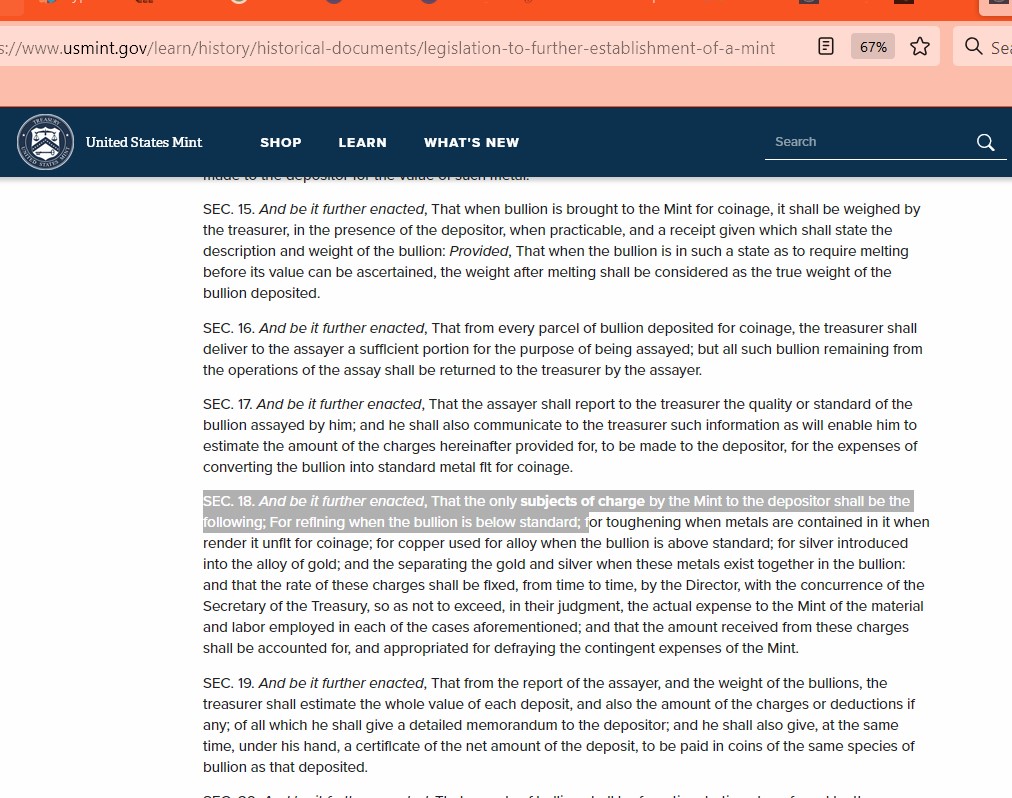 |
| |
Replies: 12 / Views: 1,388 |
|
To participate in the forum you must log in or register.
Disclaimer: While a tremendous amount of effort goes into ensuring the accuracy of the information contained in this site, Coin Community assumes no liability for errors. Copyright 2005 - 2026 Coin Community Family- all rights reserved worldwide. Use of any images or content on this website without prior written permission of Coin Community or the original lender is strictly prohibited.
Contact Us | Advertise Here | Privacy Policy / Terms of Use
|
| Coin Community Forum |
© 2005 - 2026 Coin Community Forums |
| It took 0.49 seconds to rattle this change. |
 |
|
| |
| |




 Posted 11/26/2024 3:28 pm


