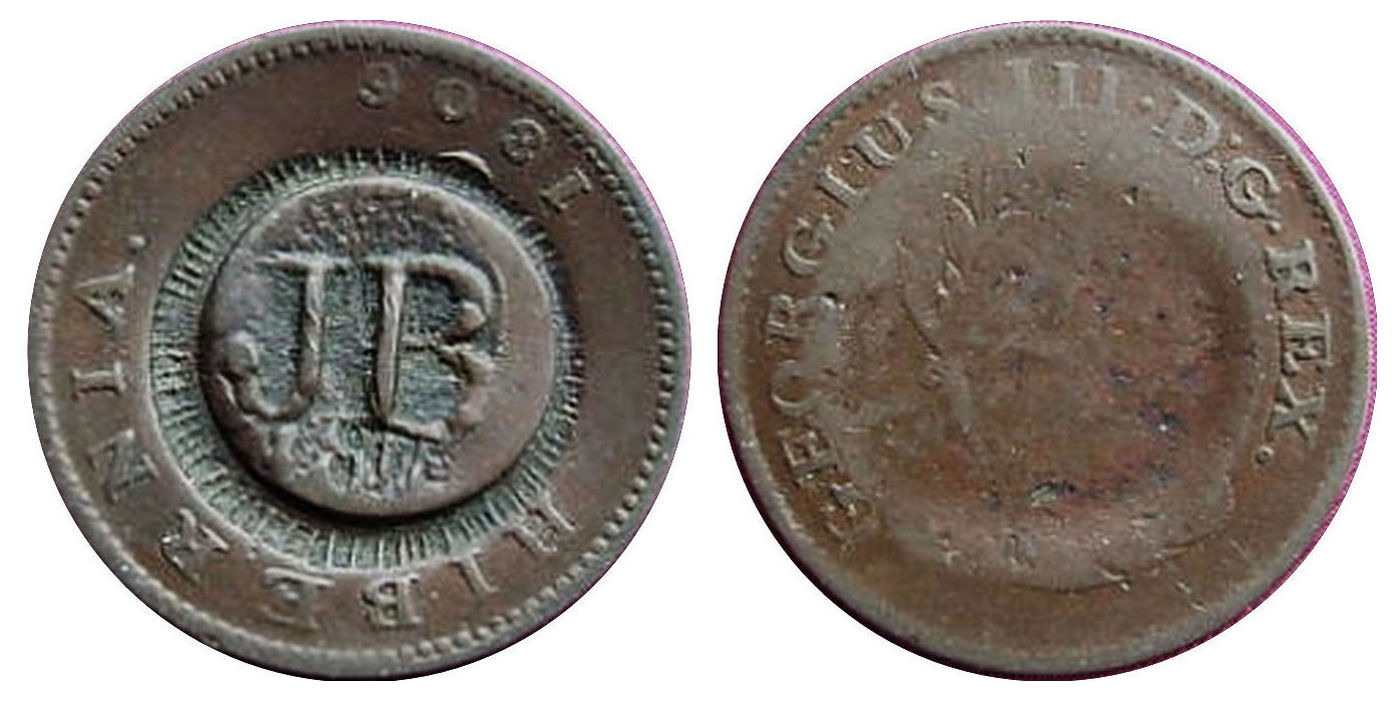
@dalt, that ball on the tip of the letter J is fairly distinctive. This might be a match, although I hope that one of our countermark experts weighs in too:
https://www.bfrankandson.com/store/...1-p706627197Quote:
IRELAND. George III (1760-1820), copper Farthing, 1806, KM-A6.1, countermarked J.B. 1811 raised within incuse circle, on reverse , Brunk-52405, , Fine.
Reference; Gregory G. Brunk, Merchant Countermarks on World Coins, World Exonumia Pres, 1989
There is also an old thread on the forums from 2008 that discusses a similar countermark. Here is a quote from British Countermarks on Copper & Bronze Coins by J. Gavin Scott:
Quote:
In view of the amount of wear on the Anglo-Irish farthings of 1806 (average weight 4.10g., compared with rescribed standard of 4.36 g.), Dolley suggests that they may have been countermarked after the Irish pieces were demonetised in 1826. This demonetisation was less effective in Ireland than in England, where Irish coins were accepted reluctantly or not at all. His theory is that the coins were sold in England as scrap copper, perhaps about 1830, the purchaser using them as blanks for truck tickets destined for premises in Lancashire or Yorkshire, but not circulating them because of the passing of the 1831 Truck Act. This leaves unexplained the date 1811 on the countermark, unless either it is not intended to be read as a date or it refers, as Dolley suggests, to the date of a firm's foundation. Were it not for the wear on the coins, one might be tempted to suppose that these pieces served as tokens for a short time about 1811 until proper dies for a token issue had been prepared, when they were recalled. Copper tokens were issued in the early nineteenth century by a number of traders with initial JB:
Gloucestershier: Cheltenham
- John Bastin, Penny 1812 (Davis 14)
- John Bishops & Co. Penny 1812 (Davis 15)
Middlesex: Walworth Road
- James Bean, Farthing 1814 (Davis 8)
Northumberland: Newcastle
- John Bell, Farthing 1815 (Davis 18-24)
It should, however, be remembered that copper coins wear far more easily than our modern bronze issues, and that, in the early nineteenth century, such low denomination coins had considerable use.
Added: Hmm now that I look more closely, I see that the old thread was from someone with the same username as you. Did you maybe forget about asking this question previously?









 Posted 02/08/2025 8:47 pm


